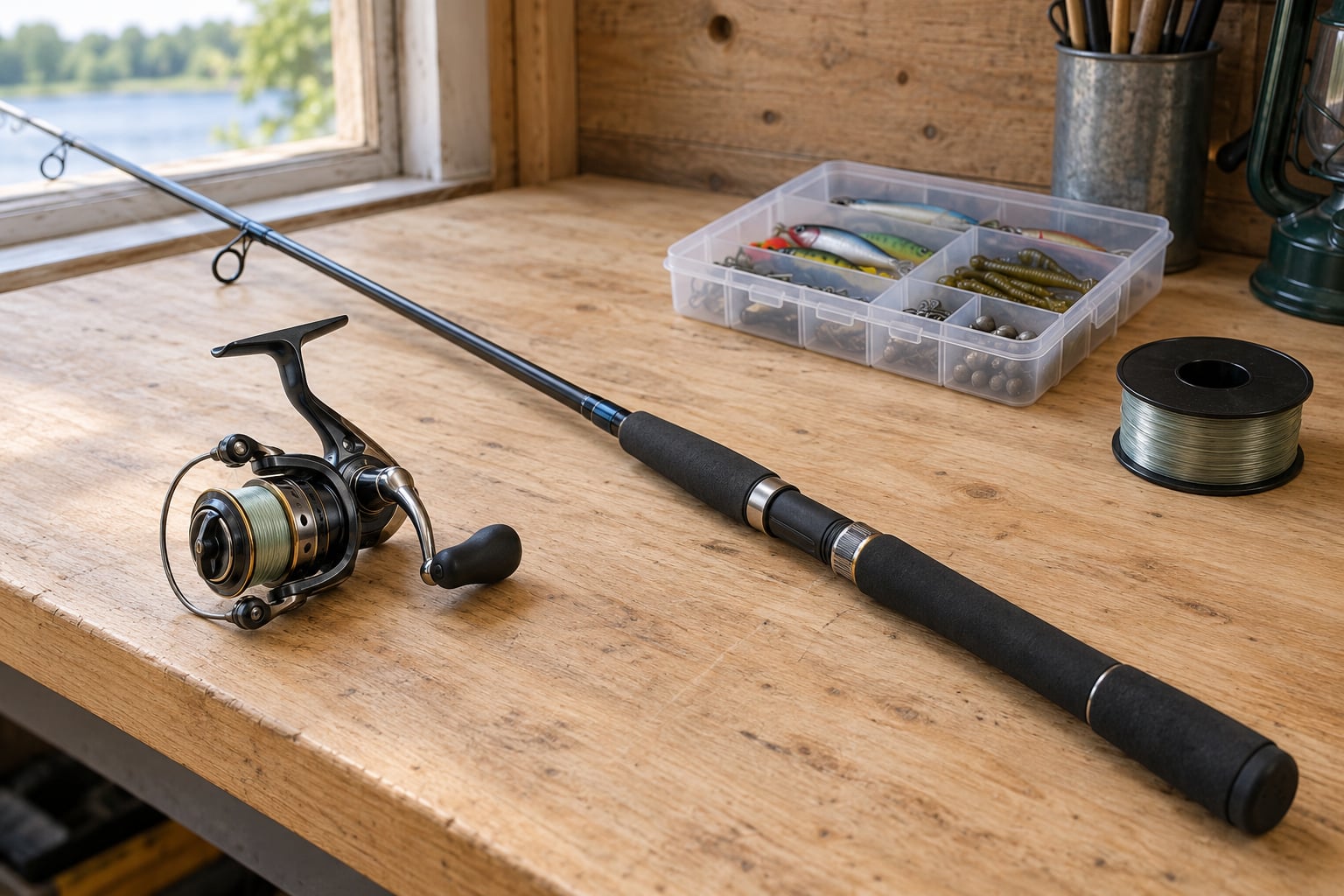
The short answer: most beginners do best with a 6 foot 6 inch to 7 foot medium or medium-light power, fast action spinning rod, paired with a size 2000 to 3000 reel and 10 to 12 lb monofilament. That combination is the one anglers on r/FishingForBeginners and r/Fishing_Gear recommend most often, and it is forgiving enough to grow with you.
Learning how to choose a fishing rod for beginners is mostly about decoding four labels: type, power, action and length. Get those right and the rest is preference. Get them wrong and the rod feels strange in your hand, breaks off line, or cannot cast the lure you bought.
This guide walks through the whole decision in order, from the water you will fish to the reel that sits underneath it. Budget ten minutes and a tape measure, and you will know exactly what to look for when you get to the shop.
Table of Contents
- What You Need
- Step-by-Step: How to Choose a Fishing Rod for Beginners
- Start With the Type of Fishing You Will Do
- Choose the Right Rod Length
- Match Rod Power and Action to Your Needs
- Consider Weight, Balance, and Materials
- Make Sure the Reel and Rod Work Together
- Set a Realistic Budget and Check the Warranty
- Test the Rod Before You Buy
- Common Mistakes
- Frequently Asked Questions
- What type of fishing rod is best for a beginner?
- Is a 6-foot or 7-foot fishing rod better for beginners?
- Should beginners buy a spinning or casting rod?
- What power and action should a beginner fishing rod have?
- Is a fishing rod and reel combo better for beginners?
- How much should a beginner spend on a fishing rod?
- Conclusion
What You Need
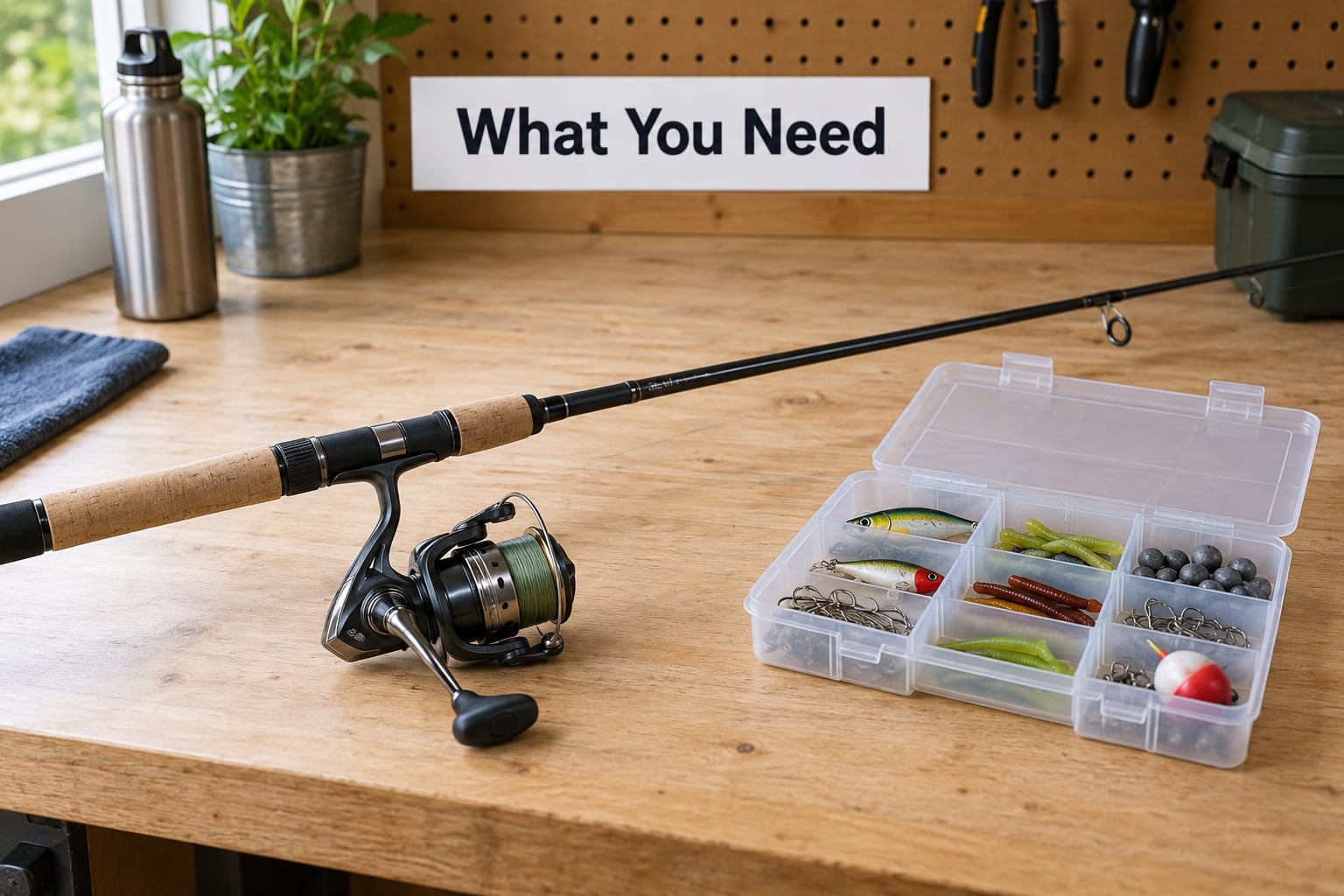
Before you look at a single product, write down four things: where you will fish, what you want to catch, how far you can cast, and what you can comfortably carry for three hours. Those four answers eliminate most of the catalogue on their own.
Then gather the information you need to compare what you see:
- Water type. Lake, river, pond, pier, shore or boat. Saltwater needs corrosion-resistant hardware and heavier blanks.
- Target species. Panfish and trout want light tackle. Bass and pike want more power. This sets your power rating.
- Rod type. Spinning, casting, baitcasting, fly or telescopic.
- Length. Measured in feet and inches, which controls casting distance and how much line you can control.
- Power and action. Power is how much weight it takes to bend the rod; action is where along the rod the bend happens.
- Material and balance. Graphite, fiberglass or composite, and how the weight sits in your hand.
- Reel compatibility. Reel size and the line rating printed on the rod blank.
- Warranty and parts. Whether the reel seat, handle and guides can be replaced, and who honours the warranty near you.
Budget is on that list too, and it is not a single number. Decide how much the whole setup gets, then split it: line and terminal tackle are where beginners most often cut corners and end up tying new leaders every trip.
Step-by-Step: How to Choose a Fishing Rod for Beginners
Start With the Type of Fishing You Will Do
Rod type decides everything else, so pick it first. Spinning rods have a fixed reel seat under the handle and are the easiest place to start, because the line comes off a stationary spool and cannot tangle into a backlash.
Casting rods and baitcasting rods sit on top of the handle and give you better accuracy and control, at the cost of a spool that can tangle when you cast badly. Fly rods are built around line weight rather than lure weight, and they use a different reel and a much heavier line. Telescopic rods collapse into a case and win for travel, storage in a small apartment, and anyone who does not want to fight a long rod in a car park.
One more structural choice sits under all of these. One-piece rods are simplest and strongest, and they are the ones to carry in a boat. Multi-piece rods break down into two or more sections, which is friendlier for storage but adds a joint you have to line up correctly under pressure. Telescopic rods collapse section by section into a tube and usually put up with more abuse than their thin tips suggest.
For most beginners, a spinning rod in the 6 foot 6 inch to 7 foot range, or a telescopic if you travel, is the right call. People who are confident casting overhanging trees or working heavy cover from a boat often prefer a casting setup, but that is a second rod rather than a first.
Choose the Right Rod Length
Length is the attribute most beginners overvalue. A longer rod casts further and lays line down more gently, but it is heavier, harder to control at close range, and awkward to carry. A shorter rod does the opposite: precise, light and easy to swing.
| Length | What it feels like | Good beginner targets |
|---|---|---|
| 5 ft | Very light, casts short, superb accuracy | Panfish, crappie, trout in tight spots |
| 6 ft | Light and quick under the arm | Ponds, small lakes, kids learning |
| 6 ft 6 in to 7 ft | Balanced, casts far enough for most water | The all-round beginner choice |
| 8 to 9 ft | Heavy for long sessions, casts a long way | Boats, surf casting, larger rivers |
| 10 ft and up | Specialty tool, not a general choice | Big rivers and saltwater surf |
For a first rod, 6 foot 6 inch to 7 foot hits the balance point most people actually want. It casts far enough to reach structure from a bank, stays under control when a fish runs, and does not make your shoulder ache by the third hour.
Match Rod Power and Action to Your Needs
Power is how much force it takes to bend the rod, and it is rated light, medium, medium-heavy or heavy. Light power bends under a small panfish; medium handles trout, bass and most general fishing; medium-heavy and heavy exist for pike, carp and saltwater species where you need to lift weight off the bottom.
Action is where the bend happens. A fast action rod bends in the top third, which loads fast, feels sensitive and gives you hook-setting power quickly. A medium action bends through the upper half, which is the easiest place to start. A slow action bends from the middle down to the tip, which loads late and is forgiving with light line but needs a heavier rod to pull a fish in.
Power and action are not the same thing, and mixing them is the most common reason a rod feels wrong. A medium-heavy fast-action rod feels stiff and springy for trout. A medium slow-action rod can feel vague when you are trying to set a hook on a panfish bite.
The beginner default is a medium-power rod in medium or fast action. Medium power covers the widest range of freshwater species, and either action responds predictably to a beginner’s timing.
Consider Weight, Balance, and Materials
A rod is judged on how it sits in your hand before anything else. Pick it up and let it hang from the grip. If the weight pulls the butt down, your arm will get tired. Most well-made beginners’ rods balance just ahead of the reel seat, which feels natural for hours.
Graphite and carbon fiber rods are lighter and more sensitive, so you feel a bite sooner, but they bend more easily under a hard pull. Fiberglass is heavier and slower to respond but shrugs off abuse, which is why it survives being wedged in a car boot. Composite blanks mix both and cost more than either.
Grips matter more than most buyers expect. EVA foam is soft, durable and warm in cold hands; cork is lighter and gives more feel, and it is what you will see on nearly every fly rod. Either is fine. What is not fine is a grip that slips when it gets wet, so test it wet if you can.
Make Sure the Reel and Rod Work Together
A rod is really a half-finished tool until a reel is hanging under it. The pairing is simple: spinning rod with spinning reel, casting rod with baitcasting reel, fly rod with fly reel. A size 2000 reel suits a 5 to 6 foot 6 inch rod and light species. A size 3000 is the standard for a 6 foot 6 inch to 7 foot rod and handles trout, bass and most general work. A 5000 or larger is for shore casting and heavy terminal tackle, and mounting one on a trout rod causes line problems without adding any power.
Check the line rating printed near the handle or on the blank. That rating tells you what the guides and blank are built to handle, and staying inside it protects the rod. Gear ratio matters less for beginners than the manuals suggest, since anything near a 6.0:1 retrieve is fine for casting and retrieving.
A pre-spun rod and reel combo is the more practical first purchase for most people. The reel is matched to the rod, the line is already threaded and tied, and you can fish the same afternoon. Buy the rod and reel separately when you already know your species and water, or when a local shop will talk you through it.
Set a Realistic Budget and Check the Warranty
Spend more of your setup budget on the reel and the line than on the blank. The blank is the part people agonise over, but the reel is what retrieves line smoothly, holds a drag that does not fail, and survives being dropped. Cheap line with knots in it is the third most common reason a good cast turns into a lost fish.
Warranty is a real quality signal. A limited lifetime warranty means the manufacturer covers defects for as long as you own the rod, while a fixed-term warranty suggests parts that will eventually need replacing anyway. Check whether the reel seat, handle, guides and tip can be ordered separately, and whether a repair shop near you will handle warranty claims rather than shipping the rod back across the country.
Test the Rod Before You Buy
If the shop allows it, wave the rod gently. A good rod loads into a smooth arc with no wobble or dead spots in the middle of the blank. Then run your thumb along every guide: they should sit in a straight line down the rod, and none should wiggle or be bent inward.
Check the handle and reel seat with a gentle twist. On a multi-piece rod, align the guides at the joint so the line runs straight through them when the rod is bent. Listen for rattle in the reel seat, which means the damping washer has dried out.
Do not overthink the in-store test, though. Anglers who have been burned by online buys usually cast a borrowed rod of similar length in a yard or at a local pond with a weight close to what they will actually throw. That is the only test that tells you whether you like the feel of it.
Common Mistakes
Buying a setup that is too heavy. The heaviest rod in the shop is the one that ends up in the garage. A medium-power spinning rod will handle more situations than you expect, and a light one you are happy to carry will be fished more often. The fix: pick the lightest rod that still covers your biggest target fish.
Going too long for your own strength. An 8 or 9 foot rod is fine for a strong angler on a boat and tiring for anyone casting from a bank all day. The fix: 6 foot 6 inch or 7 foot unless you have a specific reason.
Confusing power with action. Many beginners read “heavy” and think it will hold more fish, when power and action describe two different things. The fix: power tells you what weight the rod can handle, action tells you where it bends. Write both down before shopping.
Oversizing the reel. A size 5000 reel on a 5 foot panfish rod adds drag, tangles and snags, and takes more line to cast a light lure. The fix: match reel size to rod length and species, and stay inside the line rating printed on the blank.
Ignoring the water and the rules. Buying a freshwater set and then moving to inshore saltwater means buying again, because saltwater hardware corrodes and light freshwater blanks struggle with braid. The fix: decide on fresh water or salt water before you buy, not after.
Spending the whole budget on the rod. This is the most expensive habit, because the reel and line are what you touch every cast. The fix: split the money roughly evenly across rod, reel and line, then spend what is left on hooks, leaders and a couple of lures in the weights your rod is rated for.
Two quick maintenance habits keep a first rod alive. Reel it in and check the line for abrasion at the guides after every session, because friction there is how rods break. And rinse the reel with fresh water after saltwater use, then let it air dry before the next trip.
Frequently Asked Questions
What type of fishing rod is best for a beginner?
A spinning rod is the best starting type for most beginners because it has no backlash risk, an easy bait-casting system and a fixed reel seat. Aim for 6 foot 6 inch to 7 foot, medium or medium-light power, in medium or fast action. Telescopic spinning rods suit anyone who travels or has limited storage. Save casting and baitcasting setups for a second rod.
Is a 6-foot or 7-foot fishing rod better for beginners?
A 7-foot rod casts a little further and stays steadier when a fish runs, while a 6-foot rod is lighter and easier to handle from a bank. Most beginners are happy with either, and the difference only matters once you fish open water. Pick 6 foot for ponds and small lakes, and 7 foot for larger lakes and rivers where you need to reach structure.
Should beginners buy a spinning or casting rod?
Buy a spinning rod first. Casting and baitcasting rods control line and bait more precisely, but the spool sits above the line and can tangle into a backlash when a beginner casts. That frustration is a common reason people quit. Spinning tackle casts with a simple bail-open motion, handles lures of most sizes, and works for panfish, trout and bass alike.
What power and action should a beginner fishing rod have?
Medium power in medium or fast action is the safest all-round beginner choice. Power tells you how much weight the rod can lift, and action tells you where it bends. Medium power covers trout, bass, perch and panfish without feeling stiff, and either action gives a predictable hook set. Only step up to medium-heavy power when you are targeting pike, carp or saltwater species.
Is a fishing rod and reel combo better for beginners?
A rod and reel combo is usually better for a first setup, because the reel is already matched to the rod, the line is threaded and tied, and there is nothing to adjust. It also arrives ready to fish. Buy the rod and reel separately only if you already know your target species and water, or if a local shop will build the setup with you.
How much should a beginner spend on a fishing rod?
Judge the total setup rather than the rod alone, and split it across rod, reel and line instead of putting everything into the blank. A modest rod paired with a good reel and fresh line will out-fish an expensive rod with a cheap reel. Add room for leaders, hooks and two or three lures in the lure-weight range your rod is rated for.
Conclusion
Start with the safe defaults: a spinning rod, 6 foot 6 inch to 7 foot, medium power in medium or fast action, a size 2000 to 3000 reel and 10 to 12 lb monofilament, backed by a warranty you can actually claim locally. Those choices cover most freshwater situations a beginner will meet, and they leave room to move up later.
Once that works, the next question is always the same one: what are you trying to catch, on what water? Answer those two and the rest of the spec sheet narrows itself down fast. Target species and fresh or salt water are also the only two details a shop needs to point you at the right setup in 2026.