Sizing soccer cleats for kids comes down to one measurement and one rule: a snug, glove-like fit with a quarter inch to a half inch of space in front of the longest toe. Measure both feet in the late afternoon, use the larger one, look it up on that brand’s size chart, then confirm the fit with the soccer socks your child actually plays in. It takes about ten minutes and no special tools.
Cleats fit tighter than sneakers, and that trips up almost every parent. Kids come from roomy school shoes or sandals, put on a snug boot, and announce the shoes are too small. Getting the size right is what stops heel slippage, blisters and the slow drift out of practice that a lot of young players never explain.
Table of Contents
- What You Need
- Step-by-Step: How to Size Soccer Cleats for Kids
- Measure the Child’s Foot Correctly
- Measure Foot Width and Check the Shape
- Compare the Measurement With the Brand Size Chart
- Test the Cleats With Soccer Socks On
- Adjust for Growing Feet and Playing Conditions
- Common Mistakes
- Frequently Asked Questions
- Do you size up for kids soccer cleats?
- Is soccer cleat size the same as shoe size?
- What size soccer cleats should a 4-year-old wear?
- Are Nike and adidas soccer cleats the same size?
- Do cleats need to break in?
- Conclusion
What You Need
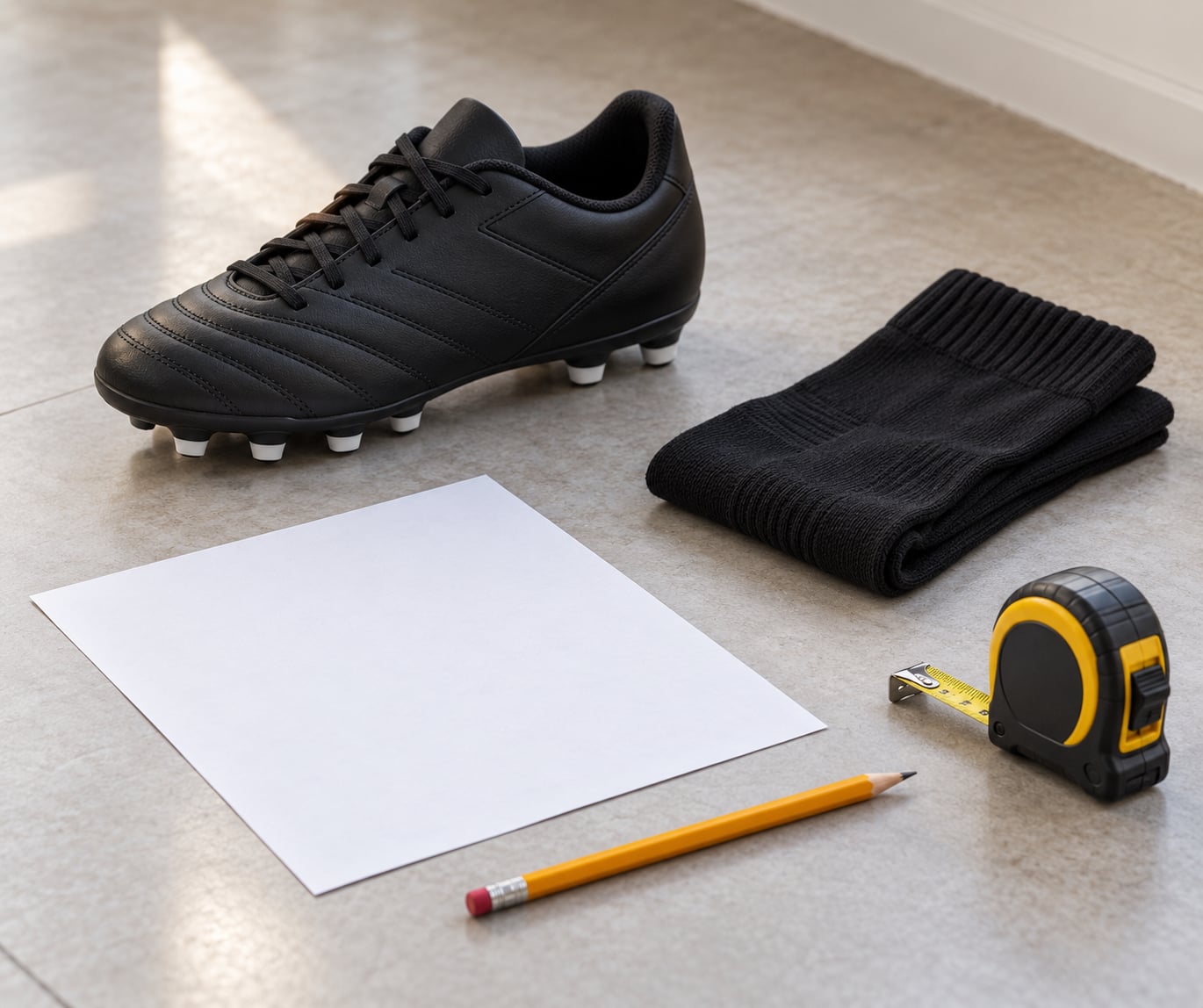
Almost nothing. Gather these five things and the job takes ten minutes.
- A sheet of white paper, taped flat to a hard floor
- A pencil or pen
- A ruler or tape measure
- The soccer socks your child wears to practice and play, not thin everyday socks
- The cleats you are considering, in the exact model you want
Measuring matters. Feet swell through the day, so a late-afternoon reading gives you the longer of the day’s two measurements and the safer size to shop for.
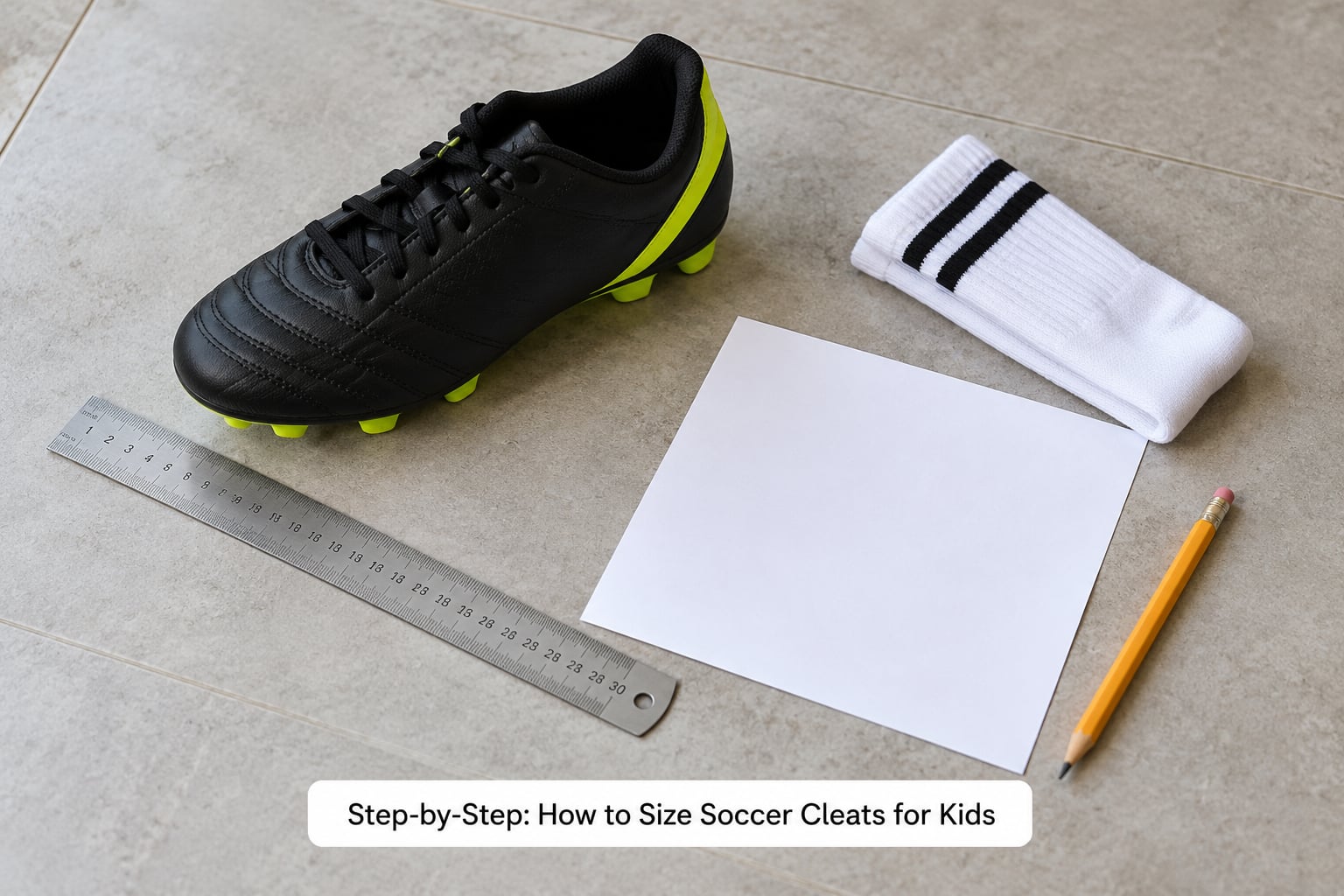
Step-by-Step: How to Size Soccer Cleats for Kids
Measure the Child’s Foot Correctly
Stand the child on the paper with weight on both feet, heels together, and mark the heel and the tip of the longest toe. Measure heel to longest toe, not the outside of the shoe, and not across the arch.
Do it twice per foot and compare. Most children have one foot slightly longer, sometimes by a quarter inch, and a small mismatch is normal. Size to the longer foot.
Skip the two classic errors: measuring a foot while it is planted on paper with the child leaning back, and tracing an empty shoe. Trace the foot itself.
Measure Foot Width and Check the Shape
Wrap a piece of paper around the widest part of the forefoot, right at the ball of the foot, just under the big toe knuckle. Mark where it overlaps and measure that width.
Then look at the foot. A high, narrow arch with a slim forefoot usually wants a narrower last, while a foot that flares out at the toes and sits slightly turned is wide and often gets labeled as needing a bigger size when it really needs a wider one.
Width is the part parents skip, and it is where a lot of “these run small” complaints come from. A boot can be exactly the right length and still pinch across the forefoot.
Compare the Measurement With the Brand Size Chart
Open the size chart on the manufacturer’s site, not a marketplace listing. Charts list the foot length each size is built for, so match your measurement to the closest foot length and read off the size for that row.
Youth cleats use the US kids scale. T sizes cover toddlers, Y sizes cover little kids and big kids, and the age bands are rough guideposts rather than rules.
| Size group | US size range | Approximate foot length | Typical age |
|---|---|---|---|
| Toddler (T) | 4T to 10T | 4.5 to 7.5 inches | 1 to 3 years |
| Little Kid (Y) | 10.5 to 3Y | 7.5 to 10 inches | 3 to 5 years |
| Big Kid (Y) | 3.5Y to 7Y | 10 to 12.5 inches | 5 to 8 years |
| Older youth (Y) | 8Y and up | 12.5 inches and up | 8 years and older |
A four-year-old usually lands in the little kid range, somewhere around 11.5 to 2Y. Treat that as a starting point and let the measurement decide.
For rough orientation, a foot measuring 8.5 inches points toward a size 1Y or 2Y, and a foot at 10 inches points toward 4Y or 5Y. Charts differ by a half size between brands, so treat any table, including this one, as a starting point.
If your child sits between two sizes, buy the smaller one and add grip socks. A thin grip layer takes up the extra volume without adding length, which a half size up does. Sizing up more than that is the most expensive mistake parents make with cleats.
| Brand | What parents report | Adjustment |
|---|---|---|
| Nike | Reports conflict. Players in r/bootroom say Nike cleats run bigger than other brands, while other parents say the opposite. | Try on both sizes. Expect Nike to land near or just below the street shoe size. |
| adidas | Frequently described as truer to size and a little narrow through the midfoot. | Start at true size. Go a half size up only for wider feet. |
Because those reports cancel each other out, treat brand labels as a hint rather than a rule. The same child can wear different cleat sizes from two brands without either being wrong.
Test the Cleats With Soccer Socks On
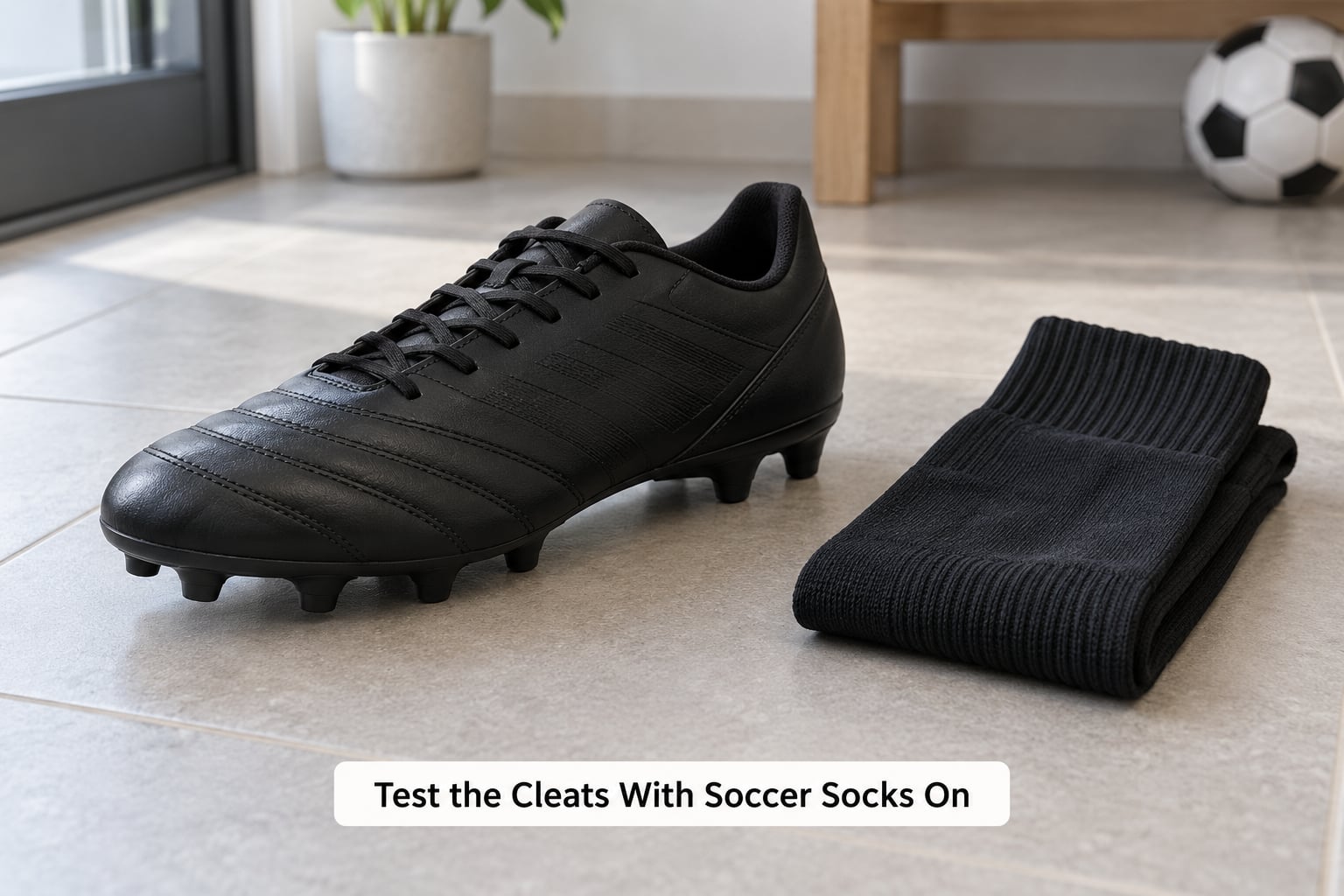
Put on the game socks, then the cleats, and close every strap and lace before judging anything. Sizing over thin socks is one of the most common mistakes and it is easy to undo at home.
Run three checks. First, the toe gap: slide a thumb between the longest toe and the front of the boot. It should fit loosely, no more than a thumb’s width, and for firm ground cleats with a firm toe bumper you can settle at the narrower end of that range.
Second, heel lockdown. With the cleat fully laced, lift the heel. If it lifts more than a few millimeters, the foot will slide inside the boot all match, and that slide is what rubs a heel into blisters.
Third, the midfoot. Press both sides of the boot above the arch. The foot should not shift, and you should not see daylight through the upper when the child curls their toes.
Now have the child walk, then do a few side steps and a light jog. Nothing should shift inside the boot, and the toes should not hit the front when the foot bends.
One more thing worth knowing: turf shoes are built with a roomier, flatter last for grip on hard indoor surfaces, so a size that feels right on an indoor pair will usually run tight in a firm ground boot. Confirm the fit on the outdoor grass pair and treat that size as the reference.
Adjust for Growing Feet and Playing Conditions
Children between the ages of about six and twelve can gain half a size in a few months, and cleats get outgrown quickly. Expect a new pair roughly every 8 to 12 months during a growth spurt, and check the fit again at the start of each season rather than trusting last year’s size.
Match the stud type to the surface. Firm ground studs work on natural grass, soft ground studs with longer, wider studs suit wet or loose ground, artificial ground studs are shorter for laid-on turf, and flat turf shoes are for indoor courts. Thinner studs feel less precise but take less volume out of the sole, and some players find firm ground boots run slightly longer than a turf shoe in the same size.
Secondhand cleats are a reasonable cost saving, but sizing from a used pair is guesswork since you cannot undo the previous owner’s break-in. Measure the child’s foot and use the chart anyway.
Common Mistakes
Buying by age. Age bands describe height and development, not foot length. Two kids of the same age can be a full size apart, and tall kids often have shorter feet than their age band suggests. Measure.
Measuring in the morning. Feet swell over the day. An early reading gives you a size that may be tight by the afternoon practice.
Sizing up for growth. This is the big one. A boot that is too long does not give the toe room, it gives the foot internal slip, and the friction from that sliding is what blisters the heel and instep. Buy the true fit and plan on replacing it.
Ignoring width. If the toe gap looks right but the ball of the foot aches, the problem is width, not length. Look for a wide last or a different model.
Testing without game socks. Thin socks take up almost no volume. The socks worn on match day change the fit noticeably, so test with those on.
Choosing the wrong style for the surface. Stud type changes the inside dimensions of the sole. Buying an indoor turf shoe for outdoor grass leaves the studs pressing on the arch all game.
Frequently Asked Questions
Do you size up for kids soccer cleats?
No. Buy the true cleat size and let the fit run snug, with a quarter inch to a half inch of space in front of the longest toe. Sizing up gives the foot room to slide forward and back inside the boot, and that internal slip is what causes heel rubs and blisters. If your child sits between sizes, take the smaller one and add grip socks to fill the gap.
Is soccer cleat size the same as shoe size?
Close, but not identical. Start at your child’s current street shoe size, then use the brand’s own chart, because cleat lasts run snugner than sneakers and each maker cuts them slightly differently. Always confirm on the chart and try the pair on with game socks before you commit.
What size soccer cleats should a 4-year-old wear?
Most four-year-olds wear little kid sizes, roughly US 11.5 to 2Y, for feet around 8.5 to 9.5 inches long. Age is only a rough guide. Measure the longer foot in the late afternoon, find that length on the brand’s chart, and choose the size listed for it.
Are Nike and adidas soccer cleats the same size?
No. Nike and adidas use the same US youth scale but their lasts are cut differently, and parents describe them in opposite ways. Reports on r/bootroom say Nike runs bigger than other brands, while other parents say Nike runs small and adidas runs true. Convert by trying both sizes on, not by trusting the label.
Do cleats need to break in?
Not much. Synthetic uppers barely soften and will not mold meaningfully, so if a pair feels tight in the shop it will still feel tight in the third match. Leather uppers relax a little. Either way, any new pair should feel snug rather than painful, and a hot spot under the ball of the foot means wrong width.
Conclusion
Start with the measurement, not the age or the brand name. Put both feet on paper in the late afternoon, mark heel to longest toe, use the larger reading, and look it up on the specific brand’s size chart. Then put the socks on and check three things: a thumb’s width at the toe, a heel that stays put when the child lifts it, and a forefoot with no pinch or dead space. A snug, secure fit is the whole job, and a child whose feet do not hurt keeps playing.