How to start running as a complete beginner comes down to one thing: alternate short, easy jogs with walking breaks, do it two or three times a week, and let the running portion grow slowly over about ten weeks. That is it. No pace target, no distance goal, no app telling you that your mile time is embarrassing. If you can walk comfortably for 15 minutes, you have everything you need to begin.
I started running at an unhurried jog pace that older runners passed me on, and it took me two months before a session felt ordinary rather than like an event. That is normal. The plan below is built for the first ten weeks of your life as a runner, not your fastest month.
Before you lace anything up, one thing worth saying plainly: if you have a heart condition, a recent injury, a chronic illness, or you’re pregnant, talk to your doctor before starting. Nothing in this guide replaces their advice.
Table of Contents
- What You Need
- Essential
- Nice to have, but not yet
- Step-by-Step: How to Start Running as a Complete Beginner
- 1. Set a Realistic Starting Goal
- 2. Choose a Safe, Flat Route
- 3. Use a Walk-Run Plan
- 4. Keep the First Runs Easy
- 5. Build Endurance Gradually
- 6. Recover and Know When to Stop
- Common Mistakes
- Frequently Asked Questions
- How long should a complete beginner run for the first time?
- Should beginners run every day or take rest days?
- Do I need special running shoes to start running?
- Is walking during a run okay for beginners?
- How do I know if I am running at the right pace?
- When should a beginner stop running and see a doctor?
- Start With One Easy Run
What You Need

You need four things, and only one of them costs real money. Here is the honest split between what is essential and what is nice to have.
Essential
- Shoes that fit. Any comfortable athletic shoe you can walk in for an hour without pain works for week one. Running shoes are worth getting eventually, but they are not a prerequisite.
- Clothing you can move in. Moisture-wicking fabric beats cotton because it dries fast and stops chafing. Wear what you would wear to the gym.
- A route you know. A flat sidewalk loop, a park path, a school track, or a quiet street with good lighting.
- Water. A reusable bottle for anything past 30 minutes. For a 20-minute out-and-back in mild weather, most beginners are fine without it.
Nice to have, but not yet
- A phone for safety and for timing your intervals.
- A running watch. Beginner runners on forums usually recommend skipping this or buying a used one. Heart-rate data is nice, not necessary.
- A foam roller. Helpful after week four, useless in week one.
- A running belt or vest. Only if you carry keys or a wallet and hate bouncing them.
Gear confusion is one of the most common reasons beginners stall before they start. It costs more time than the running does.
Step-by-Step: How to Start Running as a Complete Beginner
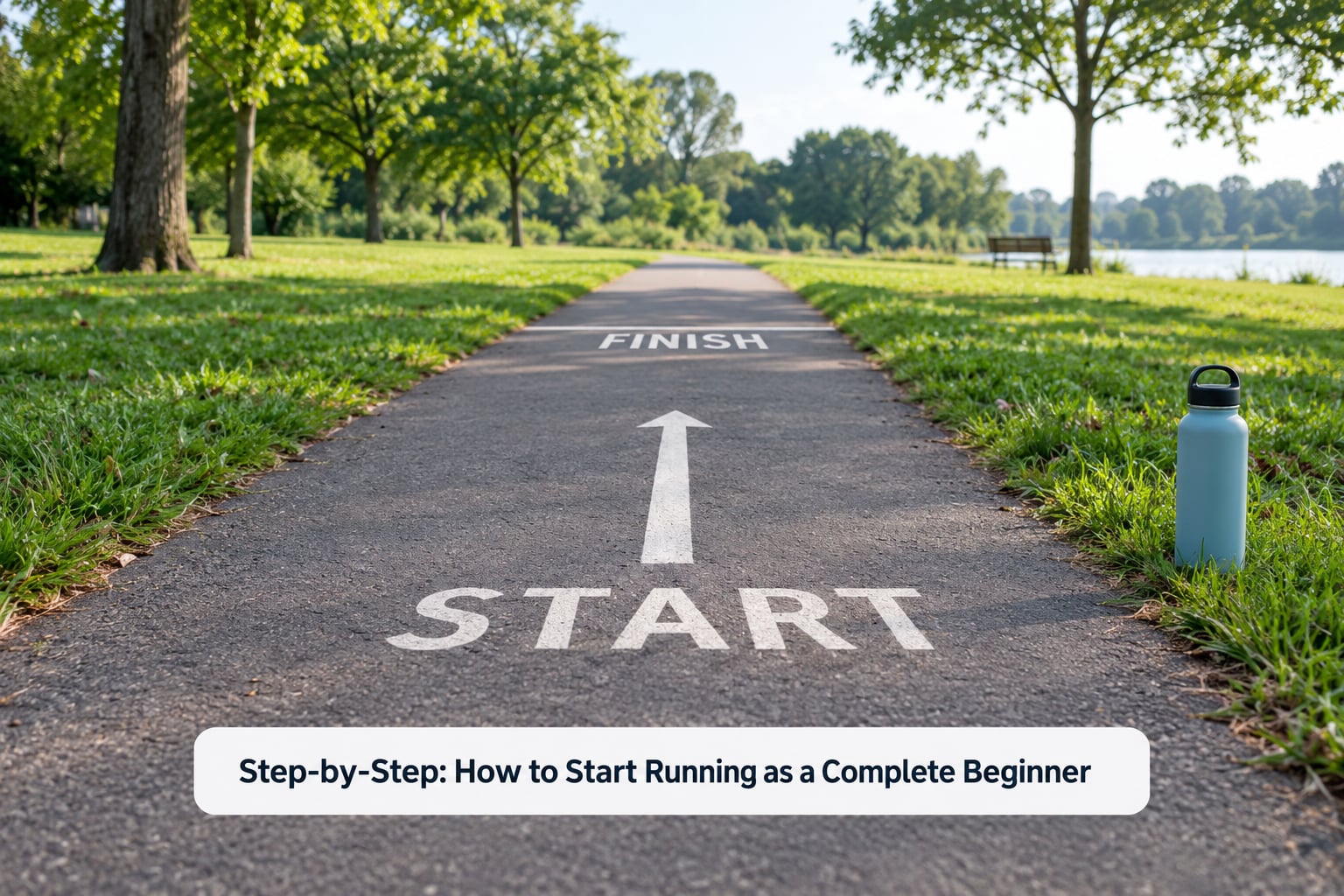
The method below is the walk-run method, sometimes called the run/walk method. You repeat a fixed pattern of jogging and walking for the whole session, and you stay inside a conversational effort the entire time. Every week, the ratio shifts a little in favour of running, and that is the only progression you need for two months.
1. Set a Realistic Starting Goal
Your first four-week goal is not a distance. It is completing three sessions per week without skipping, and finishing each one able to say that it was manageable.
Choose a pace where you could hold a conversation with a friend. Not sing, not gasp, not talk in fragments. If you can say a full sentence out loud, you are in the right zone. Anything harder and you will either bail out early or pick up an injury you did not have.
Write the goal down as something like: “Three 25-minute walk-run sessions this week.” That is concrete enough to do and vague enough to survive a bad Tuesday.
2. Choose a Safe, Flat Route
Pick a route you have already walked or driven past. Familiarity matters more than scenery on early sessions, because you want zero mental effort spent on navigation.
Look for sidewalks, separated paths, park loops, or a track. Hills are the enemy of a beginner’s stride, and uneven ground multiplies the load on your calves and ankles for no benefit at this stage.
Check the weather and daylight before you leave. Rain is fine if the temperature is mild; ice is not, and neither is a route with no pavement. If you are out after dark, stick to well-lit streets or a lit track, and tell someone the route and your expected time back.
Carry your phone on runs where the route has dead zones or where you run alone.
3. Use a Walk-Run Plan
Here is the session template. Repeat it for 20 to 30 minutes, three times a week, for your first two weeks.
- Walk for 5 minutes to warm up.
- Jog gently for 60 seconds.
- Walk for 2 minutes.
- Repeat that cycle until you have moved for 20 to 30 minutes total.
- Walk for 5 more minutes to cool down.
Note the ratio: more walking than running at the start. That feels too easy and it is exactly right. Beginners who start with equal or longer running intervals tend to injure themselves or quit inside a month.
Use a timer with vibration or voice prompts if your phone supports it. Most people stop counting intervals correctly after the third one.
4. Keep the First Runs Easy
Slow is not a failure state here. Slow running is what builds your aerobic base, and your aerobic base is what lets you run continuously for 30 minutes later without dying.
A few technique cues that keep early runs comfortable:
- Hold your arms bent at roughly 90 degrees and swing them lightly rather than driving them.
- Keep your steps short and your feet landing close under your body. Overstriding is the single most common beginner form mistake.
- Aim for a steady cadence that feels close to a brisk walk, not a sprint.
- Breathe rhythmically. A simple pattern is three steps in, three steps out. Nothing fancy.
- Look about 20 metres ahead, not at your feet.
Do not compare your pace with anyone passing you. Do not sprint on day one. Do not try to run continuously just because you feel good once. The feeling comes and goes; the plan is what builds the fitness.
5. Build Endurance Gradually
Once you can finish two weeks of walk-run sessions without feeling wiped out, start shifting the intervals. The rule of thumb most beginner plans use is to add no more than about 10% to your weekly running volume, and to repeat a week whenever soreness or fatigue climbs.
| Week | Jog interval | Walk interval | Total session | Sessions per week |
|---|---|---|---|---|
| 1 | 1 min | 3 min | 22-25 min | 3 |
| 2 | 1 min | 2 min | 25 min | 3 |
| 3 | 90 sec | 2 min | 28 min | 3 |
| 4 | 2 min | 2 min | 28 min | 3 |
| 5 | 3 min | 2 min | 30 min | 3 |
| 6 | 5 min | 2 min | 30 min | 3 |
| 7 | 8 min | 2 min | 30 min | 3 |
| 8 | 10 min | 90 sec | 30 min | 3 |
| 9 | 15 min | 90 sec | 30 min | 3 |
| 10 | 20 min | 60 sec | 30 min | 3 |
If a week feels hard, run it again. Repeating week 6 for a fortnight costs you almost nothing and beats skipping two weeks then trying to catch up.
Alongside the plan, add two short lower-body strength sessions a week: bodyweight squats, reverse lunges, calf raises, glute bridges, and a plank. Fifteen minutes is plenty. This is the cheapest insurance against the shin and calf problems that hit beginners in their first month.
6. Recover and Know When to Stop
Warm up with three to five minutes of brisk walking before your first jog, and cool down with a slow walk afterwards. A light dynamic warm-up of leg swings, side lunges, and a few high knees helps, but stretching cold muscles statically before running does not.
Keep at least one rest day between runs. Never run back-to-back days in your first month. Most beginner programs recommend three runs and two strength sessions with the rest of the week off.
Drink water before you run if you are thirsty, sip during anything longer than 45 minutes, and have a meal with carbohydrate and protein within an hour or two afterwards. That is the whole of beginner fuelling. You do not need gels, electrolyte powders, or energy drinks on a 30-minute session.
Stop running and seek medical advice if you feel chest pain, unusual shortness of breath, dizziness, or pain that sharpens or changes. Soreness that shows up in the morning and fades by the second day is common in the first month and usually settles. Pain that is sharp, one-sided, or gets worse with each run is not normal training soreness. Rest it and get it looked at.
Common Mistakes
Almost every beginner mistake traces back to doing too much, too soon. Here are the five I see most often, with the fix for each.
Going too far on the first run. The fix is to treat the first four weeks as practice, not progress. Stop while you still feel like you had something left. That feeling is the reason you go back out next time.
Only running when motivation shows up. Motivation is unreliable by design. The fix is to fix the time and place instead: same route, same window, three days a week, decided in advance. Habit beats mood.
Buying complicated gear. The fix is to spend nothing for the first month beyond shoes you already need replaced. Beginner runners consistently report that their most useful early purchase was a used watch, or none at all.
Skipping rest and recovery. The fix is to put rest days in the plan on day one, not as a reward for training hard. Muscles and tendons adapt more slowly than your lungs do, and that gap is where injuries come from.
Ignoring pain. The fix is a simple rule: pain that changes how you run gets checked out, pain that stays the same for two days gets watched, and discomfort that fades gets ignored.
Tracking progress helps more than almost anything else, because week three is where most beginners quit. The drop-off is so common it has a nickname, and the usual cause is that nothing measurable has changed yet. What to watch instead:
- Total session minutes completed each week, not speed or pace.
- How long your easy run intervals have grown.
- Sessions completed versus planned.
- Soreness duration the morning after.
- Mood and sleep on running days versus rest days.
A simple note in your phone is enough. A dedicated app is fine too if you enjoy logging, but the best log is the one you will still be filling in in week six.
Frequently Asked Questions
How long should a complete beginner run for the first time?
Aim for 20 to 30 minutes total, and treat most of that as walking. Five minutes of warm-up walking, then repeating one minute of easy jogging with two to three minutes of walking, then five minutes of walking to cool down. Running 30 minutes straight on day one is the most common way beginners end up sore, injured, or discouraged. Stopping at 20 minutes when you could have done more leaves you with the good feeling that makes week two happen.
Should beginners run every day or take rest days?
Take rest days. Most beginner plans use three run days with at least a day between each, plus two days of light strength work. Muscles, tendons, and bone adapt more slowly than your cardiovascular system, so the day between runs is when your body actually gets stronger. Beginners who run daily usually manage a few days and then get shin, calf, or Achilles pain that ends their attempt. Consistency across a month beats frequency in a single week.
Do I need special running shoes to start running?
No. Any comfortable athletic shoe you can walk in for an hour without pain will carry you through your first month of walk-run sessions. Running shoes with more cushioning and a narrower toe box help later, when you are running longer distances, but they are not a starting requirement. Many beginners run their first 5K in shoes they already own. If you do buy them, get fitted later in the day when your feet are swollen, and leave a thumb of space at the toes.
Is walking during a run okay for beginners?
More than okay. Walking is not a failed run. The walk-run method is built on the idea that alternating jogging and walking lets you accumulate running volume without the injury risk of running continuously. It also gives you the recovery you need to keep the effort conversational across a whole session. Plenty of experienced runners still take walk breaks at the halfway point of a long run. If you are following a beginner plan, walking is the plan, not a deviation from it.
How do I know if I am running at the right pace?
Use the talk test: if you cannot speak a full sentence out loud while running, slow down. You should be able to talk in short, complete phrases without gasping. On a perceived effort scale of 1 to 10, easy running sits around a 4, 5, or 6. Many beginners describe easy running as a pace slightly faster than a fast walk, which is usually the right ballpark. Over the first few weeks, your slow pace will get slower as your endurance improves, and that is progress, not a step backwards.
When should a beginner stop running and see a doctor?
Stop and get advice for chest pain, unusual shortness of breath, dizziness, or a heart racing far beyond what the session explains. Separately, book in if you have a chronic condition, a recent injury, or a family history of heart disease before you start at all. For musculoskeletal pain: morning soreness that fades within a day or two is normal early soreness, but sharp pain, one-sided pain, or pain that worsens each run needs assessment. Rest and see a doctor or physiotherapist rather than trying to run through it.
Start With One Easy Run
Put on clothes you do not mind sweating in, pick a flat route you already know, and do one 20-minute walk-run session at an effort where you can still talk. That is the whole first step, and nothing on this page changes it.
Then do it again on a Tuesday, and again on a Thursday. Three easy sessions a week for four weeks will do more for you than any single hard run, and they are the reason people are still running a year from now instead of telling the story about the time they tried running once.