Replace running shoes at 300-500 miles (500-800 km) or about 3-6 months of regular running, whichever comes first. But retire them sooner if the midsole feels flat, the outsole is smooth or bald, the shoe leans to one side, or your feet, shins or knees start complaining. Age on its own is a weak reason to throw a pair away.
This is the question almost every runner eventually has to answer, usually at the worst possible moment: three weeks into a training block, with a race on the calendar. The trouble is that the number everyone repeats, 300 to 500 miles, is a guideline rather than a law.
Guides here cover how mileage varies by shoe type, the seven physical and bodily signs worth checking, five quick at-home tests, and what the research actually found when scientists measured foam degradation rather than trusting the outsole.
Last updated: October 2026
Table of Contents
- When to Replace Running Shoes
- How Many Miles Should Running Shoes Last?
- How to track the mileage on each pair
- 7 Signs You Need New Running Shoes
- 1. The outsole tread is worn smooth
- 2. The midsole feels flat
- 3. You can see the midsole through the outsole, or the sole is creased
- 4. Uneven outsole wear
- 5. The cushioning feels noticeably harder or flatter
- 6. The shoe no longer fits the way it did
- 7. New or recurring pain shows up
- How to Tell Whether Your Shoes Still Support You
- Press test
- Twist test
- Tread test
- Lean test
- Sidewall and heel check
- Flattened midsole foam: the plainest warning
- Does the midsole still decompress?
- When to Replace Running Shoes Because of Pain
- Do Running Shoes Lose Cushioning Before the Tread Is Worn?
- Running Shoe Age: Does It Matter?
- How to Choose Replacement Running Shoes
- Habits that shorten a shoe’s life
- Habits that extend it
- When to Replace Running Shoes: Frequently Asked Questions
- At what mileage should I replace my running shoes?
- Why do running shoes only last 300 miles?
- Are two-year-old running shoes still good?
- How do I find shoe mileage on Strava?
- Can I keep running in worn-out running shoes?
- Are expensive running shoes worth it?
- A Simple Replacement Checklist
When to Replace Running Shoes
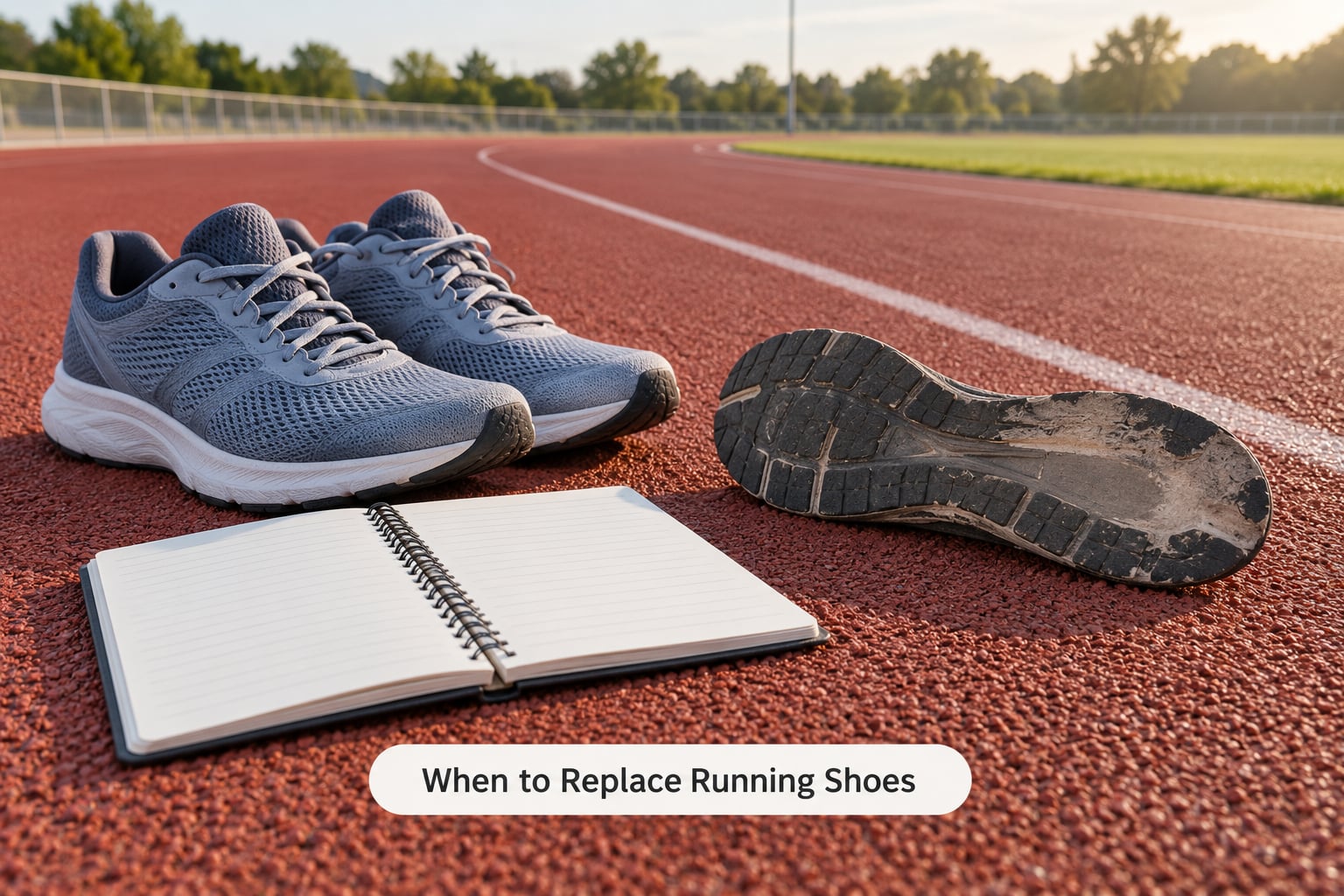
The short version: replace running shoes when any one of four things happens. Your mileage passes the point where the foam has lost its spring, the shoe shows clear physical damage, it stops feeling stable and comfortable on easy runs, or your body starts sending signals it did not send before.
Age alone is not a reliable trigger. A two-year-old shoe that sat in a dry cupboard and ran 40 miles may have more life left than a five-month-old pair you wore to the shop every Saturday and ran wet track sessions in.
What does not work as a trigger either: the pair still looking tidy. Most modern midsoles stay visually intact long after they stop absorbing shock properly, which is exactly the frustration runners describe on r/running and r/RunningShoeGeeks when they notice their shoes look fine but their shins do not feel fine.
How Many Miles Should Running Shoes Last?
The commonly quoted range is 300-500 miles, or 500-800 km. Treat it as a starting point for tracking, then adjust it with the four tests below.
Several things move that number. Body weight matters because a heavier runner compresses the same foam harder on every step. Running surface matters too: concrete and asphalt grind faster than a soft track or treadmill, while trail surfaces chew through outsoles rather than midsoles. A heavier, faster runner with a pronounced heel strike typically reaches the end of the range first.
Shoe type matters more than most brands admit. Carbon-plated racers and other super shoes are built for speed over a short window, and their foam and plate give up much sooner.
| Shoe type | Typical lifespan | In kilometres | Rough months at 25 miles a week |
|---|---|---|---|
| Everyday trainer | 400-600 miles | 645-970 km | 16-24 months |
| Trail shoe | 300-500 miles | 480-800 km | 12-20 months |
| Lightweight or minimalist trainer | 250-400 miles | 400-645 km | 10-16 months |
| Carbon-plated racer or super shoe | 200-300 miles | 320-480 km | 8-12 months |
| Trainer worn for errands and walking too | 300-450 miles | 480-725 km | 12-18 months |
That super shoe figure is not just marketing copy. Runners on r/BeginnersRunning report getting around 250 miles out of a plated pair while getting 400-600 out of a daily trainer, and the same thread notes shin splint pain showing up reliably as the shoes wear down.
How to track the mileage on each pair
Most runners know their weekly total and nothing about individual shoes. Here is the fastest way to fix that.
- Add the pair to your watch or phone app. Strava and COROS both have gear tracking, and Garmin watches, Apple Health-connected phones and most running watches can pair with one of them. Set it up on the day you buy the shoes.
- Name it something specific. Use the model and colour, not “shoes 1”, because you will own several pairs within a year and you will want to tell them apart at a glance.
- Select the pair when you save each run. In Strava the shoe is picked from your gear list as you upload an activity or edit it afterwards. In the COROS app you enable the shoe in the gear settings and it links automatically on your next sync.
- Write the starting mileage down. Note the distance already on the shoes if you bought them secondhand, then add to it.
- Check the number every month or two. If your app shows two or three shoes and you cannot remember the last run in any of them, that is the pair to watch.
No app, no problem. A permanent marker line on the midsole of each shoe, plus a running log, does the same job for the price of a pen. Some runners photograph their shoes on day one so they have a visual reference to compare against later.
7 Signs You Need New Running Shoes
These are the checks, in rough order of how much they should worry you.
1. The outsole tread is worn smooth
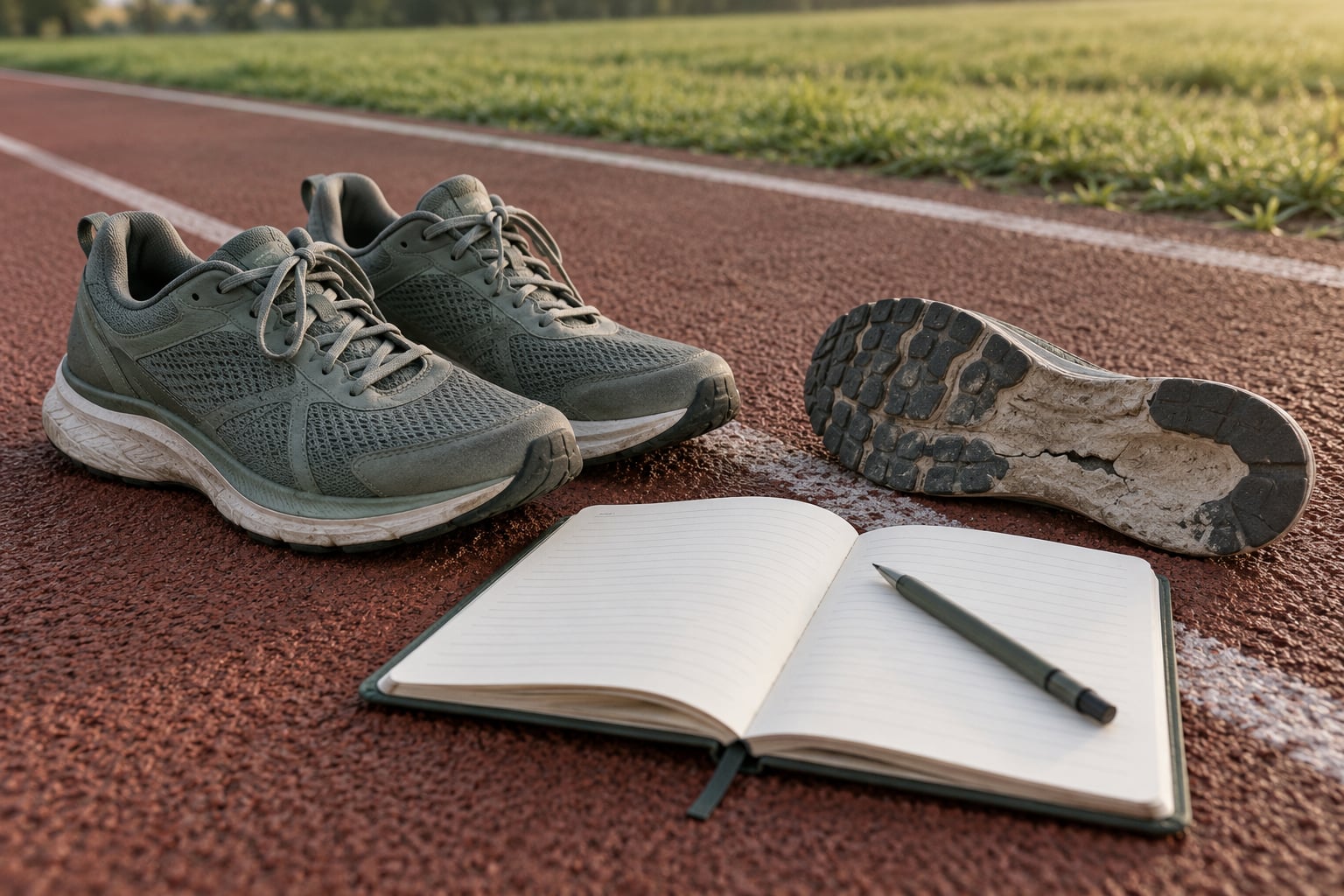
Look at the rubber bottom under a light. If the lugs have rounded off, if you can barely see the pattern, or if you can read the brand name straight through the sole from underneath, the rubber has lost its grip. Wet roads and technical trail ground both take out traction long before they take out cushioning.
2. The midsole feels flat
Press your thumb into the foam just behind the ball of the foot. On a fresh shoe the foam pushes back against your thumb and springs when you let go. On a tired shoe the same press leaves a dent that slowly fills back in, or barely fills back in at all.
3. You can see the midsole through the outsole, or the sole is creased
Hold the shoe side-on to the light. When the foam in the heel compresses unevenly, diagonal crease lines appear through the rubber, and in heavier wear the midsole colour starts to show through the outsole at the ball of the foot or at the outer edge of the heel.
4. Uneven outsole wear
A healthy shoe wears across the ball of the foot and lightly under the heel. If one side of the outsole is nearly gone while the other still has deep tread, your gait is loading the shoe asymmetrically. That pattern often shows up as a shoe that feels like it wants to roll outward or inward.
5. The cushioning feels noticeably harder or flatter
Run in them and compare with a pair you know is fresh. This is the sign runners trust most, because it is the one their body notices. Cushioning that no longer absorbs impact leaves your Achilles, calf and shin working harder on every step.
6. The shoe no longer fits the way it did
Foam in the heel counter and the toe box packs down over time, so the shoe can become loose at the heel or tight across the forefoot without either changing size. Slipping heels on stairs or feeling your toes crowd near the end of a long run are both fit changes, not normal ageing.
7. New or recurring pain shows up
Achilles stiffness that lasts into the morning, shin splints that return every week, plantar fasciitis pain in the arch, knee ache on downhill days, or a lower back that grumbles after long runs. Runners on r/running and r/XXRunning repeatedly describe replacing at the first hint of shin splint pain, which tells you how strongly this signal is trusted in the community.
| Sign | What it usually means | How worried to be |
|---|---|---|
| Flat, hard midsole | Foam has lost its resilience and compression recovery | Replace soon |
| Bald tread | Outsole rubber is gone; traction is compromised | Replace before wet or technical runs |
| Diagonal creases in the sole | Uneven compression in the heel or forefoot | Replace |
| Leaning to one side | Asymmetric wear from gait pattern | Replace, and consider a stability check |
| New blisters or hot spots | Shoe shape has changed underfoot | Replace |
| Ache that shows up and stays | Body is no longer absorbing the load comfortably | See a clinician if it persists |
How to Tell Whether Your Shoes Still Support You
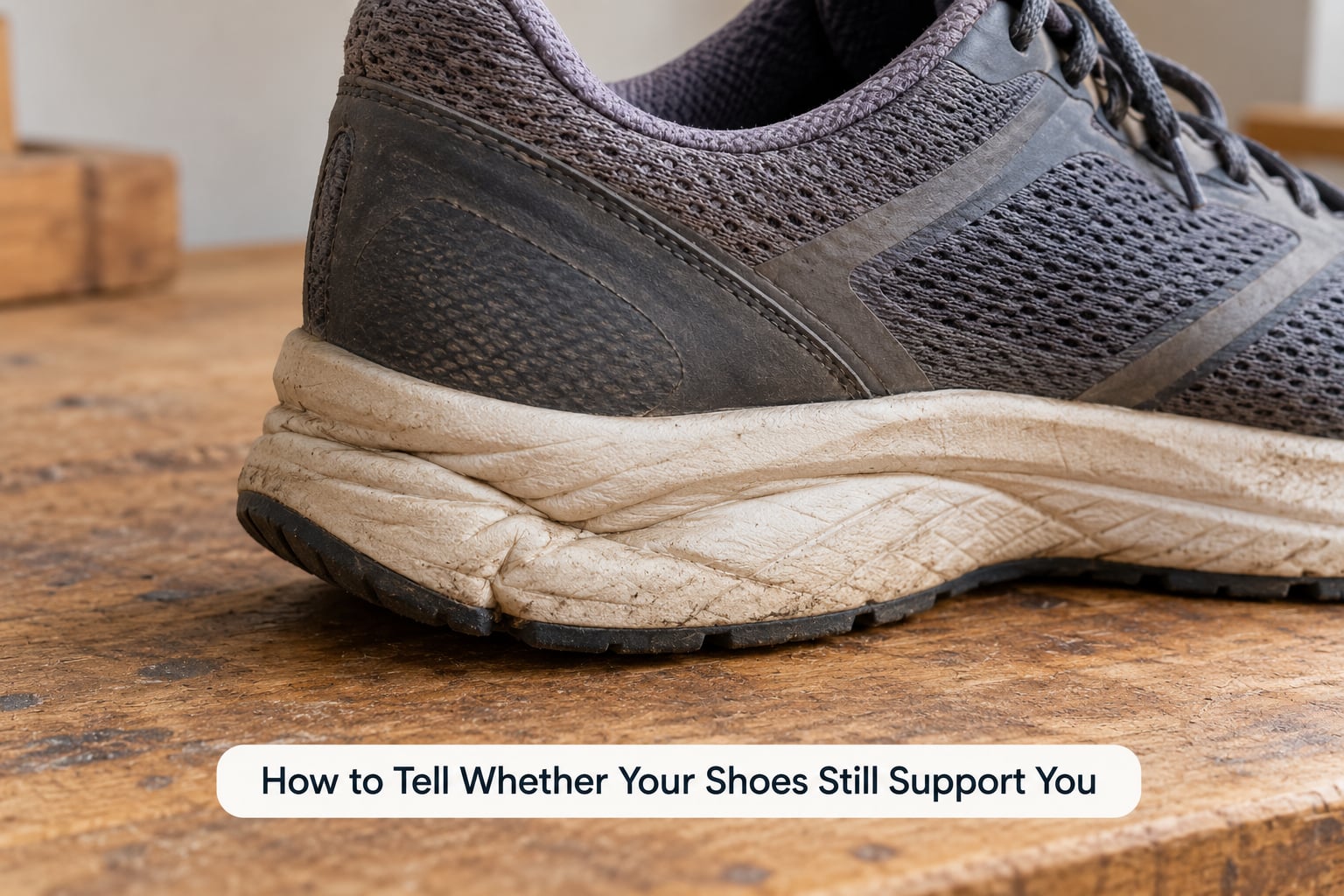
These checks take about a minute in total, and they work on any running shoe. Take the pair out of rotation, run it in your hand and let the foam be the judge. The first five are the ones most runners only ever need.
Press test
Push a thumb hard into the midsole at the ball of the foot, then release. Fresh foam rebounds quickly. Worn foam stays compressed, sometimes for a noticeable moment.
Twist test
Grab the shoe at the heel and forefoot and twist it in opposite directions. Fresh running shoes are stiff enough that the midsole does not fold sharply. If the shoe twists into a shallow S with no resistance, the foam has lost structural support.
Tread test
Turn the shoe over. You want visible grooves and defined edges on the outsole. Flat rubber with a sheen, especially under the heel, means the grip is gone.
Lean test
Place the shoe on a flat surface and look at it from behind and from above. A worn shoe often leans, because one side of the midsole has compressed more than the other.
Sidewall and heel check
Run your thumb along the sidewalls and squeeze the heel counter between your fingers. Soft, dented foam or a heel counter that no longer holds its shape means the shoe is finished, even if the outsole still looks usable.
Flattened midsole foam: the plainest warning
Turn the shoe inside out or look at the footbed. A midsole that has lost its bounce often shows a flattened, sharply creased shape where the heel and forefoot used to curve. If the shoe no longer rocks smoothly heel to toe when you flex it by hand, the cushioning is spent.
Does the midsole still decompress?
Foam needs hours between runs to recover its shape. If you wear the same pair on back-to-back days and it never feels quite right in the morning, it is never fully recovering. That is the argument for rotation: a second pair gives each midsole a full day or more to come back.
When to Replace Running Shoes Because of Pain
New pain is the most reliable replacement signal there is, and also the one most often ignored. Runners push through because the shoes still feel fine on foot, while the ache builds over weeks.
Not all soreness is a shoe problem. Ordinary post-run fatigue fades within a day or two. What deserves attention is discomfort that lingers longer than usual, comes back earlier in each session, or appears in a place it has never been before.
- Shin splints: dull aching along the front of the shin, often worse at the start of a run and easing once you are warmed up, then returning harder later in the week.
- Plantar fasciitis: sharp heel or arch pain with the first steps of the morning that eases as you walk.
- Knee pain: aching under the kneecap or on the inside of the joint, especially on downhill running when impact is highest.
- Achilles and calf: stiffness that lingers into the next day, or a tendon that feels thicker or tender to touch.
- Lower back: fatigue through the hips and lumbar area after long runs, which often shows up when cushioning has dropped.
If you can trace the pain to a worn shoe, replacing it is a sensible first step. If the pain persists after two or three weeks in a fresh pair, or if it is sharp, worsening, or present at rest, stop running and see a doctor or a sports physiotherapist. Swelling, numbness or pain that wakes you at night are reasons to seek care without delay.
Do Running Shoes Lose Cushioning Before the Tread Is Worn?
Yes, and usually by a wide margin. This is the single most important thing to understand about shoe wear, because it explains why runners routinely over-run their shoes.
The outsole is designed to outlast the midsole, so a shoe can look almost new while the foam underneath has already lost much of its spring. A 2017 study on midsole ageing found that the foam hardens after roughly 160 km, while runners’ perception of cushioning barely moved, dropping by only about 3% even at 640 km.
That gap between physical change and felt change is why the shoes feel fine. Researchers who have studied this put the practical threshold closer to a 10% loss of perceived cushioning than to any particular mile count. Once a runner crosses that line, comfort drops noticeably and the shoe starts working harder against the runner rather than for them.
The performance side of the same question has a measurable answer. A 2020 University of Connecticut study found running economy, meaning how efficiently you run, began to deteriorate after around 240 km and reached statistical significance at about 320 km. In other words, the foam changes measurably well before you feel it.
This effect shows up most sharply in carbon-plated race shoes, where the plate and foam work as a system built for freshness. That is why racers are typically replaced on a much shorter cycle than trainers.
Running Shoe Age: Does It Matter?
Sometimes yes, but the calendar is a supporting clue rather than a deadline. Foam and rubber degrade over time even without running, and heat makes it happen faster.
Storage is where most pairs quietly lose their lives. A car parked in summer reaches temperatures that cook the foam and dry out the glue. Closets next to a boiler or under a roof space have the same problem at a slower rate. Humidity does its own damage by breaking down the adhesives and the foam’s cellular structure.
Store shoes somewhere cool, dry and out of direct sunlight. Take the insoles out between runs so both the shoe and the footbed can dry, and never wash a running shoe in a washing machine. Air them at room temperature, away from radiators.
For an unused pair, keep the box and the silica pack if the manufacturer supplied one, and check the glue lines and foam colour every few months. Yellowing is normal with age on some foams, but crumbling or separating glue is not.
Two years is not a cut-off. A lightly used, well-stored pair can still be fine at that age, and a badly stored one can be finished at eight months. Judge the condition, not the date.
How to Choose Replacement Running Shoes
Start by identifying what the pair is for. Most runners are better served by a simple set than by a single shoe: an easy trainer for most mileage, a faster shoe for workouts and race day, and a trail or grippy shoe for anything off the road.
Fit beats everything else. Feet swell over a long run, so try shoes late in the day, and go up half a size to a full size in the toe box compared with your street shoes. You want roughly a thumb’s width in front of your longest toe, with the midfoot held securely.
Bring your current pair when you shop. Comparing a worn shoe against a candidate tells you things a fit check on a fresh pair cannot, particularly about your foot’s width and how you actually strike.
Then think about cost. Cheaper shoes are not automatically shorter-lived, but entry-level foams often are less resilient and take more of a beating under a heavier runner, while racing-grade foams wear faster because they are deliberately soft and springy. The lifespan comes from the material and the use, not the label.
Habits that shorten a shoe’s life
- Wearing running shoes for long walks and errands, which compresses the midsole without letting it recover
- Running every day in one pair, so the foam never gets a full recovery window
- Training in plated shoes rather than reserving them for races
- Leaving shoes in a hot car or a damp garage
- Running long sessions on pavement in a light, low-mileage shoe
Habits that extend it
- Rotating between two pairs, giving each midsole 24 hours or more to decompress
- Keeping shoes for running only
- Air drying at room temperature and loosening the laces before running so the upper stops pulling on the midsole
- Rotating your training surface so the same foam does not take every impact type
- Buying two pairs and using them as a pair rather than running each into the ground
When to Replace Running Shoes: Frequently Asked Questions
At what mileage should I replace my running shoes?
Replace daily trainers at 400-600 miles (645-970 km) and carbon-plated racers at 200-300 miles (320-480 km). The familiar 300-500 mile rule sits in the middle of that range. Treat it as a tracking number rather than a deadline: if your mileage is still low but the midsole feels flat or new aches have appeared, replace the shoes anyway.
Why do running shoes only last 300 miles?
Because the midsole foam hardens and loses its ability to rebound long before the outsole wears out. Research from 2017 found midsole material hardening after roughly 160 km while perceived cushioning barely changed. A 2020 University of Connecticut study also found running economy started declining after about 240 km. Body weight, surface and gait all speed this up.
Are two-year-old running shoes still good?
It depends entirely on how they were stored and used. A lightly used pair kept in a cool, dry cupboard can still be fine at two years. A pair left in a hot car or worn daily for walking will have lost far more cushioning than its age suggests. Check the midsole for hardening and creasing rather than counting from the purchase date.
How do I find shoe mileage on Strava?
Add the pair under Settings, then My Gear, choosing Add a new shoe and entering the brand and model. When you upload or edit an activity, select that shoe from the gear dropdown and Strava adds the distance to its running total. Strava also offers a shoe rotation reminder when a pair crosses a mileage threshold you set.
Can I keep running in worn-out running shoes?
You can finish a short easy run in them, but a pair with a flat midsole or bald tread no longer absorbs impact properly, so your tendons and joints take more of the load. Runners report shin splint pain appearing reliably as shoes wear down. If you have pain that persists more than a couple of days, stop and get it checked.
Are expensive running shoes worth it?
For most runners, price is not a reliable predictor of lifespan. What determines how long a pair lasts is the foam’s resilience, your body weight, the surface you run on and how you use it. Racing-grade shoes wear faster because their foam is deliberately soft and springy, while cheaper trainers can outlast pricier shoes if they are used only for running.
A Simple Replacement Checklist
Start with the two numbers and two checks that take five minutes. Check your per-shoe mileage in Strava or your watch app, then press the midsole, look at the outsole under a light, and squeeze the heel counter.
If the mileage is past roughly 500 miles (800 km), or the foam stays compressed under your thumb, or the tread has gone smooth, replace the pair. If the mileage is low but you are getting new aches in your feet, shins or knees, replace it anyway and treat the pain as the reason to stop running until it settles.
One more thing worth doing with the old shoes: keep them for yard work and messy garage jobs. It is the easiest retirement strategy there is, and it means the decision never has to feel wasteful.