Aperture vs shutter speed explained simply: aperture is how wide the opening inside your lens is, and shutter speed is how long the sensor stays exposed to light. Both change how much light reaches the sensor, but they change different parts of the picture — aperture decides how much of the scene looks sharp, shutter speed decides how movement looks.
If you have ever shot on Auto, wondered why a portrait came out with a blurry background, or picked up a frame that was too dark to use, you have already met both settings. You just did not have a name for them yet. Everything below is built around one idea: these two controls trade against each other, and once you can see that trade, choosing between them stops being guesswork.
Table of Contents
- Aperture vs Shutter Speed Explained Simply: At a Glance
- The full-stop scale you will see on every camera
- What Does Aperture Do?
- What f/2.8 Actually Means
- How Aperture Changes Depth of Field
- Aperture in Practice: Portraits, Wide Vistas and Low Light
- What Does Shutter Speed Do?
- Fast Shutter Speeds Freeze Movement
- Slow Shutter Speeds Show Movement Instead
- The Handheld Rule for Beginners
- How Do Aperture and Shutter Speed Affect Exposure Together?
- One Stop In, One Stop Out
- Where ISO Fits In
- Priority Modes Do Half the Work
- Aperture vs Shutter Speed: Which One Should You Change First?
- Which Should You Choose?
- Frequently Asked Questions
- What is the difference between aperture and shutter speed?
- Should I use a wide aperture or fast shutter speed?
- What f-stop is best for portraits?
- What shutter speed freezes motion?
- Does a lower f-number mean better photos?
- What is a good starting aperture and shutter speed for beginners?
- The Bottom Line
Aperture vs Shutter Speed Explained Simply: At a Glance
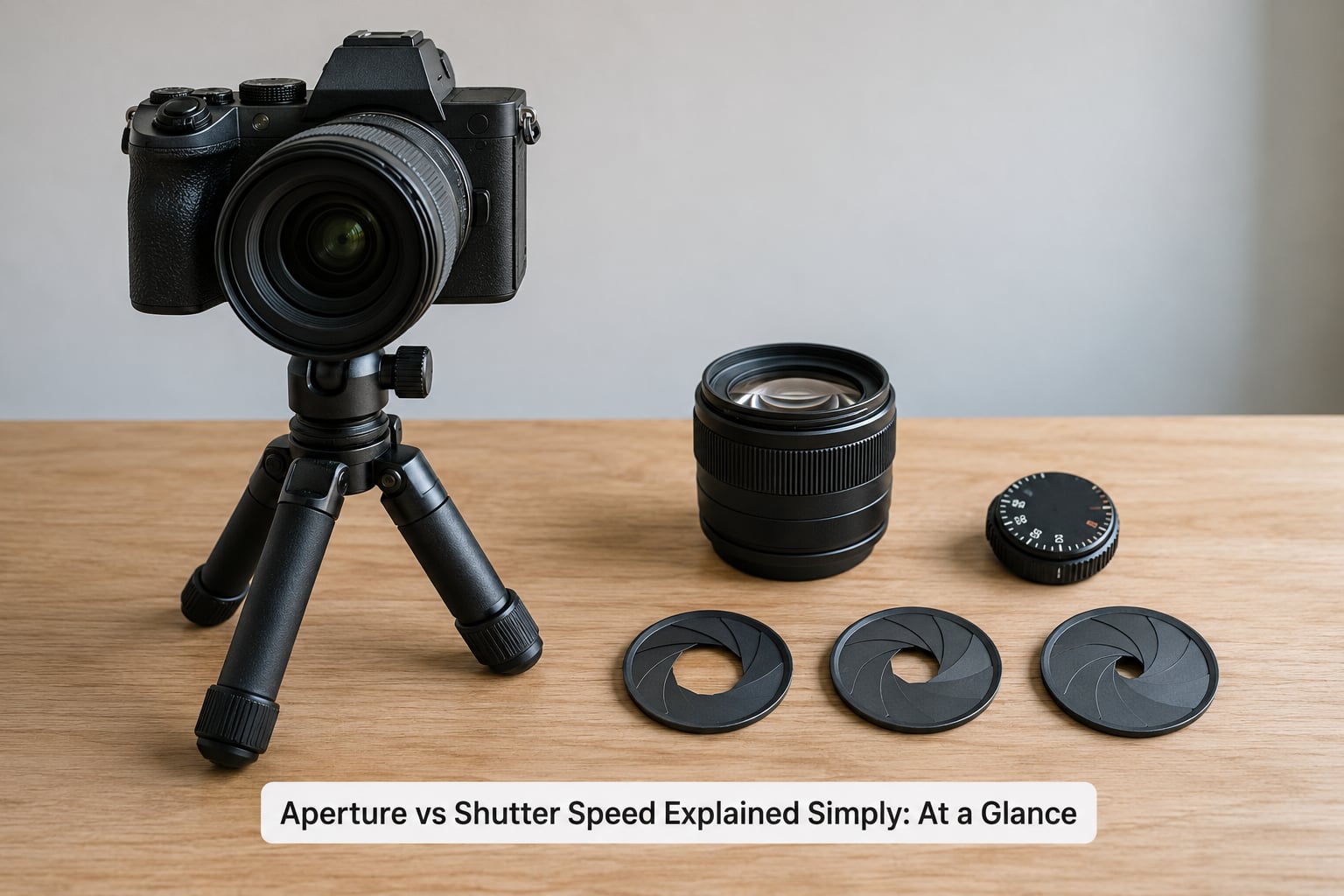
Here is the short version before the detail. Read across each row to see where the two settings genuinely overlap and where they diverge.
| What it controls | Aperture | Shutter speed |
|---|---|---|
| Physical mechanism | Size of the opening inside the lens | How long a curtain covers the sensor |
| Written as | f-number: f/1.8, f/5.6, f/16 | Fraction of a second: 1/1000s, 1/60s, 2s |
| Effect on light | Wider opening means more light | Longer exposure means more light |
| Effect on the image | Depth of field, background blur, bokeh | Motion: frozen or blurred |
| Going one way | Lower f-number = wider hole = blurrier background | Faster speed = less time = sharper action |
| Going the other way | Higher f-number = narrower hole = more in focus | Slower speed = more time = more blur |
| Common mistake | Leaving it wide open for every subject | Leaving it too slow for moving subjects |
One line to remember: low f-number means a wide aperture and a blurrier background, while a fast shutter speed means a shorter time and sharper action. Those two phrases are the whole difference between the settings, and everything else is detail.
The full-stop scale you will see on every camera
These are the standard full stops, and each step halves the light compared with the one before it.
| Aperture | f/1 | f/1.4 | f/2 | f/2.8 | f/4 | f/5.6 | f/8 | f/11 | f/16 |
|---|---|---|---|---|---|---|---|---|---|
| Light compared with f/1 | Full | Half | Quarter | Eighth | 1/16 | 1/32 | 1/64 | 1/128 | 1/256 |
What Does Aperture Do?
Aperture is a hole inside the lens. It sits behind the glass elements and its job is to let a controlled amount of light reach the sensor. The size of that hole is written as an f-number, and the number counts backwards: f/1.8 is a very wide hole, f/16 is a narrow one.
What f/2.8 Actually Means
The f-number is the focal length of the lens divided by the diameter of that opening. On a 50mm lens set to f/2, the opening is 25mm across; at f/1.4 it is about 36mm. So when a photographer says “I shot it at 2.8”, they mean f/2.8 — a wide opening that passes plenty of light and throws the background out of focus.
The numbering feels inverted because it is a ratio, not a measurement of the hole itself. A bigger denominator gives a smaller opening. Once that clicks, the scale stops being confusing.
How Aperture Changes Depth of Field
Depth of field is the slice of the scene that looks acceptably sharp. A wide aperture gives a shallow slice, so your subject is sharp and everything behind it softens — that softness, when it forms clean circles of light, is what people call bokeh. A narrow aperture gives a deep slice, so foreground, subject and background all read clearly.
Distance matters as much as the f-number here. Moving closer to your subject or using a longer focal length shrinks the sharp slice even at the same aperture. That is why a 400mm lens at f/6.3 blurs more than an 85mm lens at f/3.2 from the same spot.
Aperture in Practice: Portraits, Wide Vistas and Low Light
Portraits live at wide apertures — f/1.8 to f/4 — because the blurred background pushes attention onto a face. Wide vistas and group scenes usually get f/8 to f/11, where the near and far edges both stay sharp. In low light a wide aperture is also the easiest way to gather enough light without slowing the shutter into a blur.
Wider is not automatically better, though. At f/1.8 on a thin subject, a nose can be sharp while the ears fall outside focus. Stopping down to f/2.8 or f/4 is the cheapest fix there is.
What Does Shutter Speed Do?
Shutter speed is the length of time the sensor is exposed to light, written as a fraction of a second. 1/1000s is a thousandth of a second; 1/60s is a sixtieth; 2s is two full seconds. Double the time and you double the light, which is why it sits alongside aperture in every exposure calculation.
Fast Shutter Speeds Freeze Movement
From about 1/500s upward you start freezing action mid-stride. Sprinting children, a dog shaking water off, a bird in flight — 1/1000s to 1/2000s catches them crisp with no blur at all. Fast speeds also cut out accidental camera shake, which is why they feel forgiving.
Slow Shutter Speeds Show Movement Instead
Drop below 1/60s and moving subjects start to smear. At 1/15s a walking person has soft edges; at 1/4s they become a streak. That blur is sometimes the point: waterfalls turn silky, moving traffic draws light trails, and a slow handheld sweep pans with a cyclist while the background smears.
The Handheld Rule for Beginners
A useful starting point is to keep the shutter speed at least as fast as one over your focal length. On a 50mm lens that means 1/50s or quicker; on a 200mm lens, 1/200s or quicker. If you fall well short of that and the camera is not on a tripod, you will usually get hand shake as well as subject blur — two problems at once.
How Do Aperture and Shutter Speed Affect Exposure Together?
Aperture and shutter speed are two dials on the same control. Together with ISO they form the exposure triangle, and because each one only changes brightness, moving any of them changes what the other two must do.
One Stop In, One Stop Out
Each of these combinations gives the same brightness on the sensor. Once a setting changes by one stop, one of the other two has to follow by one stop in the opposite direction.
| Aperture | Shutter speed | Light |
|---|---|---|
| f/1.4 | 1/1000s | Baseline |
| f/2 | 1/500s | Same |
| f/2.8 | 1/250s | Same |
| f/4 | 1/125s | Same |
| f/5.6 | 1/60s | Same |
| f/8 | 1/30s | Same |
| f/11 | 1/15s | Same |
| f/16 | 1/8s | Same |
Read that table downward and you are watching the classic trade: each stop of background blur is paid for with twice the time and more risk of motion blur. That is the whole decision, in eight rows.
Where ISO Fits In
ISO is the third leg, and it answers a different question. Aperture and shutter speed control how long light is let in and how big the opening is; ISO controls how sensitive the sensor is to the light you did let in.
Raising ISO brightens a frame without touching either aperture vs shutter speed setting, at the cost of grain and reduced detail in shadows. A common beginner habit is to reach for it too early. The usual order is to open the aperture first, then slow the shutter as far as your subject allows, and only then raise ISO.
Priority Modes Do Half the Work
Most people start out in Aperture Priority (A or Av), where you pick the f-number and the camera picks a matching shutter speed. Shutter Priority (S or Tv) flips it: you choose the speed and the camera handles the aperture.
Users who switch from Auto to Aperture Priority usually find it far easier than manual, because they pick a single creative control and ignore the rest. In Automatic ISO modes the camera may also adjust ISO on its own to protect a slow shutter speed, which is a common source of confusion — check your ISO ceiling if your shutter speeds keep creeping downward.
Aperture vs Shutter Speed: Which One Should You Change First?
Ask one question about your subject: is it moving? If the subject moves, shutter speed wins. If it stays still, aperture wins, because blur from a slow shutter is a mistake while a soft background is a choice.
Here is the procedure I use, in order.
- Check whether the subject moves. People, pets, vehicles and sports set a fast shutter speed as the non-negotiable. Buildings, flowers, empty streets and most scenery do not.
- Set the moving-subject speed first. Roughly 1/500s for casual action, 1/1000s for fast sport. Anything moving across the frame needs at least this.
- Then set the aperture for the look you want. f/1.8 to f/4 to isolate a subject, f/5.6 to f/8 as a safe middle, f/11 for maximum sharpness front to back.
- Let the camera find the brightness. In a priority mode it handles the third value. In manual, match whatever ISO you are comfortable with.
- Raise ISO last. Only when steps two and three have run out of room.
If the frame comes out too dark, work through it in that same order: open the aperture one stop, then slow the shutter one stop, then raise ISO one stop. Reverse the sequence for a frame that is too bright. Changing two settings at once is the fastest way to lose track of why a picture looks the way it does.
The one situation where you flip the order is a static subject that will not stop shaking — an indoor concert, a candlelit dinner, a city after dark. There, shutter speed is what you can afford to lose, so aperture comes first.
Which Should You Choose?
Match the settings to what you are shooting. These starting points assume daylight or bright indoor light, and all of them are worth adjusting by a stop either way.
| Subject | Choose first | Aperture | Shutter speed |
|---|---|---|---|
| Portraits | Aperture | f/1.8 to f/4 | 1/125s or faster |
| Street photography | Shutter speed | f/5.6 | 1/250s |
| Sports and action | Shutter speed | f/4 to f/8 | 1/1000s to 1/2000s |
| Children and pets | Shutter speed | f/2.8 to f/5.6 | 1/500s or faster |
| Wide vistas | Aperture | f/8 to f/11 | 1/125s or tripod |
| Indoor events | Aperture | f/1.8 to f/2.8 | 1/125s, raise ISO |
| Night and cityscapes | Both | f/8 | Tripod or 1/15s minimum |
| Waterfalls and long exposures | Shutter speed | f/8 to f/16 | 1s to 30s on a tripod |
Two of these rows cause most beginner disappointment. Children and pets get blurry because 1/125s is not fast enough for a running child, and night shots get noisy because the aperture is already wide and the shutter is still too slow for a handheld frame.
Frequently Asked Questions
What is the difference between aperture and shutter speed?
Aperture sets the size of the opening inside the lens, which changes how much light arrives and how much of the scene looks sharp. Shutter speed sets how long the sensor is exposed, which changes how much light arrives and whether movement is sharp or blurred. Both control brightness, but aperture controls focus and shutter speed controls motion.
Should I use a wide aperture or fast shutter speed?
It depends on whether your subject moves. A wide aperture like f/2.8 is right for a still subject you want to separate from a blurred background. A fast shutter speed like 1/1000s is right for anything that moves, because it freezes the action. Most scenes need both: f/2.8 and 1/500s together is a common all-round starting point.
What f-stop is best for portraits?
For portraits, f/1.8 to f/4 is the usual range. Anything within about two stops of your lens widest opening will blur the background enough to separate the face from it. If a nose is sharp but the ears are not, stop down to f/2.8 or f/4. Keep the shutter speed at 1/125s or faster so the subject does not blur.
What shutter speed freezes motion?
Around 1/500s freezes ordinary movement such as walking or a gesturing hand. Fast sport, vehicles and jumping animals need 1/1000s to 1/2000s. The general test is to compare the blur against your subject: if a moving edge looks soft, go one or two stops faster. In low light, raise ISO rather than slowing below the speed the movement needs.
Does a lower f-number mean better photos?
No, a lower f-number means a wider opening, and wider is not automatically better. It gives you more light and a blurrier background, which suits portraits and low light. A higher f-number such as f/8 keeps more of the scene sharp, which suits wide vistas and group scenes. Choose the f-number for the look you want, then balance brightness with shutter speed and ISO.
What is a good starting aperture and shutter speed for beginners?
Start in Aperture Priority at f/5.6 with Auto ISO and take a few frames, then check the shutter speed the camera chose. If it lands slower than 1/125s, the light is low, so open to f/2.8 or raise the ISO limit. Shoot in good daylight first, where f/5.6 and 1/250s is usually a safe, sharp, well-exposed starting point.
The Bottom Line
Decide whether your subject moves before you touch a dial. If it moves, pick the shutter speed and give up a little background blur. If it stays still, pick the aperture for the look you want and buy the light back with the shutter speed.
Then practice on one scene. Stand in the same spot, shoot at f/2.8, f/5.6 and f/11, then at 1/1000s, 1/60s and 1/4s. The difference stops being theory pretty fast.