Keep the top inch of soil continuously damp and water new grass seed two to four times a day in short, gentle sessions until it germinates, then lengthen the gaps as roots take over. It takes about 15 minutes on seeding day and roughly ten minutes a day for the next two weeks.
Grass seed has no root system yet, so it can only draw water from that top inch of soil. Let it dry out and the seed dies. Keep it soaked and the seed rots, because saturated soil has no oxygen. Almost every failed seedbed traces back to one of those two errors in the first fortnight.
The schedule below assumes a typical home lawn and average soil. Adjust for your climate and soil type as described in step 4.
Table of Contents
- What You Need
- Step-by-Step: How to Water New Grass Seed
- 1. Prepare the Soil Before Seeding
- 2. Water the Seed Bed Before and After Seeding
- 3. Keep the Surface Evenly Moist: Watering New Grass Seed Day to Day
- 4. Adjust the Schedule for Weather and Soil
- 5. Check for Germination and Gradually Reduce Watering
- Common Mistakes
- Frequently Asked Questions
- How often should I water new grass seed?
- How much water does new grass seed need each day?
- Should I water new grass seed every day?
- Can I overwater new grass seed?
- How long should I keep the soil wet after seeding?
- When can I mow grass after seeding?
- Conclusion
What You Need

- A drop spreader so seed lands evenly instead of in patches
- Your grass seed, plus a starter fertiliser if the soil has not been fed in the last few months
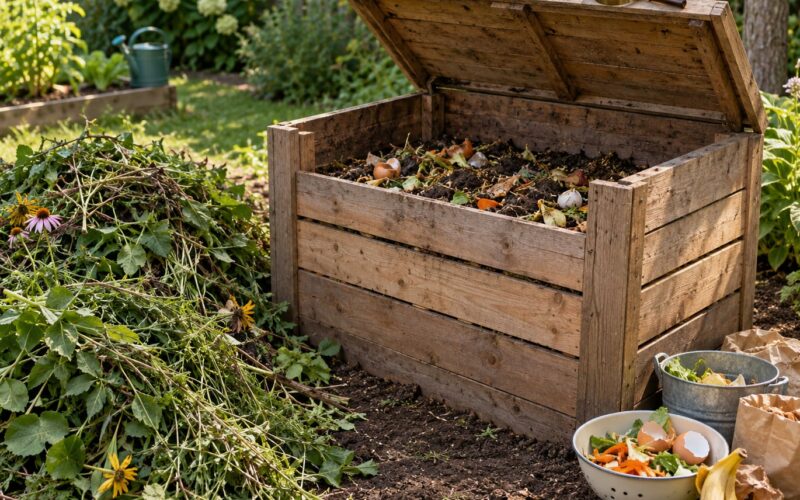
- Topsoil or compost to cover bare spots and fill low areas that would dry out fast
- A watering can or hose-end sprinkler that produces a fine spray rather than a hard jet
- A timer, so a session can run while you are elsewhere
- Something to check the soil with — a screwdriver, a finger, or a flat-head tool for probing moisture at seed depth
If you have no irrigation system, a soaker hose laid across the area does the same job more evenly than a single handheld head, and it works on a timer overnight if your schedule is tight.
Step-by-Step: How to Water New Grass Seed
1. Prepare the Soil Before Seeding
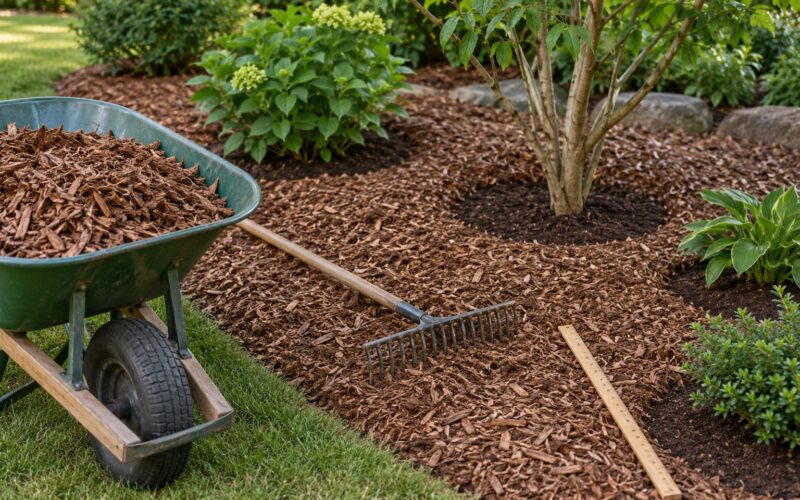
Break up the surface so the seed bed holds moisture. Rake out debris, fill any ruts with topsoil, and check that water drains away rather than sitting. A bed that sheds water will not hold the damp layer grass seed depends on.
Pull a handful from a few spots and squeeze it. If it holds together and leaves a dark stain on your palm, the moisture level is about right. If it crumbles to dust, water the bed first and wait for it to soak in before you sow.
2. Water the Seed Bed Before and After Seeding
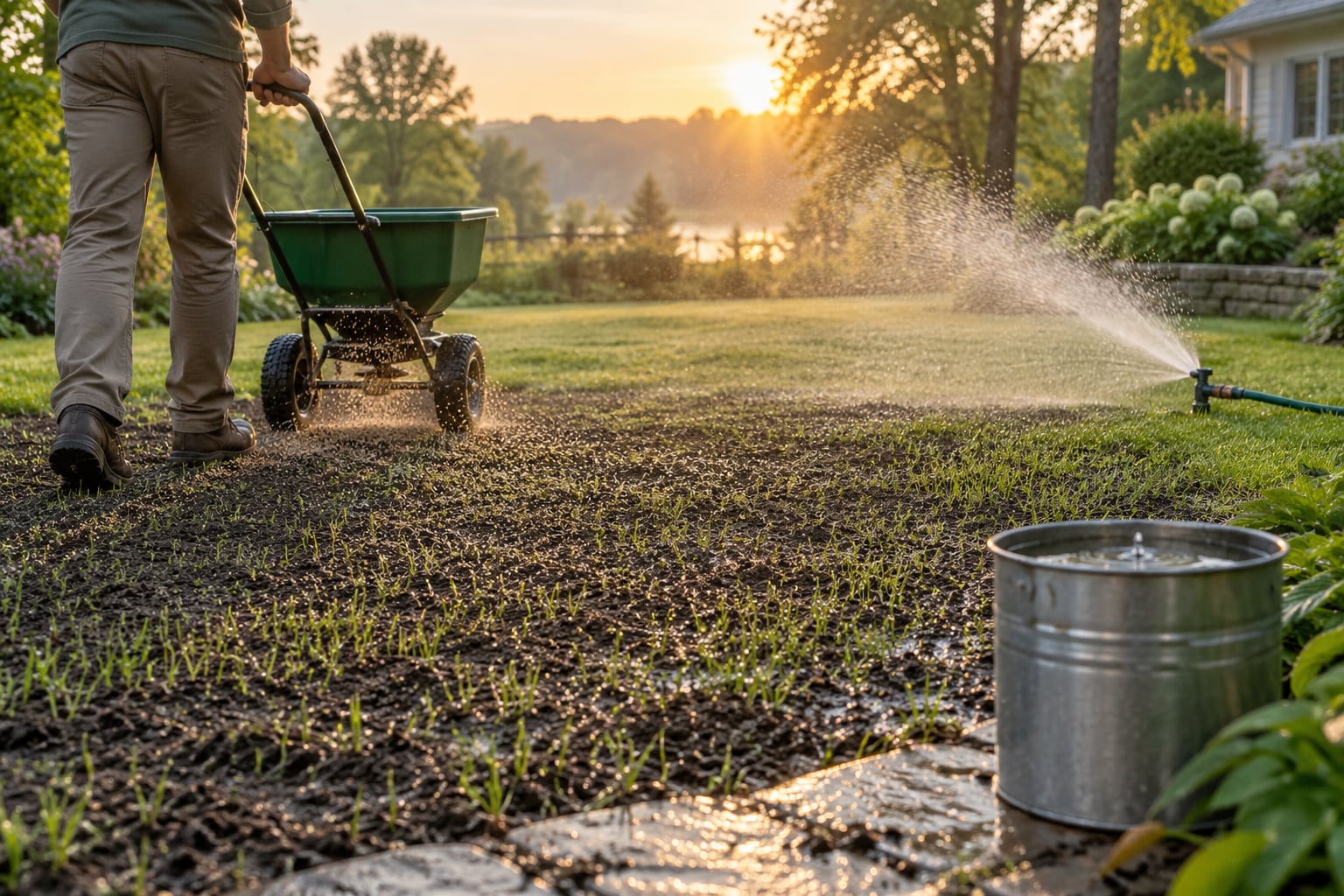
Water immediately after seeding. This initial soak settles the seed into contact with the soil, which matters more than any straw or mulch blanket, because seed that sits on a dry crust never takes hold.
Run the sprinkler long enough to wet the top inch thoroughly, usually 10 to 15 minutes with a hose-end head, then let the bed drain. Keep going if water pools in low spots. Soggy, standing water pushes the seed into the air rather than the ground.
3. Keep the Surface Evenly Moist: Watering New Grass Seed Day to Day
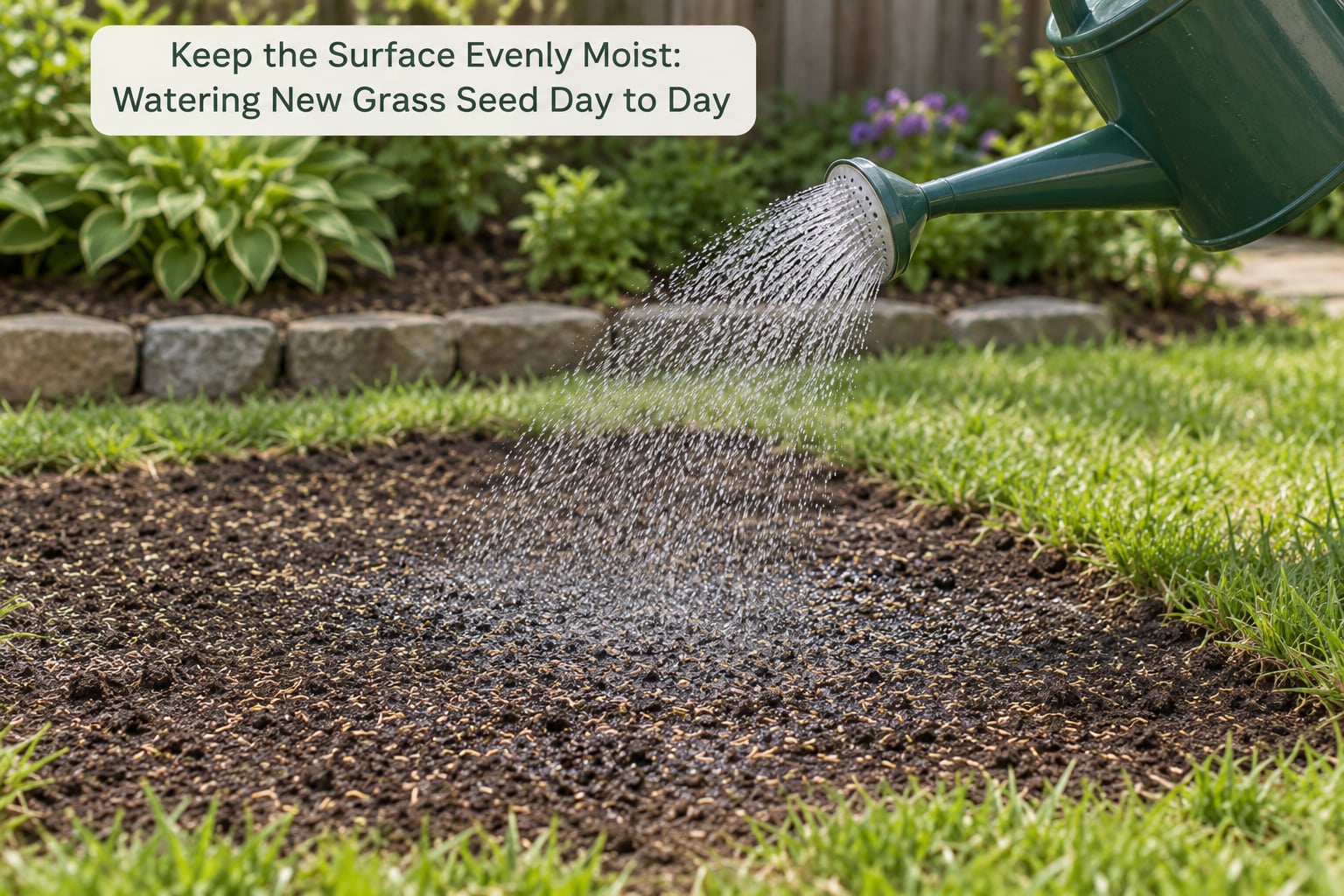
Water lightly, two to four times a day, during the first two weeks. Split the day around the clock if you can — early morning, then early afternoon, then early evening — rather than soaking once. The seed has no roots yet, so it dries out from the top down within hours on a warm day.
Touch the soil between sessions. The top inch should feel cool and damp, never wet and never dry. Water again the moment it starts to feel dry rather than waiting for the next scheduled time.
Spray, do not pour. A hard stream washes seed into low spots or off the edge of the lawn, which is why a crusty surface is a real problem: the soil seals, water runs across it instead of into it, and seedlings underneath dry out anyway.
Use a straight-sided can or cup as a gauge if you want a number. A tuna can is exactly one inch tall, so the depth of water standing in it after a session tells you how much you applied. Run the sprinkler for ten minutes, measure, and you have your personal rate.
Roof and rotor heads throw far more water than spray heads and hose-end nozzles. A rotor delivering half an inch per hour needs about 20 minutes for a quarter inch, so published advice to run for ten minutes badly under-waters a lawn like that. Measure your own head rather than trusting the number on the bag.
4. Adjust the Schedule for Weather and Soil
Change the volume and the frequency to match your conditions. The rule is the same everywhere — damp, not wet — but the amount of water it takes to get there varies a lot.
- Sandy soil drains fast and holds almost nothing. Water more often, in shorter bursts, since much of it runs past the seed.
- Clay soil holds water for a long time. Water less often and for longer, and stop as soon as you see the surface darken.
- Hot, windy weather speeds evaporation. Add an early session and expect to check the soil twice a day.
- Rain counts. If half an inch falls, skip the next session or two and re-check the soil before returning to your normal routine.
- Shade slows drying, so you can usually drop a session compared with a sunny slope.
If you can only manage one watering a day, keep that one session but make it longer, aim for early morning before the heat, and cover the seed with a light mulch blanket or straw so the moisture stays in the soil. Weekend-only watering is harder. Short sessions on Saturday and Sunday and a mulched bed will carry most seed through germination, at the cost of somewhat thinner cover.
On a slope, water more often than you think you need to, always with a fine spray, and check the bottom of the slope first. That is where the washout happens.
5. Check for Germination and Gradually Reduce Watering
Grass seed typically germinates in 7 to 21 days depending on the species and the soil temperature. You will know it has worked when the seed coat splits and a pale, fragile shoot pushes through, often with the seed still attached at the tip.
Once seedlings are up and the blades are roughly half an inch tall, move to one longer watering a day. Let the top layer dry slightly between sessions so air can reach the crown, and lengthen the intervals a little each week.
By weeks five and six, you should be watering two or three times a week, deeper each time. This is where roots get built. Light daily water keeps them shallow and the lawn wilts in the first dry spell of summer.
The lawn is established, and you can stop treating it as a seed bed, once you have mowed it twice at a three-inch height, the blades are thick enough that the soil is hard to see, and it survives a missed watering without yellowing. Keep watering the seed bed until you hit all three. After that, one deep inch a week, the same as any mature lawn, is enough.
Common Mistakes
Overwatering. Saturated soil has no oxygen, so seed rots and you may notice a sour smell, a green algae film, or a brown patch that never recovers. The test is simple: if the spot is still a mud puddle 12 hours later, you are putting on too much. Cut back to a few minutes a pass.
Underwatering. A crusty surface, seeds visibly floating or sitting on top rather than pressed in, and a pale, hard surface all point to dryness. Seed that has not germinated cannot recover from being allowed to dry out, so water by the feel of the soil rather than by the calendar.
Watering too hard. A forceful spray moves seed, rips up young roots and erodes soil onto the pavement. Fix it with a finer nozzle or by lifting the spray head so the droplets have time to fall.
Ignoring runoff. When water stops soaking in and starts flowing, stop the sprinkler and wait around 20 minutes before resuming. Two short passes deliver more to the seed than one long run that mostly runs off.
Walking on it too soon. Foot traffic and mower weight flatten young shoots before the roots can hold them. Keep people and pets off the bed until the grass is established, or lay a plank to step over while you check it.
Mowing too early. Wait until the grass is roughly three inches tall, then mow high and never remove more than a third of the blade. Cutting short scalps the crown and sets the lawn back.
Trusting a fixed schedule. Guides, bag directions and neighbours all assume a climate that may not be yours. The soil does not care what the calendar says, and a finger in the ground settles most arguments.
Frequently Asked Questions
How often should I water new grass seed?
Two to four light waterings a day during the first two weeks, while the seed has no roots. Once sprouts appear and blades reach about half an inch, drop to one longer session a day. By weeks five and six, water two or three times a week, more deeply. Check the soil instead of trusting the clock, and water whenever the top inch starts to feel dry.
How much water does new grass seed need each day?
Enough to keep the top inch of soil damp without pooling, which in practice is a quarter inch or so per session early on, split across two to four passes. After germination, the amount rises as you shift to one deep watering a day. Rather than guessing, place a straight-sided can on the soil and time how long it takes to fill to one inch, then use that number for your own sprinkler.
Should I water new grass seed every day?
Yes, for the first week or two, and daily is still sensible once seedlings are up. Daily watering is fine at this stage because each pass is small and there are no roots yet, so there is no risk of forcing shallow growth. The mistake is keeping the same light daily routine forever. Root depth only develops once you start letting the surface dry between deeper waterings.
Can I overwater new grass seed?
You can, and it is a common failure. Saturated soil drives out the oxygen the seed needs, so seed rots before it sprouts. Warning signs include a soggy mud puddle still present 12 hours later, a sour smell, a green algae film, and brown patches that never appear at all. Reduce to a few minutes of fine spray per pass and let the soil drain between sessions.
How long should I keep the soil wet after seeding?
Keep the top inch damp from the day you seed until the lawn is established, usually six weeks in warm conditions and closer to eight in cooler weather. You are aiming for moist, not wet, throughout. Stop treating it as a seed bed once you have mowed twice at three inches, the blades are thick enough to hide the soil, and the lawn survives a missed watering without yellowing.
When can I mow grass after seeding?
Wait until the blades are about three inches tall, which for most grass is around three to four weeks after seeding. Mowing earlier pulls seedlings out by their short roots and can undo a successful start. Cut high on that first pass and never remove more than a third of the blade length. Also stay off the lawn with a mower until it has dried enough that mower wheels will not tear the soft ground.
Conclusion
Put your finger in the soil before you turn the sprinkler on. If the top inch is damp, skip the session; if it is drying out, water gently and evenly, then come back later the same day. That habit, repeated through the first two weeks, is what separates a lawn that fills in from one that fails.