Yes, you can drill into concrete with a standard power drill if you use a carbide-tipped masonry bit, run it at low speed, apply steady pressure, and cool the bit in water every ten seconds or so. It takes roughly twice as long as a hammer drill and works the tool much harder, so it suits a handful of small holes rather than a long run of anchors. A single 1/4 inch hole for a shelf bracket takes a beginner a few minutes; a dozen holes in reinforced concrete is a different job entirely.
The reason a regular drill can do it at all is that a masonry bit has a carbide chisel tip instead of the twisted flutes of a wood bit. That tip grinds abrasive concrete powder away rather than boring into soft material, which is why it needs slow speed and cooling instead of speed and lean. Get those two things wrong and the tip dulls in under a minute.
Table of Contents
- What You Need to Drill Into Concrete Without a Hammer Drill
- Rotary drill or hammer drill, and what the difference actually is
- Can an impact driver or a multi-tool do it?
- Whether to buy or borrow
- Step-by-Step
- How to Drill Into Concrete Without a Hammer Drill
- Use a Rotary Hammer or Cordless Multi-Tool Instead
- Choose the Right Bit for the Job
- Mark, Drill, and Check the Hole
- Common Mistakes
- Safety and Dust-Control Tips
- Frequently Asked Questions
- Can you use a regular drill to drill in concrete?
- What can I use instead of a hammer drill?
- Can you screw directly into concrete?
- Why won’t my masonry bit go through concrete?
- Can you drill into concrete with an impact driver?
- Do you need water to cool a masonry bit?
- Conclusion
What You Need to Drill Into Concrete Without a Hammer Drill
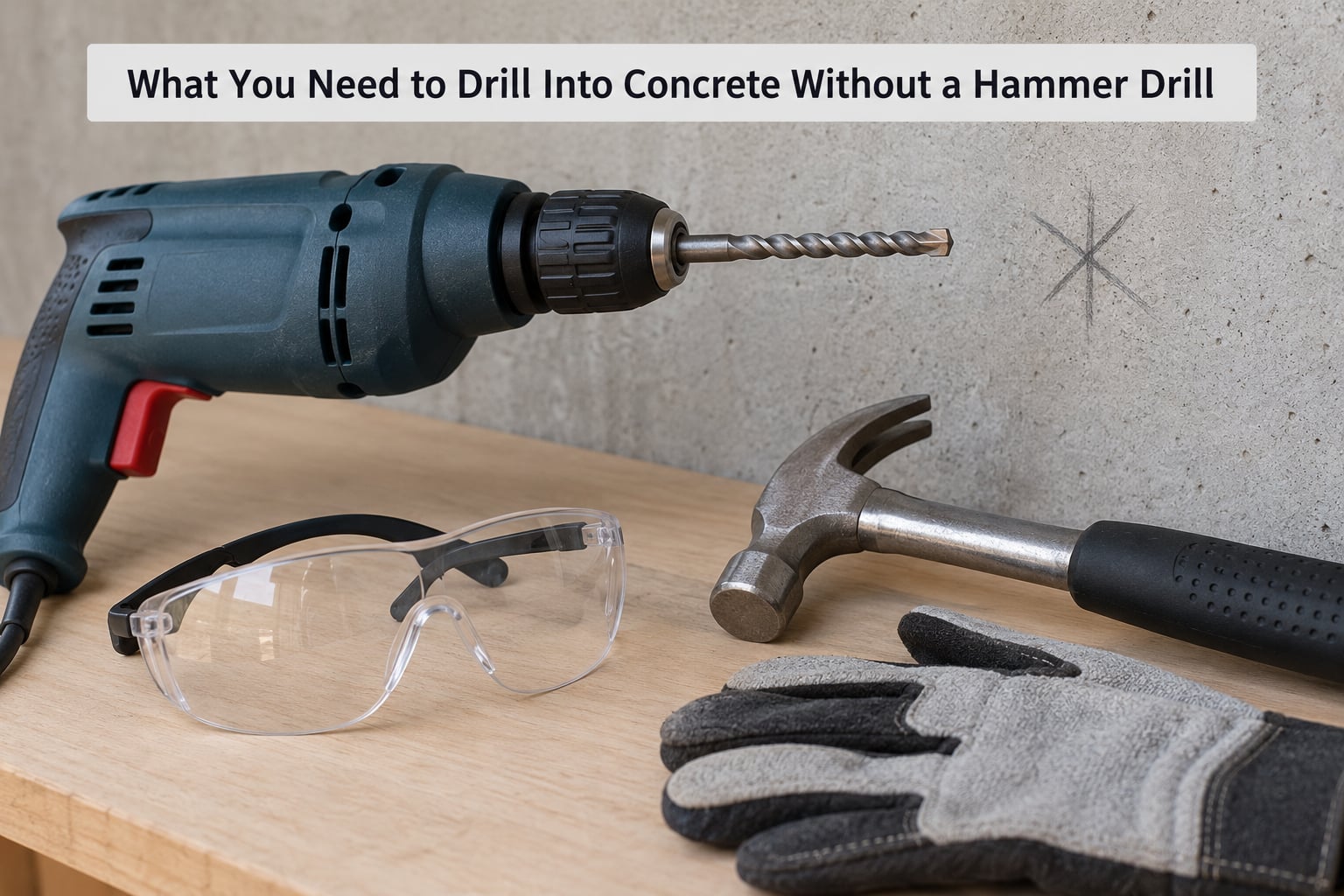
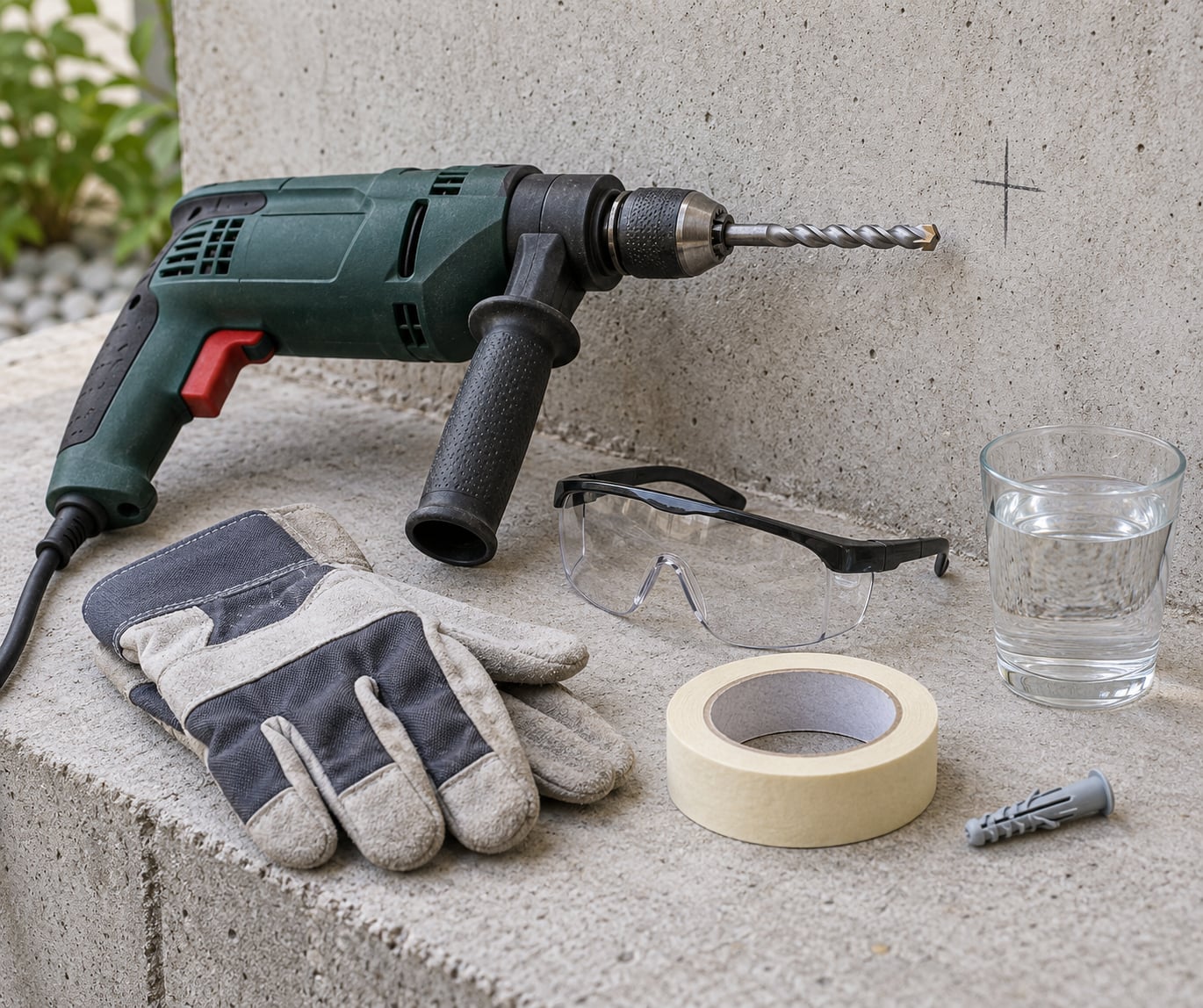
Five things cover almost every job you will run into:
- A standard corded or cordless drill with a variable speed trigger and, ideally, a two-speed gearbox. The low gear is the one you want for concrete.
- A carbide-tipped masonry bit in the diameter your anchor calls for. For 1/4 inch Tapcon screws, most people use a 3/16 inch bit.
- A cup of water and a rag, for cooling the bit on longer holes.
- Masking tape and a marker to mark the location and stop the bit from skating.
- Safety glasses, hearing protection and a P100 respirator, plus a brush or shop vac to clear the dust.
Rotary drill or hammer drill, and what the difference actually is
A rotary drill — that is what a drill without a hammer setting is — spins the bit and does nothing else. A hammer drill adds a rapid impact action on top of the rotation, and the hammer is what actually breaks the concrete. That impact is why a hammer drill cuts 1/4 inch concrete in seconds while a rotary drill grinds for minutes.
Some people call a rotary hammer an SDS drill. Those are different: an SDS rotary hammer uses a different bit shank and a much higher impact rate, and it is the right tool for rebar and sustained work rather than for two or three holes in a basement wall.
Can an impact driver or a multi-tool do it?
An impact driver will not drill concrete. Its impact action is built for driving screws, and it has no adjustable clutch or a chuck that takes a 3/16 inch masonry bit cleanly. An oscillating multi-tool with a carbide blade or a half-round blade can scrape a shallow notch in concrete, which is occasionally useful for cutting a recess, but it is not a substitute for a drilled hole.
Whether to buy or borrow
If you already own a drill with a two-speed gearbox, you do not need to buy anything for a small job. If you are facing more than about eight holes, or holes larger than 3/8 inch, borrowing a hammer drill for a weekend is usually faster than buying a second drill you will use twice.
Step-by-Step
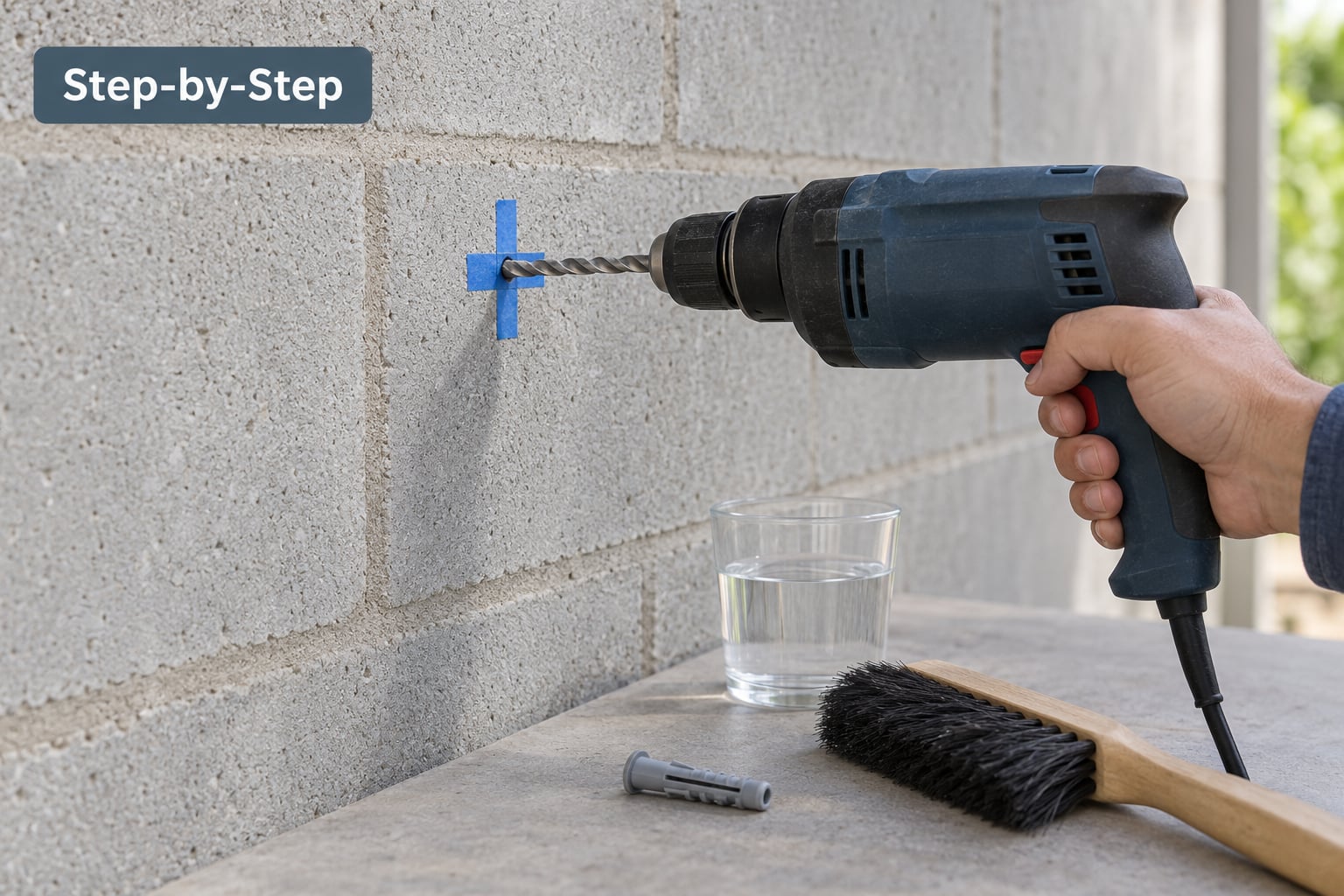
How to Drill Into Concrete Without a Hammer Drill
- Mark the spot. Put a piece of masking tape on the wall and mark the exact centre with a marker. The tape gives the bit a grippy surface and a visible target instead of bare concrete.
- Fit the masonry bit. Chuck it tight by hand. A loose bit on a rotary drill is the main reason the hole ends up oval.
- Start the hole at low speed. Use the low gear or hold the trigger just barely in. Set the drill square to the wall with your wrist, not your shoulder.
- Apply steady moderate pressure. Push firmly and evenly. Leaning on it hard does not speed anything up, it just heats the bit and your drill motor.
- Drill in bursts and cool the bit. Run about ten seconds, pull the bit out, dip it in water, and go again. This is the step that keeps the carbide tip alive and it is the one most people skip.
- Clear the dust every few inches. Withdraw the bit fully and brush or blow the powder out, then re-enter the hole. A hole packed with slurry will not hold a fastener properly.
- Stop 1/4 inch deeper than the anchor. That extra depth gives the anchor room to expand and keeps you from bottoming out on the fastener.
How do you know it is working? The sound changes from a high grind to a lower crunch, the dust turns from a dry powder to a wet grey slurry, and the bit advances at a steady pace. If the bit is screaming, smoking or not moving, stop.
Use a Rotary Hammer or Cordless Multi-Tool Instead
Here is the honest decision rule, because the forums are split on this and both sides are partly right.
| Tool | What it does to concrete | Buy or borrow it when |
|---|---|---|
| Regular drill (rotary) | Grinds it slowly, bit gets hot fast | A few small holes under about 3/8 inch in non-reinforced concrete |
| Impact driver | Nothing useful, screw-driving torque only | Never for drilling concrete |
| Hammer drill | Impact plus rotation, fast and smooth | More than about eight holes, or anything over 3/8 inch |
| SDS rotary hammer | High impact rate, designed for concrete | Rebar, dense concrete, repeated or large holes |
| Oscillating multi-tool | Shallow scraping notch only | Recesses and cutouts, not holes |
A regular drill earns its place on light-duty work: hanging a shelf on a basement wall, a picture frame, a small handrail bracket. It loses badly on dense concrete, holes larger than a half inch, or any wall you suspect is reinforced.
For a real reference point, one r/Tools user with two non-hammer drills drilled a 3/16 inch by 3 inch hole into a poured basement wall with a masonry bit in roughly 30 seconds on speed 1, then repeated the same hole in about 5 seconds with a hammer drill on speed 2. That six-fold gap is the whole argument in one number.
Choose the Right Bit for the Job
Do not use a standard wood or metal twist bit. Those will dull or snap almost immediately on concrete and can leave a mess of chipped face around the hole.
What that bit is doing matters more than most beginners realise. A wood bit has two spiral flutes that scoop out fibres; run one on concrete and the flutes fill with grit, the cutting edges burn, and the bit usually snaps at the shank. A masonry bit has a solid shaft with a carbide chisel tip brazed at the head, and nothing to scoop. It grinds instead, and grinding concrete is slow, hot and expensive to get wrong.
That carbide tip is also why the low gear matters. High speed spins the tip faster than it can cut, which raises friction temperature without removing any more material. Low speed plus firm, constant forward pressure lets the tip do the work. On a single-speed drill, feather the trigger and pulse it instead of holding the trigger wide open.
| Fastener | Masonry bit diameter |
|---|---|
| 1/4 inch Tapcon or concrete screw | 3/16 inch (5/32 inch for a snug fit in softer concrete) |
| 3/8 inch Tapcon or concrete screw | 1/4 inch |
| Plastic expansion anchor | The diameter printed on the anchor carton, usually 1/4 inch |
| Hollow wall anchor in block cavity | Match the anchor body, often 1/4 inch |
| Conduit or pipe pass-through | 1 inch to 2 inch hole saw or annular bit |
Hole saws and annular bits for larger openings need more power than a rotary drill can give, and they cut far better with a hammer drill. Save those for when you have borrowed one. Annular bits hollow out an annulus and leave a core you break out, which is why an electrician running conduit on a rotary drill will fight the whole job.
Some multi-tools take a carbide-grind or a carbide-saw attachment, and a carbide-grind head does let you widen or clean up a hole without a hammer drill. It is fiddly, it needs a steady hand and a lot of patience, and it is a rescue move rather than a first choice.
Concrete age matters more than most beginners expect. Concrete is soft and easy to drill for the first few days, noticeably firmer after a month, and decades-old cured concrete is close to its hardest. A residential basement wall from the eighties often has no coarse aggregate at all, which is why it drills far faster than a commercial slab.
Mark, Drill, and Check the Hole
Mark the location in a cross, not a dot, so you can recenter. Put tape over it and score the centre with a nail or the tip of the bit at low speed. This is your defence against bit walk, the skating movement that happens because a sharp carbide tip on smooth concrete has almost nothing to grip.
If the bit starts to wander, pull out and correct before it chews a cone-shaped divot. Hold the drill perpendicular and back the bit out to the surface, reposition, and re-enter at the mark. You can also drill a shallow pilot hole with a smaller bit first when the wall is thin or the surface is polished.
For depth, wrap a strip of tape around the bit at the required distance from the tip as a stop, or use the collar on a drill depth accessory. Drill a quarter inch past the anchor length and no deeper.
Concrete block is the case that catches people. Standard block has hollow cores with solid webs and dividers between them. Aim for a divider when you can and use a screw; if you land in a cavity, switch to a hollow wall anchor sized to the hole, or move a few inches and try again.
Inspect the hole before you load it. It should be round, clean out to the depth you need, and free of slurry. Brush it out, then a quick blow with the drill’s own exhaust at low speed clears the last of it. Seat the fastener by hand first to confirm it starts straight.
Common Mistakes
Using a wood or metal bit. It will dull or break on contact, and it may chip the face of the wall while it happens.
Forcing the drill. Extra force on a rotary drill generates heat, not penetration. It overheats the carbide tip, strains the motor and can snap the shank.
Drilling at an angle. A tilted bit makes a hole that is wider on one side and will not hold an anchor square. Fix your wrist and watch the bit, not the back of the drill.
Ignoring what is inside the wall. Electrical conduit, plumbing and radiant heat lines run through poured concrete, and rebar or post-tension cables run through structural slabs. Before drilling an interior floor or a wall you have not seen opened up, use a detector or map the runs. Hitting a live post-tension cable is a structural emergency, not a project.
Letting the dust go. Drilling into the surface without pulling the bit out every few inches packs the hole with slurry and glazes the bit.
Holes that are too small or too shallow. An undersized hole will not admit the anchor, and a shallow one leaves the fastener bottoming out instead of expanding. Also keep holes well separated; a row of closely spaced holes weakens the concrete more than the anchors you are hanging.
Safety and Dust-Control Tips
Concrete dust contains crystalline silica, and the fine fraction that drilling produces is exactly the part you do not want to breathe. Wear a P100 or better respirator, not a paper mask, and put on safety glasses before you pick up the drill.
Do not blow concrete dust out with a compressor indoors. It puts the respirable fraction straight into the air you are standing in. A brush, a shop vac, or wet the hole and wipe it out instead.
Work outside or in a well-ventilated space, keep other people out of the area while drilling, and open a window when you are working in a basement. A plastic sheet hung over the work area keeps most of the powder on one side of it.
Hearing protection matters more than people expect, because a few minutes of drilling is loud and a small hole is not a loud job. Wear gloves to keep grit out of your hands, and check that the chuck is clear of your fingers and clothing before you pull the trigger.
Set your feet so the drill is supported by your body rather than your arms for a long hole. Nobody has ever finished a basement wall faster by bracing a spinning masonry bit with a pinched hand.
Frequently Asked Questions
Can you use a regular drill to drill in concrete?
Yes, for a small number of holes in non-reinforced concrete. Use a carbide-tipped masonry bit, run the drill on its low speed setting, apply steady moderate pressure, drill in about ten-second bursts and dip the bit in water between bursts, and pull the bit out every few inches to clear dust. Expect it to take roughly twice as long as a hammer drill and to wear the bit faster.
What can I use instead of a hammer drill?
For a handful of small holes, a standard corded or cordless drill with a two-speed gearbox and a carbide masonry bit is enough. For more than about eight holes, anything over 3/8 inch in diameter, or concrete you suspect is reinforced, borrow or buy a hammer drill instead. An impact driver will not drill concrete at all, and an oscillating multi-tool can only scrape a shallow notch.
Can you screw directly into concrete?
Not reliably by hand, and a self-drilling concrete screw still needs a correctly sized hole in most cases. Drill a hole matched to the screw diameter, usually 3/16 inch for a 1/4 inch Tapcon, clean out the dust, and drill 1/4 inch deeper than the screw is long. The expansion happens in that hole, not in the concrete itself.
Why won’t my masonry bit go through concrete?
The usual causes are the wrong bit, a dull or snapped carbide tip, too much speed, or a stone in the concrete. If you are on high speed, switch to low. If the bit is dull or overheating, dip it in water and let it cool before continuing. If progress stops suddenly and the bit deflects, you have likely hit aggregate or rebar, and you should stop and find a new spot rather than push.
Can you drill into concrete with an impact driver?
No. An impact driver delivers high torque at low speed for driving screws, and it cannot hold a masonry bit the way a keyed chuck can, nor does it have the adjustable speed range a rotary drill needs. Use it for driving the Tapcon screw once the hole is drilled, and use a drill or hammer drill to make the hole.
Do you need water to cool a masonry bit?
Water matters most on deeper holes and in hard concrete, where friction alone will burn the carbide tip away. The simple method is to drill about ten seconds, pull the bit out, dip it in a cup of water, and repeat. You can also pause and let the bit cool, but dipping is faster and keeps dust down while you are at it.
Conclusion
Start by identifying the fastener, because it dictates everything else. A 1/4 inch Tapcon wants a 3/16 inch carbide masonry bit, and a regular drill on low speed with steady pressure and a water dip every ten seconds will make that hole in a couple of minutes on light-duty work. Drill 1/4 inch deeper than the anchor, clear the dust, and seat the fastener by hand to check it is straight. If you are drilling more than a few holes, or the wall is reinforced, borrow a hammer drill for the weekend and save your rotary drill for wood and drywall.