A dog food label is not a mystery, it is a regulated document with eight required parts. Once you know which panel answers which question, you can read any bag in about ninety seconds and stop guessing from the front of the package. That is the whole promise of learning how to read a dog food ingredient label: the bag tells you more than the marketing intends, if you know where to look.
Below is the same seven-step routine I walk owners through, with the parts that trip people up (fresh meat listed first, guaranteed analysis numbers, the product name rules) explained in plain language. No brand is better than another here, and nothing replaces your veterinarian for medical or diet-specific questions.
Table of Contents
- What You Need
- Step-by-Step: How to Read a Dog Food Ingredient Label
- Check the Nutritional Adequacy Statement First
- Read the Ingredient List by Weight
- Separate Required Nutrients From Added Ones
- Calculate the Real Calorie and Feeding Picture
- Evaluate Marketing and Health Claims
- Check Directions, Storage, and Manufacturer Details
- Mistakes to Skip at Each Step
- Common Mistakes
- Frequently Asked Questions
- In what order are ingredients listed on a dog food label?
- What is the 95 percent rule in dog food?
- What is the 80/20 rule for dog food?
- Is a shorter ingredient list better for dogs?
- Are grain-free dog foods better than foods with grains?
- Which ingredients should you actually stay away from in dog food?
- Conclusion
What You Need
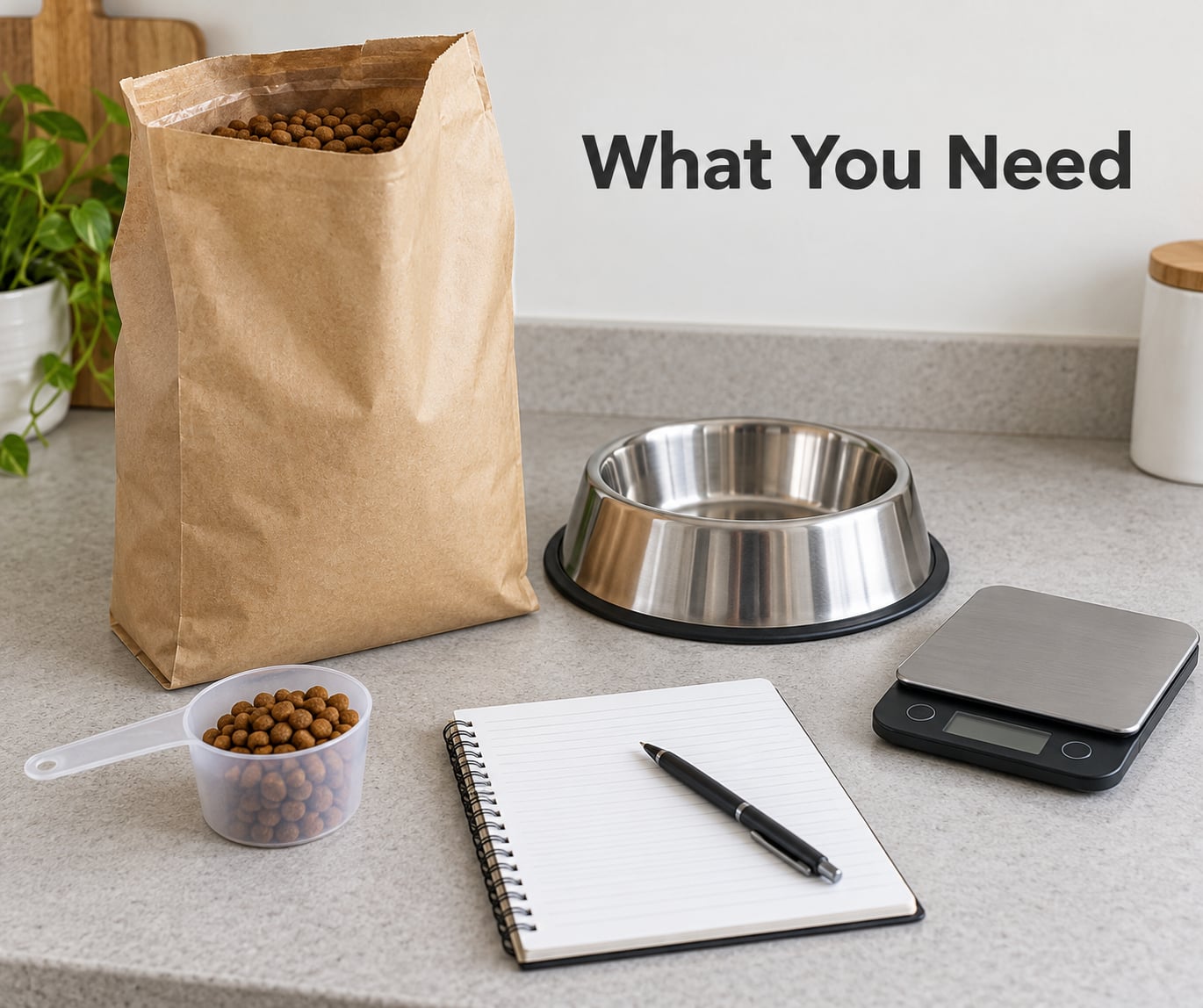
You need the physical bag, ideally unopened and not faded, because part of the required information sits on the back and bottom panels where sunlight ruins it. Photo of the side panel usually works for the ingredient list, but get the whole bag if you can.
You also need four numbers about your dog: age, current weight, body condition, and any health condition or dietary restriction. Without those, the label is just a list. With them, it becomes a feeding decision. If your dog is on a prescription or elimination diet, bring that information to your vet before changing anything.
A kitchen scale and a notebook help more than people expect. Write down the calorie count per cup for each food you consider, and the date you started, because the real test of a food is what your dog’s weight and stool look like after four weeks.
One more thing: compare identical package sizes when shopping. A 30 pound bag and a 5 pound bag of the same recipe are not the same deal once you price them per pound, and the bigger bag only saves money if the food is eaten before it goes stale.
Step-by-Step: How to Read a Dog Food Ingredient Label
Read the back panel from top to bottom in this order: the nutritional adequacy statement, the ingredient list, the guaranteed analysis, the calorie content statement, the feeding directions, then the manufacturer information. That order matters. Each panel answers a different question, and reading them out of sequence is how people end up with conclusions the label never supported.
| Label element | What it tells you | What it does not tell you |
|---|---|---|
| Product name | How much of a named ingredient the food contains, under AAFCO naming rules | Nothing about overall quality or digestibility |
| Statement of intended use and life stage | Whether the food is meant for growth, adult maintenance, or both | Whether it suits a specific medical condition |
| Nutritional adequacy statement | Complete and balanced, formulated to meet a nutrient profile or feeding trial tested | That the food is right for your individual dog |
| Ingredient list | Names of ingredients in descending order by pre-processing weight | Exact amounts of any single ingredient |
| Guaranteed analysis | Minimum protein and fat, maximum fiber and moisture | Digestibility, amino acid quality, or vitamin levels |
| Calorie content statement | Kilocalories per kilogram and often per cup | How much your dog needs; that is a separate calculation |
| Feeding directions | The manufacturer’s starting portion in cups per weight range | A finished portion for your dog’s body condition |
| Manufacturer name and address | Who made it and how to contact them or verify a lot code | Anything about the food itself |
Those eight elements are required by the US Food and Drug Administration, which sets pet food labeling rules under 21 CFR, and by the Association of American Feed Control Officials (AAFCO), the group of state feed control officials whose model regulations most states follow. Know the two names, because a lot of what circulates online is one person’s opinion dressed up as regulation.
Check the Nutritional Adequacy Statement First
Start here, before anything else. The nutritional adequacy statement tells you whether the food is complete and balanced for a stated life stage, and whether that claim comes from formulation against a nutrient profile or from a feeding trial. A treat, a topper, or a food labeled complementary does not carry that statement, which is why it cannot replace a meal.
Four phrases cover almost every bag you will meet: growth, which is for puppies and kittens; adult maintenance; all life stages, which covers both growth and adult maintenance; and intermittent feeding, which is a topper, not a meal. A bag that says nothing about life stage is telling you it is a complementary product.
Two other things fall out of this one line. Life stage has to match your dog, so a maintenance formula is not the right choice for a growing puppy, and a puppy formula is calorie-dense in a way most adult dogs do not need. And complete and balanced is a legal claim with a defined meaning under AAFCO, not a quality judgement, so a food can carry it and still be a poor fit for the dog in front of you.
Read the Ingredient List by Weight
Ingredients are listed in descending order by weight as they exist in the finished food, measured before cooking. That means the first ingredient weighs more than the second before heat and moisture are removed, and the order tells you proportion before processing, not what ends up in the bowl.
So does chicken listed first mean the food is mostly chicken? Not necessarily, and this is where most people get burned. AAFCO allows a fresh ingredient such as fresh chicken to be listed first when it is added to a food primarily for palatability, up to about ten percent of the product weight. A bag can legally lead with fresh chicken and still be built on a rendered chicken meal further down the list. Compare it the other way and the picture flips: chicken meal absorbs far less water than fresh chicken, so a food listing meal first is often heavier in actual chicken protein.
What the first three ingredients should tell you is narrower than most people expect. Look at whether the first three are animal protein sources, whether water appears among them, and whether you recognize every name. Do not try to derive a percentage, because the label will not give you one outside the product name rules.
- If water is the second or third ingredient, the food is largely wet, whatever the kibble shape suggests.
- If the third ingredient is a grain or a named vitamin compound, the recipe is more plant-forward than the product name implies.
- If you cannot identify an ingredient, look it up in the AAFCO public ingredient database rather than guessing.
- If the list is fifteen items long and the third one is chicken meal, that is not filler, it is concentrated protein.
One more myth to drop before you move on. A shorter ingredient list is not a better ingredient list. Owners repeat this constantly on breeder forums and dog food boards, and it comes from reading human food packaging, where additives are counted. A complete and balanced dog food with a long, unrecognizable list and a clear adequacy statement is a better bet than a short list that says nothing about life stage. What matters is whether the nutrients are guaranteed, not how many words are printed.
Separate Required Nutrients From Added Ones
The guaranteed analysis looks like a nutrition panel but behaves differently from one, because the numbers are legal promises rather than averages. Crude protein and crude fat are guaranteed as minimums, and crude fiber and moisture are guaranteed as maximums. That asymmetry is the part people miss, so read it carefully.
A minimum tells you the food contains at least that much, which means the real value could sit anywhere above it. A maximum tells you the food contains no more than that, which means the real value could sit anywhere below it. A food listing 30 percent crude protein is promising at least 30, and dry foods commonly land well above their own minimums. Comparing two labels by minimum protein alone flatters whichever brand set the lower bar.
| Guaranteed analysis line | Example value | Guaranteed as | How to use it |
|---|---|---|---|
| Crude protein | 28% | Minimum | Compare foods on dry matter, not on the raw number |
| Crude fat | 16% | Minimum | A floor on energy density from fat; check calories too |
| Crude fiber | 4.5% | Maximum | A ceiling, useful for dogs needing a lower residue diet |
| Moisture | 10% | Maximum | Explains why the same protein number means different things in wet food |
| Dry matter | 90% | Calculated | Moisture subtracted, the only fair basis for comparison |
Protein, fat, fiber, vitamins, minerals, and water all come from somewhere, and a label can deliver them two ways. Naturally present nutrients arrive with the ingredients, while added vitamins and minerals show up as a premix or as individual chemical names, usually clustered near the end of the list. Preservatives are similar: mixed tocopherols, which are vitamin E, or BHA and BHT, which are synthetic, both keep fat from going rancid, and neither one tells you anything good or bad about the recipe.
Here is the limit of the panel. It does not tell you protein quality, digestibility, vitamin amounts, or whether the food contains a specific allergen you are worried about. It is a coarse screen, and the calorie statement is the one that changes portions.
Calculate the Real Calorie and Feeding Picture
The calorie content statement gives kilocalories per kilogram, and many brands add kilocalories per cup or per can. This is the number that turns a food into a daily quantity. The feeding directions on the back are a starting estimate by weight range, and the calorie line is what lets you check that estimate against a target from your vet.
Compare foods on dry matter, because moisture is a huge variable. A wet food showing 9 percent crude protein is not low protein, it is 9 percent of a food that is roughly 80 percent water, which works out to about 45 percent protein on a dry matter basis. The same arithmetic on a dry food with 10 percent moisture makes the number much smaller. Two labels that look wildly different often are not.
| Food | Calories per cup | Calories per kg | Moisture | What it means for portions |
|---|---|---|---|---|
| Standard dry kibble | about 400 | about 3,600 | about 10% | A dense cup, so volume portions are small |
| High fat dry kibble | about 550 | about 4,000 | about 8% | Same cup, roughly a third more calories |
| Wet pate | about 250 per 5.5 oz can | about 900 | about 80% | Small volumes, many cans, easy to overfeed |
Now the arithmetic, using round numbers only as an illustration. If your vet sets a daily target of 750 calories, a food at 250 calories per cup gives three cups. Move to a food at 420 calories per cup and the same target is under two cups. Same dog, same target, a third less food, and the only reason you knew was the calorie line. Treats count inside that total too, and most labels suggest keeping them under about ten percent of daily calories.
That is a math exercise, not a diet plan. Weight goals, weight loss plans, puppy growth rates, and any condition involving kidneys, liver, urinary health, or food allergy are veterinary decisions, and the label gives you the numbers to bring to that appointment.
Evaluate Marketing and Health Claims
AAFCO also regulates how ingredients are named in the product name itself, which is where most of the front-of-bag claims get their structure. Four rules cover the language you see in stores.
| What the bag says | AAFCO rule | Minimum named ingredient share | What it actually means |
|---|---|---|---|
| A single animal named, such as Chicken | 95 percent rule | 95% of total weight | The food really is mostly that ingredient |
| Chicken dinner, Chicken entree, Chicken platter | 25 percent rule | 25% of total weight | A qualifying word drops the requirement sharply |
| With chicken and brown rice | WITH rule | 3% of total weight | A garnish-level mention dressed up as a feature |
| Chicken flavor | Flavor rule | 2% of total weight | Present for taste, not nutrition |
Add a fresh ingredient named first and the whole calculation shifts again, because of that ten percent palatability allowance. A product name is a legal threshold, not a nutritional profile, and it says nothing about the food beyond that one ingredient.
Then there are the words with no legal definition at all: premium, gourmet, holistic, and similar quality language carry no standard, and any manufacturer may use them. Natural does have a definition in AAFCO’s model rules, but it is narrow, referring to materials that are not processed or made synthetic, and it says nothing about nutritional adequacy. Organic follows USDA rules for human food, and human-grade is not a term with a regulatory definition. Grain-free describes the absence of grains and says nothing about the quality of the protein replacing them.
For any claim tied to a health condition, your veterinarian is the only reliable reader. The label cannot tell you a food is right for a dog with a diagnosed condition, and a food that suits one dog may be a poor choice for another in the same household.
Check Directions, Storage, and Manufacturer Details
Feeding directions give cups per day by weight range, and they are a starting point that assumes an average body condition. Adjust from there using your dog’s actual weight trend, not the chart. When you switch foods, transition over about a week by mixing increasing amounts of the new food, and go slower for dogs with sensitive stomachs.
The bottom of the bag carries the manufacturer name and address, which you can use for real questions: full ingredient list including the sub-ingredients of any premix, the dry matter calculation, and the feeding trial protocol if the food claims to be feeding trial tested. Brands often publish a longer list online than the panel shows, because the panel is the regulated version.
Look for a lot code as well. It usually carries a plant code, a year and a day of the manufacturing cycle, and it is what the FDA Center for Veterinary Medicine uses in recall notices. If you want to go further, the AAFCO public ingredient database explains unfamiliar ingredient names, and the FDA recalls and withdrawals listings let you check a specific product before you buy a large bag.
Finally, storage. Follow the package, whatever the reason. A bag that says to keep the food in its original bag away from heat is telling you that light and heat degrade the fats and the added vitamins, and that a food opened and left on a counter for a month is not the food the panel describes.
Mistakes to Skip at Each Step
- Skipping the adequacy statement and starting with the ingredients. If there is no statement, nothing else on the label is a complete diet.
- Reading the ingredient list as if it were a recipe with percentages. It is an ordered list of names, nothing more.
- Comparing guaranteed analysis numbers between a dry and a wet food without doing the dry matter math.
- Believing the product name is a quality statement. It is a percentage threshold and nothing more.
- Portioning straight from the feeding chart when the dog is not at average body condition.
- Buying the largest bag before checking the lot code and the recall history.
- Throwing out the bag after it is open, which removes the storage, lot, and manufacturer information you may need later.
Common Mistakes
These are the errors that show up again and again, and each one has a practical fix.
- Judging the food by the first ingredient alone. Fix: read the first five, check whether water appears, and remember the fresh ingredient allowance of about ten percent.
- Assuming a short ingredient list means a better food. Fix: look for the adequacy statement and the guarantee instead, which is where nutrient adequacy is actually promised.
- Treating a treat, topper, or complementary food as a meal. Fix: if there is no nutritional adequacy statement, it is a supplement to the diet, not a replacement for it.
- Reading a named ingredient as a guaranteed amount. Fix: a name in the list is not a percentage. The only percentages on the bag come from the product name rules.
- Believing grain-free is automatically healthier. Fix: check the adequacy statement and the calories. Grain-free is a description, not a nutritional result, and it works against dogs whose vet recommends grains.
- Overlooking the calorie count and portioning by volume alone. Fix: convert cups to calories with the label number and compare against a target from your vet.
- Changing food overnight. Fix: transition over roughly seven days, and go slower for a dog with a sensitive stomach.
Two things outrank every line of packaging: your dog’s life stage, body condition, and medical history, and your veterinarian’s advice. Use the label to make those conversations specific, not to replace them.
Frequently Asked Questions
In what order are ingredients listed on a dog food label?
Ingredients appear in descending order by weight as they exist in the finished food, measured before cooking. So the first ingredient weighs more than the second before processing, but not necessarily more once water is removed. AAFCO also allows a fresh ingredient added for palatability, up to about ten percent of the product, to be listed first. The order tells you relative weight, not exact amounts.
What is the 95 percent rule in dog food?
The 95 percent rule comes from AAFCO product naming rules. When a specific ingredient such as chicken or lamb is named in the product name on its own, that ingredient must make up at least 95 percent of the product by weight. Add a qualifying word like dinner, entree, or platter and the requirement drops to 25 percent. A name preceded by with requires 3 percent, and an ingredient named for flavor requires about 2 percent.
What is the 80/20 rule for dog food?
There is no AAFCO rule called the 80/20 rule, and it does not appear in FDA pet food labeling regulations. The name comes from the wild diet idea that dogs eat about 80 percent meat and 20 percent plant material, and it circulates as a quality slogan. Use the label instead: check the adequacy statement, the first five ingredients, and the dry matter protein figure.
Is a shorter ingredient list better for dogs?
No. List length tells you nothing about nutritional adequacy, and it is a habit carried over from human food packaging. What matters is whether the food carries a nutritional adequacy statement for your dog’s life stage, whether protein and fat are guaranteed as minimums, and how many calories a cup contains. A long list with a clear adequacy statement beats a short list with neither.
Are grain-free dog foods better than foods with grains?
Grain-free describes what is absent, not what is present in its place, and it is not a nutritional result. Some dogs need grain-free diets for diagnosed allergies or digestive conditions, and for those dogs a veterinarian should be choosing. For healthy dogs, compare calories, protein on a dry matter basis, and the adequacy statement. Ask your vet before switching, especially if your dog has urinary issues.
Which ingredients should you actually stay away from in dog food?
Skip the label on a single scary-sounding name, because most ingredients flagged online are regulated and appear in complete and balanced foods. The practical exceptions are ingredients your own dog reacts to, a food with no nutritional adequacy statement, and a product making a disease claim without veterinary direction. Bring the bag to your vet, who can weigh a real risk against your dog’s history instead of a list on the internet.
Conclusion
Start at the nutritional adequacy statement, then read the ingredient list knowing that fresh ingredients can lead the list, then convert calories per cup into an actual daily number using a target from your veterinarian, and check the feeding directions and lot code before you buy. Those four panels together tell you almost everything a label can tell you. Choose with your dog’s life stage, body condition, and health history in front of you, and let the front of the bag stay where it belongs: on the shelf.