Most healthy adult dogs need a full bath about every 4 to 12 weeks, but that range only sets a starting point. Coat type, activity level, season, skin condition and plain old odor all move the schedule in one direction or the other, so the honest answer to how often should you bathe a dog is: often enough to keep the skin clean, rarely enough to keep the oils on it.
There is no calendar that fits every dog. A hairless Shar-Pei and a long-haired Basset Hound do not share a schedule, and neither does a sedentary indoor dog compared with a hunting dog that works in wet fields. What follows is how to work out the interval for your specific dog, plus the signs that tell you the balance has tipped too far in either direction.
This is general care guidance, not a substitute for your veterinarian. Anything involving a skin condition, parasites, wounds or prescription products belongs with a vet.
Table of Contents
- How Often Should You Bathe a Dog? Quick Answer
- How often should you bathe a dog by age and lifestyle?
- Bathing Frequency by Coat Type and Condition
- Signs Your Dog Needs a Bath
- Signs You Are Bathing Your Dog Too Often
- How to Bathe a Dog Without Causing Stress
- When to Ask Your Veterinarian About Bathing
- Frequently Asked Questions
- Can I use human shampoo on my dog?
- Can I bathe my dog with baking soda or vinegar?
- How often should I bathe a dog after a walk or trip to the dog park?
- Should I blow-dry my dog after a bath?
- How do I bathe a dog that is afraid of water?
- What to Do First
How Often Should You Bathe a Dog? Quick Answer
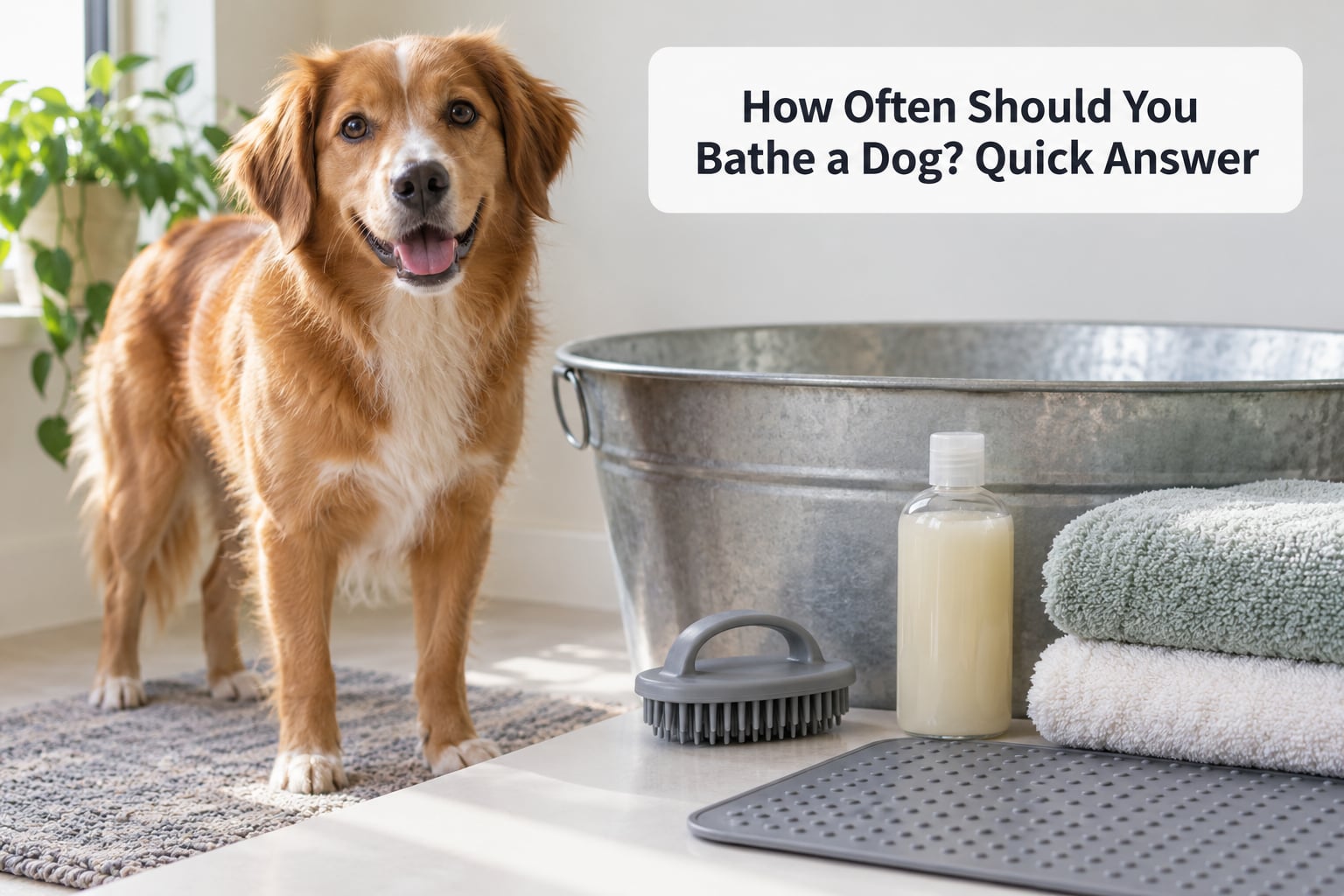
For a healthy adult dog with no skin problems, most veterinary and groomer guidance points to somewhere between every 4 weeks and every 3 months. Short-haired indoor dogs usually sit at the long end. Curly, oily, wrinkled and hairless coats sit at the short end. An allergic dog on a prescribed shampoo may need baths two or three times a week, on veterinary instruction only.
Here is the short version:
- Short or smooth coat, indoor life: a bath every 8 to 12 weeks, more often if the dog sweats or wears booties indoors.
- Double coat or long hair: every 4 to 8 weeks, plus brushing several times a week on its own schedule.
- Curly or wool coat: every 4 to 6 weeks, because curls trap oil and moisture at the root.
- Wire coat: roughly every 6 to 10 weeks, with regular towel-drying after wet walks.
- Oily or wrinkled coat: every 1 to 2 weeks, and the folds need cleaning far more often than the whole dog.
- Hairless or skin-exposed breed: every 7 to 10 days, since there is no coat to absorb oil.
- Medically managed dog: whatever schedule your veterinarian set, which may be several baths a week for a while.
Every one of those is a starting point. A dog who swims daily, sleeps in your bed or works in mud needs more than the number says. A dog who is perfectly clean and comfortable does not need a bath just because the calendar said so.
| Dog type or situation | Typical starting interval | What drives it |
|---|---|---|
| Clean, inactive indoor dog | Every 8 to 12 weeks | Little dirt, healthy oil production, dry indoor air |
| Active or outdoor household dog | Every 2 to 4 weeks | Daily walks, yard play, grass and pollen pickup |
| Hunting, farm or service dog | Rinse after every outing, full bath weekly or more | Repeated mud, water, scent and physical contact |
| Long-haired or double-coated breed | Every 4 to 8 weeks | Dense coat holds water and dead hair near the skin |
| Curly-coated breed such as a poodle or doodle | Every 4 to 6 weeks | Curls trap oil and damp close to the skin |
| Oily-coated or wrinkled breed | Every 1 to 2 weeks | Sebaceous glands and skin folds stay greasy and damp |
| Hairless breed | Every 7 to 10 days | Oil and dirt sit directly on exposed skin |
| Dog with allergies, infection or seborrhea | Set by your veterinarian | Treatment plan, medicated shampoo and contact time |
How often should you bathe a dog by age and lifestyle?
Puppies are the exception to everything. Their skin is more delicate, many have not finished their first vaccination course, and a bath is a big new experience, so keep sessions short, warm and forgiving until the puppy is comfortable. Many people wait until the first adult coat comes in and then settle into something like monthly baths.
A dog you have just adopted deserves a pause too. Shelters often bathe animals heavily, sometimes with products not chosen for that skin. Let the coat settle for a couple of weeks, watch the skin, and only add a bath if it is actually dirty or irritated.
Senior dogs usually need less frequent bathing, not more. Their skin produces less oil, their coat is often thinner, and many have joint pain that makes the tub miserable. When an older dog does need a bath, spot cleaning with damp cloths often works better than lifting them in. Incontinence is common at that age, so the rear and bedding get cleaned daily even if the whole dog is bathed rarely.
Lifestyle is the biggest swing factor. A dog that lives alone indoors on a carpet can go far longer than one that swims in a lake every weekend. Owners I know tend to use their own comfort as the trigger rather than a number, and that is honestly fine as long as the skin stays clean.
Bathing Frequency by Coat Type and Condition
Coat type sets the baseline because it decides how fast oil and dirt get trapped against the skin. A short coat lets oils and shed hair fall away on their own. A dense double coat holds both, plus water, right next to the skin where they cause irritation.
| Coat type | Example breeds | Starting range | Watch for |
|---|---|---|---|
| Curly or wool coat | Poodle, Doodle, Portuguese Water Dog | Every 4 to 6 weeks | Curl mats at the ears, chin and tail base; damp patches that never dry |
| Double coat | Husky, Golden Retriever, Australian Shepherd, Collie | Every 6 to 10 weeks | Dense undercoat stays damp for days; heavy shedding twice a year |
| Wire coat | Dachshund, Terrier breeds, Wirehaired Vizsla | Every 6 to 10 weeks | Trapped moisture under the furnishings; dull, broken-feeling texture |
| Long silky or feathered | Cocker Spaniel, Shih Tzu, Afghan Hound, Papillon | Every 2 to 4 weeks | Mats behind the ears and in the feathered tail; eye and ear staining |
| Short or smooth coat | Beagle, Boxer, Dachshund smooth, Dalmatian | Every 8 to 12 weeks | Little natural resistance to odor; grease builds on the collar and bedding |
| Oily coat | Basset Hound, Shar-Pei, Chow Chow | Every 1 to 2 weeks | Greasy build-up at the neck and tail; yeast smell in skin folds |
| Hairless or skin-exposed | Chinese Crested, Xoloitzcuintli, American Hairless | Every 7 to 10 days | Acne, pimples and blackheads; no coat to protect the skin |
| Shedding-heavy coat | Labrador, Shiba Inu, German Shepherd | Every 4 to 6 weeks | Undercoat matting in the armpits and behind the ears during shed season |
No coat type decides this on its own. Two Labrador retrievers in the same house can be on completely different schedules, because one swims and one does not. Use the table to pick a starting point, then let what you find under the coat adjust it.
Signs Your Dog Needs a Bath
Owners usually ask for a reliable trigger instead of a date, and there are three physical checks that work far better than the calendar.
1. The smell test, in the right place. Odor is strongest at the shoulders, behind the ears and along the back of the neck, not at the tail where people usually check. Put your nose near the base of the collar and sniff. That is the smell other people notice first from across a room.
2. The grit test. Run your fingers down to the skin at the base of the coat, parting the hair. If you feel dirt, sand or sticky residue at the skin itself rather than on the surface, dirt has reached the part that shampoo can actually reach, and it is time.
3. The texture test. Feel the skin behind the ears and at the base of the tail. Slightly soft and warm is normal. Waxy, greasy or thickened means the coat has had longer than it should between baths.
Beyond those three, a dull coat that has lost its shine, visible soil in the paw pads or under the tail, and a dog who has stopped being huggable all point the same direction. Owners tell me the furniture test works better than any schedule: if the couch smells like the dog, the interval is too long.
Some situations override the schedule completely. Skunk, manure, paint, motor oil, road tar and similar substances need a bath today, no matter what the last one was. So does a dog who has been in a chlorinated pool or salt water, though a thorough fresh-water rinse usually handles it without a full bath. Mud to the elbows after a hike is often just a hose-down job.
At the other end, some messes do not need a bath at all. Paw dirt comes off with a plain-water rinse. A muddy belly can be spot cleaned. Grass stains on the coat usually wash out on their own over a couple of days, and spot cleaning with damp cloths handles a localized smell far better than a full bath.
Signs You Are Bathing Your Dog Too Often
A bath strips a thin layer of the natural oil, called sebum, that keeps the skin barrier sealed and the coat supple. That is not a catastrophe once. Done repeatedly, it leaves skin dry and vulnerable, and the result often looks like the problem you were trying to fix.
Warning signs of over-bathing:
- White flakes or dandruff along the back and shoulders that were not there before.
- Itching that starts a day or two after each bath, rather than before.
- A coat that feels straw-like or dull instead of soft.
- Hair that breaks off at the tips rather than shedding cleanly during brushing.
- Reddened patches, hot spots or skin that feels tender to the touch.
- Odor that returns unusually fast, sometimes within days.
Under-bathing produces a different set of signs, and comparing the two makes the direction obvious:
| Under-bathing looks like | Over-bathing looks like |
|---|---|
| Odor at the shoulders and collar | Flakes and dry scurf along the back |
| Grit and sticky residue at the skin | Itching that starts after the bath |
| Greasy, thickened skin in folds | A dull, straw-textured coat |
| Mats behind the ears and in the tail | Hair breaking instead of shedding |
| Skin irritated by trapped moisture | Redness and tenderness with no cause |
Itching that leads to scratching leads to bathing leads to more itching is a loop worth breaking deliberately. Return to a longer interval, switch to a soap-free moisturising shampoo, and brush more often. If the skin has not settled within a couple of weeks, book a vet visit rather than continuing to experiment at home.
How to Bathe a Dog Without Causing Stress
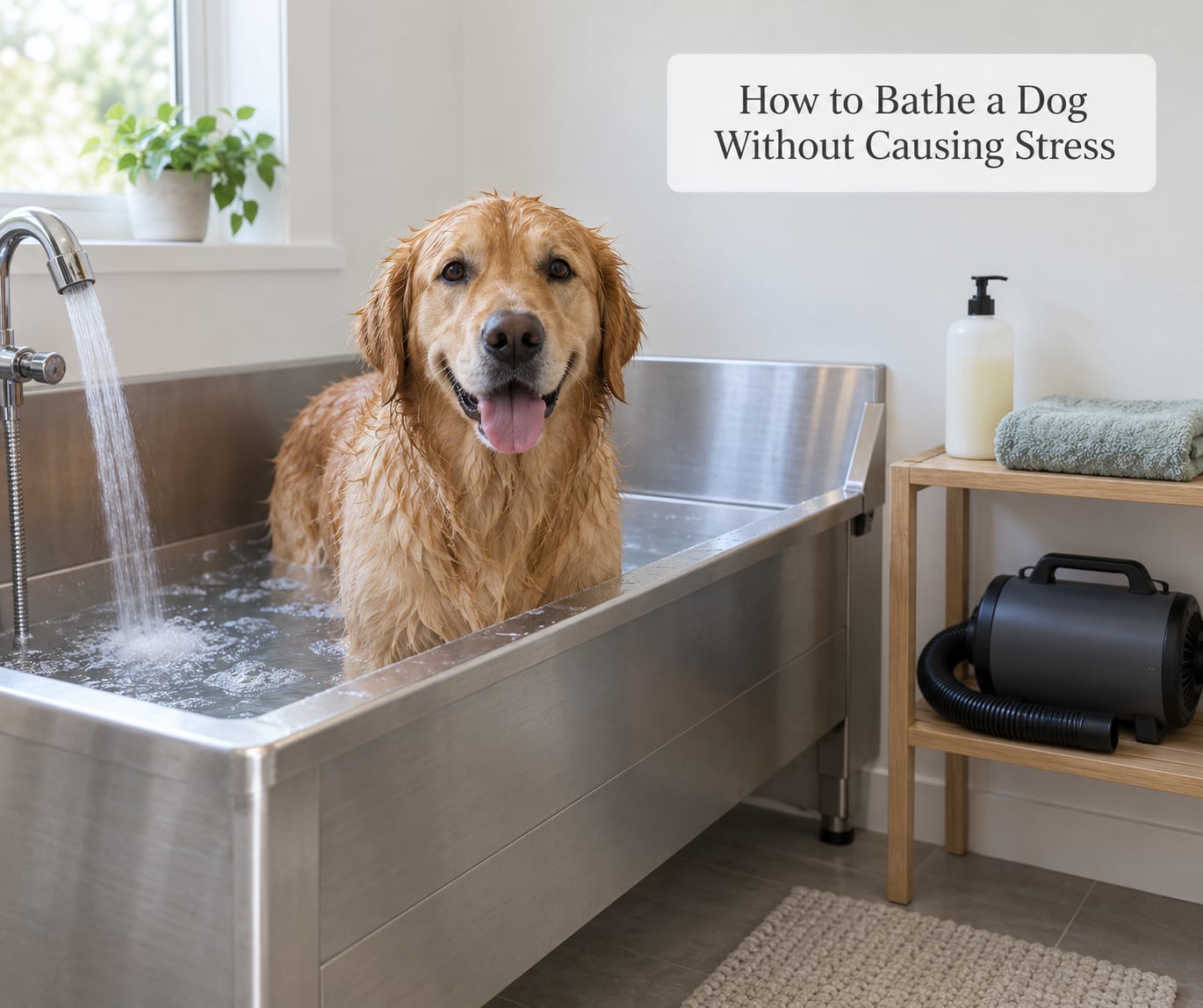
A bath that is rushed ends badly for everyone. Working through it in order takes longer once and much less time over the next two months.
Brush first. Full detangling before water goes on means you are not trying to pull knots tight under a wet coat, which is how most matting gets created. A slicker brush and a metal comb handle most dogs.
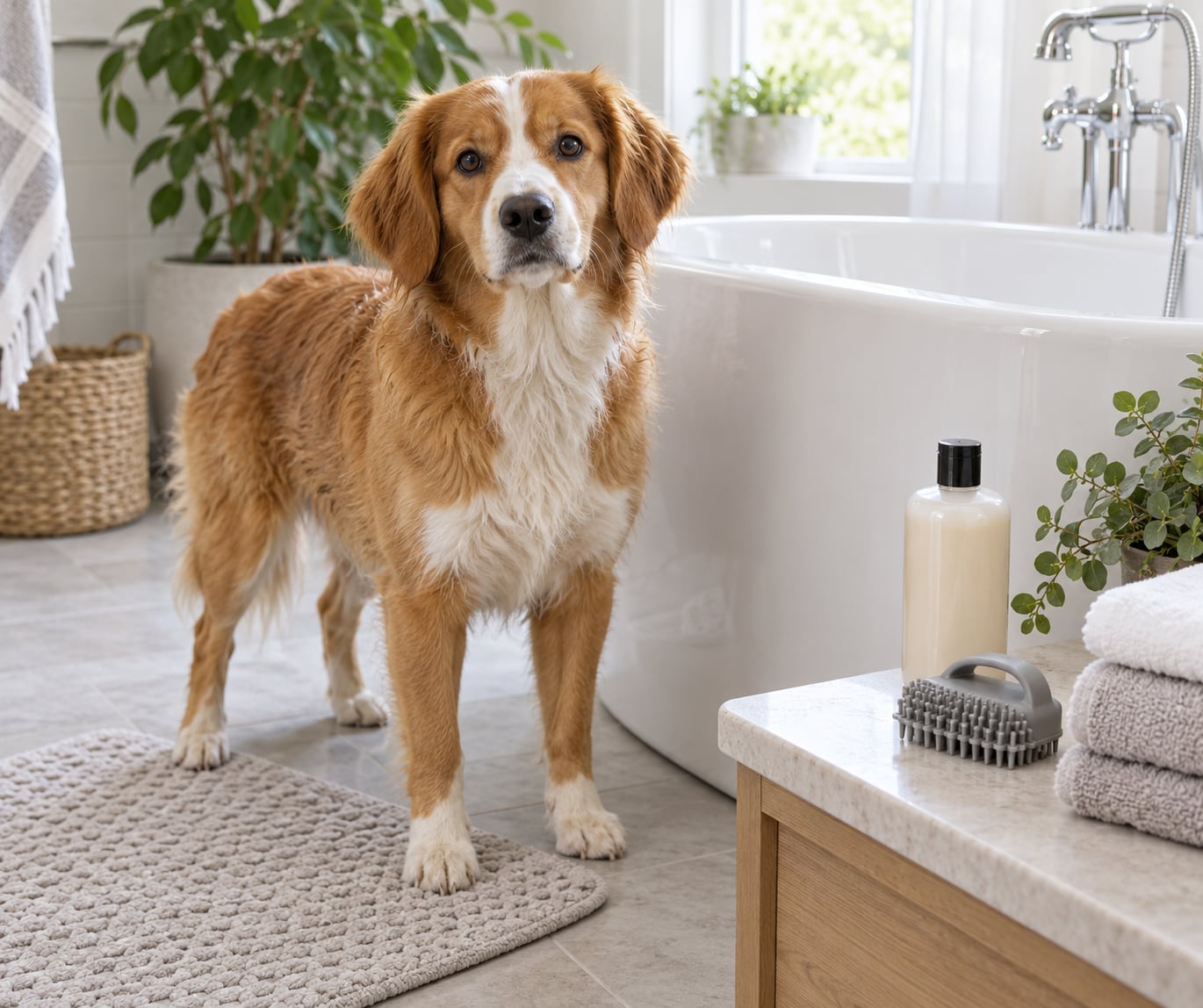
Set the water lukewarm and put down a non-slip mat. Test it on your inner wrist. Dogs tolerate a bath far better when they can stand without sliding, and a nervous dog needs to feel four paws on a solid surface before you turn the water on.
Wet to the skin, not just the fur. Work from the neck backward, letting water soak through the undercoat. Shampoo sitting on top of the coat does almost nothing.
Keep it out of the wrong places. Cotton balls loosely in the ears help, and a damp cloth handles the face better than a hose. Eyes and ears get protected by keeping the water low and the movements slow.
Rinse longer than you lathered. Leftover shampoo is the number one cause of post-bath itching. If the dog smells cleaner when you work through a section, you have not rinsed enough.
Dry to the skin. Towel blot, then air dry or use a dryer on a cool setting while you brush through. Double coats hide damp undercoat for days, and that trapped moisture is what causes hot spots.
Use dog shampoo. Human products are formulated for a different skin pH, and dish soap is harsh enough to strip a coat badly enough to need weeks to recover. Essential oils added to a home mix can be toxic to dogs, with tea tree and lavender oil being common examples. Never apply human medication, creams or topical treatments to a dog without asking a veterinarian first.
One warning nobody mentions often enough: a bath washes off topical flea and tick treatments. If your dog is on a spot-on or a medicated topical, check the label for reapplication timing after bathing, and tell your vet if the schedule changes. Bathing an untreated puppy younger than the product’s stated age is worth checking against the label too.
For a dog who is terrified of the tub, reduce the ask. Treats during the bath, a non-slip surface, lukewarm water and brushing beforehand all lower the stress. Do the face with a damp cloth and the paws in a shallow bowl rather than running a full bath. Many owners get there eventually by stopping while the dog is still relaxed, rather than pushing to the end of a session and ending on a note of fear.
When to Ask Your Veterinarian About Bathing
Some situations are not yours to schedule. Talk to a vet before you plan a bath if:
- You suspect fleas, ticks, mites or a skin infection. Medicated shampoo has a contact time of about 5 to 10 minutes before rinsing, and using it wrongly does nothing.
- Your dog has allergies or atopic dermatitis, which often needs a prescribed shampoo on a set schedule rather than a general one.
- There are wounds, sores, hot spots, lumps or bleeding. Water and shampoo in an open sore cause real problems.
- Your dog has seizures, a heart condition, arthritis or limited mobility, so lifting and handling carry risk.
- Bathing reliably triggers panic severe enough to injure you or the dog.
- Your dog is on a prescribed topical and you need to know how the schedule interacts with it.
Do not diagnose a skin problem yourself and do not apply human remedies. If itching, redness or odor persists after a couple of weeks of gentler care, make the appointment. A quick phone call to your vet is also reasonable before the first bath of a new routine, and for puppies or brand-new rescues, that is worth doing before the first bath ever.
Frequently Asked Questions
Can I use human shampoo on my dog?
Human shampoo is not formulated for dog skin, which is more acidic and has a thinner epidermis. Using it strips oils faster and can leave skin dry, flaky and itchy. Plain baby shampoo is gentler but still not a good long-term choice. Use a dog shampoo, ideally soap-free, and ask your vet which one suits your dog’s skin if it is sensitive or reactive.
Can I bathe my dog with baking soda or vinegar?
Baking soda is mildly alkaline and vinegar is mildly acidic, and both can upset a dog’s skin barrier and natural pH when used often. Neither replaces shampoo, and neither treats odor caused by yeast or bacteria. Some owners use a very dilute rinse for a smelly coat, but if odor is the ongoing problem, a vet should look at the skin rather than the pantry.
How often should I bathe a dog after a walk or trip to the dog park?
A normal walk does not need a bath, and rinsing muddy paws in plain water handles most of it. After a dog park visit where the coat picked up dirt, smell or pollen, a spot clean or a full bath if the dog is properly dirty is reasonable, even off schedule. After swimming in a lake or pool, a thorough fresh-water rinse is usually enough. Skunk, manure, oil or paint always mean bathing today.
Should I blow-dry my dog after a bath?
Dry the coat all the way to the skin, however you do it. Towel blot plus air drying in a warm room works for many dogs, and a dryer on a cool setting while you brush speeds things up for thick coats. Double coats are the priority case, because damp undercoat hidden under the topcoat can sit for days and lead to hot spots. Puppies and nervous dogs often settle better with low noise and no heat.
How do I bathe a dog that is afraid of water?
Work in small stages rather than saving up for a big session. Start with treats on the floor near the tub, then introduce water on a sponge, then fill the tub without turning it on. Add a non-slip mat, keep water lukewarm, brush the dog out beforehand, and stop while the dog is still relaxed. Doing the face with a damp cloth and the paws in a shallow bowl avoids most of the stress.
What to Do First
Assess before you bathe. Sniff the shoulders, part the coat to the skin at the collar, and feel the skin behind the ears. If grit, grease or odor show up, that is your bath day, whatever the date. If the coat is just shedding and smells fine, brush it instead and push the next bath out a few weeks.
Use the 4 to 12 week range for a healthy adult as your starting point and adjust from what you find, not from what a chart says. Between baths, brushing a few times a week does more for coat condition than any amount of washing.
Get to a veterinarian if there is persistent itching, redness, odor, wounds, suspected parasites or a sudden change in the coat. Those cases are the ones where the bathing schedule is a symptom rather than the problem, and no amount of shampoo solves them.