To measure your draw length at home, stand with your back against a wall, stretch both arms straight out, measure fingertip to fingertip for your wingspan, then divide that number in inches by 2.5 and round down to the nearest half inch. That gives you an estimate that usually lands within about an inch of your real full-draw length. The exact figure comes from measuring a bow at full draw, from the center of the nock point to the pivot point of the grip. Budget ten minutes for the estimate and another five for the check.
Getting this number right matters more than beginners expect. Too long and you are leaning around the arrow, stacking your shoulder past the string and missing the backstop. Too short and the arrow hangs off the rest, sits short of the point of support and flutters at launch. Either one flattens your anchor and you will chase the fix for months.
Table of Contents
- What You Need
- How to Measure Your Draw Length at Home: Step-by-Step
- How to measure your draw length at home with a helper
- Common Mistakes
- How to Know When the Measurement Is Right
- Safety Before You Draw
- Frequently Asked Questions
- Do I add 1.75 inches when measuring draw length?
- What is the correct draw length for a compound bow?
- Can I measure draw length without a helper?
- Should I measure to the nocking point or the arrow tip?
- Why do my draw length measurements change each time?
- When should I ask an archery shop to check my draw length?
- Conclusion: Check the Measurement Before You Shoot
What You Need
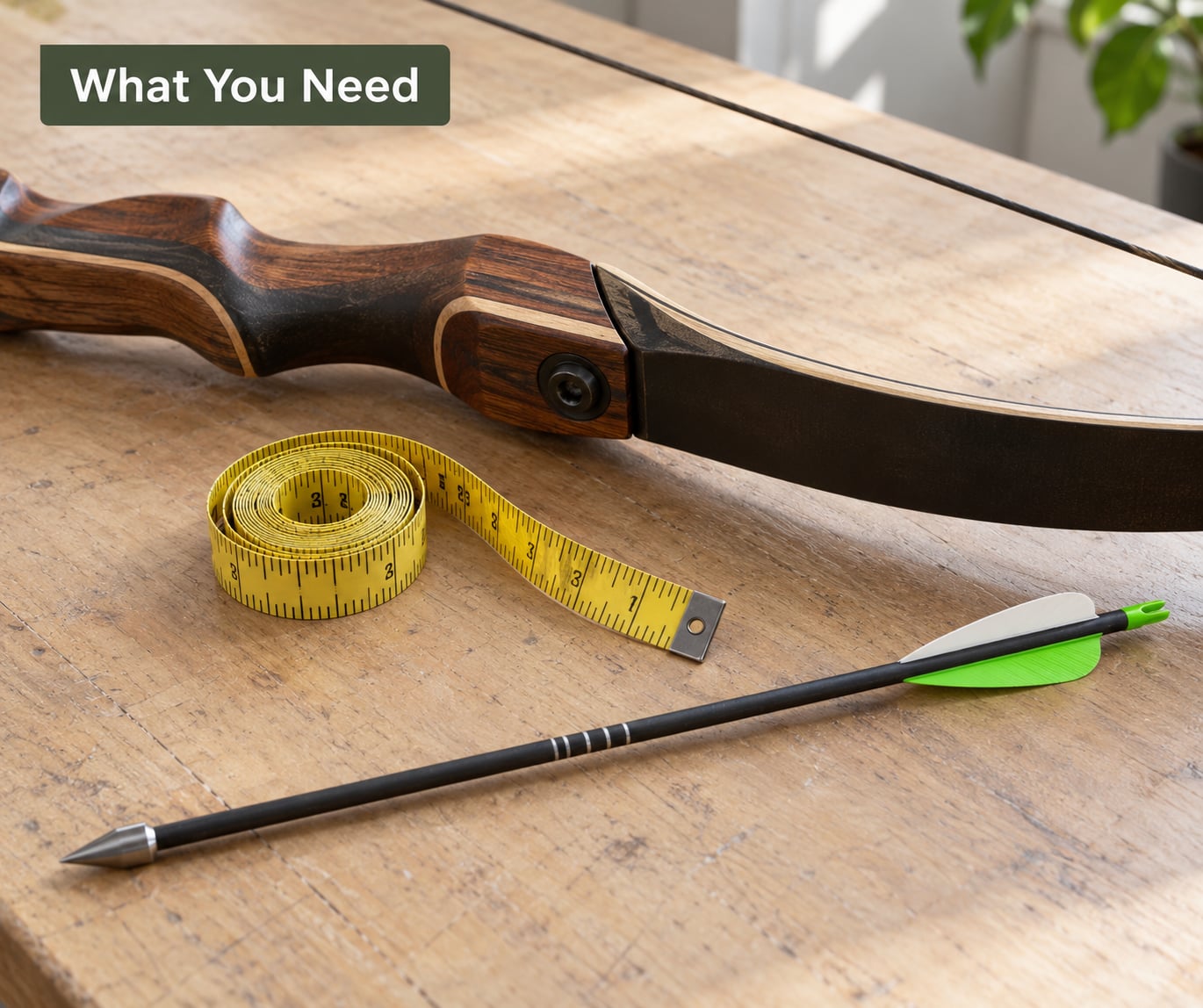
You need very little, and none of it is expensive or specialized.
- A flexible tape measure. A fabric or soft tape stays flat along a curved string. A stiff plastic tape can kink and give you a short reading.
- A flat wall or doorframe. This is your reference for the wingspan measurement and it costs nothing.
- A helper. Optional. The most accurate home check needs a second pair of hands at full draw.
- A pen and paper or your phone. You will take this measurement three or four times and need the numbers side by side.
- The bow itself, if you own one. You cannot do the bow-side measurement on a bow you do not have in hand, which is why the wingspan estimate exists.
- An arrow, optional. Useful as a marker for the nocking point, and handy later when you check arrow length.
Read the bow manufacturer’s instructions before you draw anything unfamiliar. Do not draw a bow with a cut or frayed string, a creased limb, a loose limb bolt, or a grip you cannot see clearly. A bow press is not required for any step here, and for a compound you should never press the limbs by hand.
How to Measure Your Draw Length at Home: Step-by-Step
The formula in plain text, so you can copy it straight into your phone:
Estimated draw length = wingspan in inches / 2.5, rounded down to the nearest half inch.
Bow draw length (the ATA figure a bow tech quotes) = estimated draw length + 1.75 inches.
Here is how to measure your draw length at home, one step at a time.
- Measure your wingspan. Stand with your back flat against the wall or a closed door. Extend both arms straight out to the sides at shoulder height, palms facing forward. Have the tape run from the tip of one middle finger to the tip of the other. Stand tall, do not shrug, and do not arch your back to squeeze out another inch. If you are doing it alone, mark your fingertip positions with a pencil on the wall and lay the tape across them.
- Divide by 2.5. A 70 inch wingspan divided by 2.5 gives 28 inches. A 76 inch wingspan gives 30.4 inches, which surprises people, but it is the same arithmetic working correctly.
- Round down to the nearest half inch. Most compounds change in half-inch increments, so a 30.4 inch estimate becomes 30 inches, not 30.5. Rounding up puts the bow past what the adjustment range will give you.
- Add 1.75 inches if you want the bow number. Archery draws a bow at full draw, then adds 1.75 inches to reach the bow string itself. So a 28 inch draw is a 29.75 inch bow, which shops call a 29.75 inch compound. Shooters usually talk in draw length, so both numbers are correct, they just describe different things.
- Verify it at full draw. Do not skip this part. An estimate you never checked is a guess with decimals in it.
Here is the same range as a quick lookup table, so you can convert a wingspan without doing the division twice.
| Wingspan | Estimated draw length | Bow draw length (+1.75) |
|---|---|---|
| 60 in | 24 in | 25.75 in |
| 64 in | 25.5 in | 27.25 in |
| 68 in | 27 in | 28.75 in |
| 70 in | 28 in | 29.75 in |
| 72 in | 28.5 in | 30.25 in |
| 74 in | 29.5 in | 31.25 in |
| 76 in | 30 in | 31.75 in |
| 80 in | 32 in | 33.75 in |
Most adult compound bows fall somewhere between 26 and 31 inches of draw. If your estimate lands outside that, measure twice before you worry, because frame size and how you stand both move the number.
How to measure your draw length at home with a helper
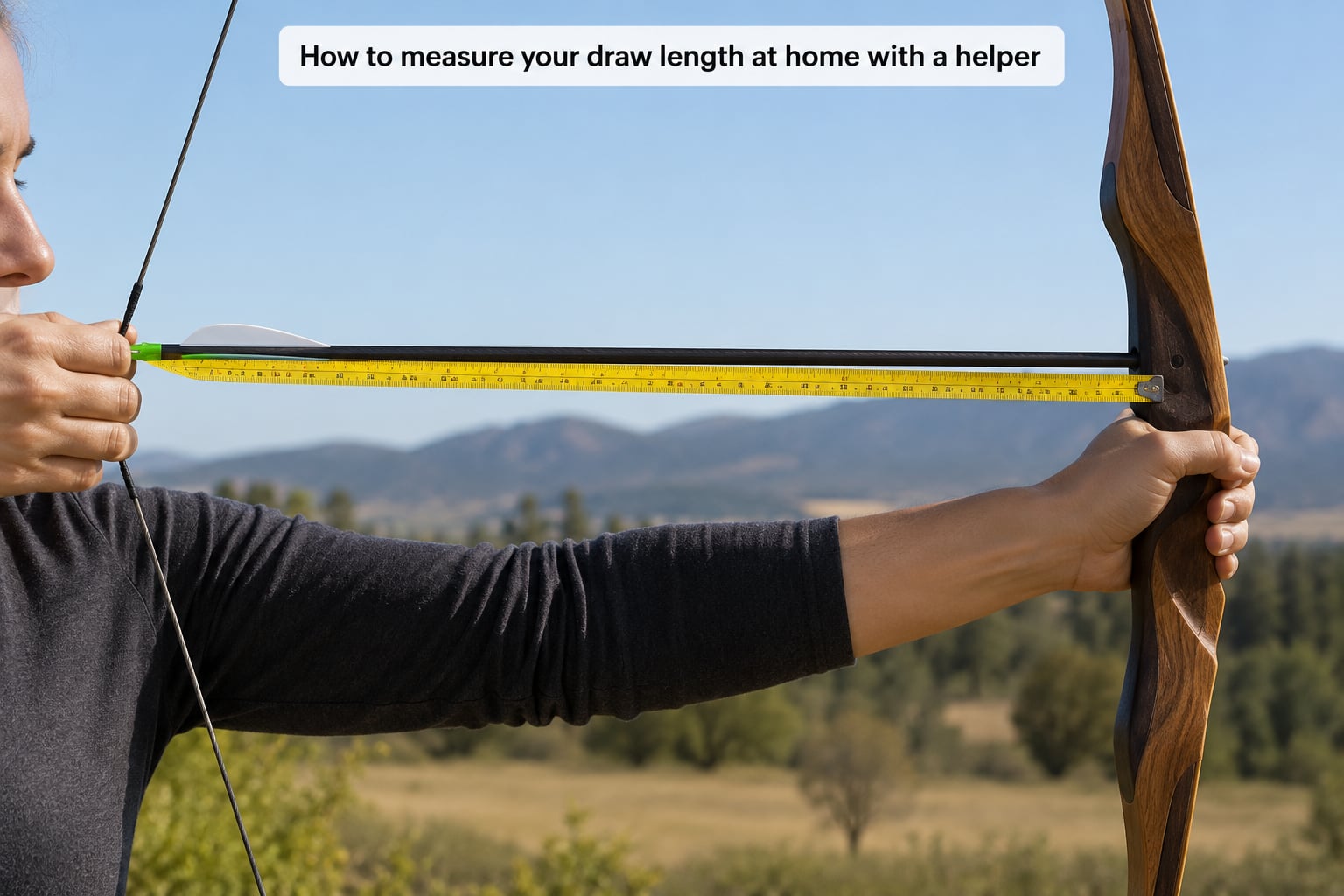
This is the method that actually settles the question, and it works on a recurve, a compound or a traditional longbow.
- Brace the bow safely. For a compound, brace it to its manufacturer setting or just past the brace-height window with an arrow rest. For a recurve or traditional bow, string it and check the string is fully seated in both grooves before you touch the tape.
- Get a consistent anchor. Nock an arrow, draw to the same spot under your chin or jaw you use every time, and set your anchor fingers. Tucking more fingers at full draw lengthens your draw without you noticing.
- Keep the string and grip steady. Your helper holds the tape at the pivot point, the deepest crease of the grip where it meets the riser. Do not let the bow shift in your hand between readings.
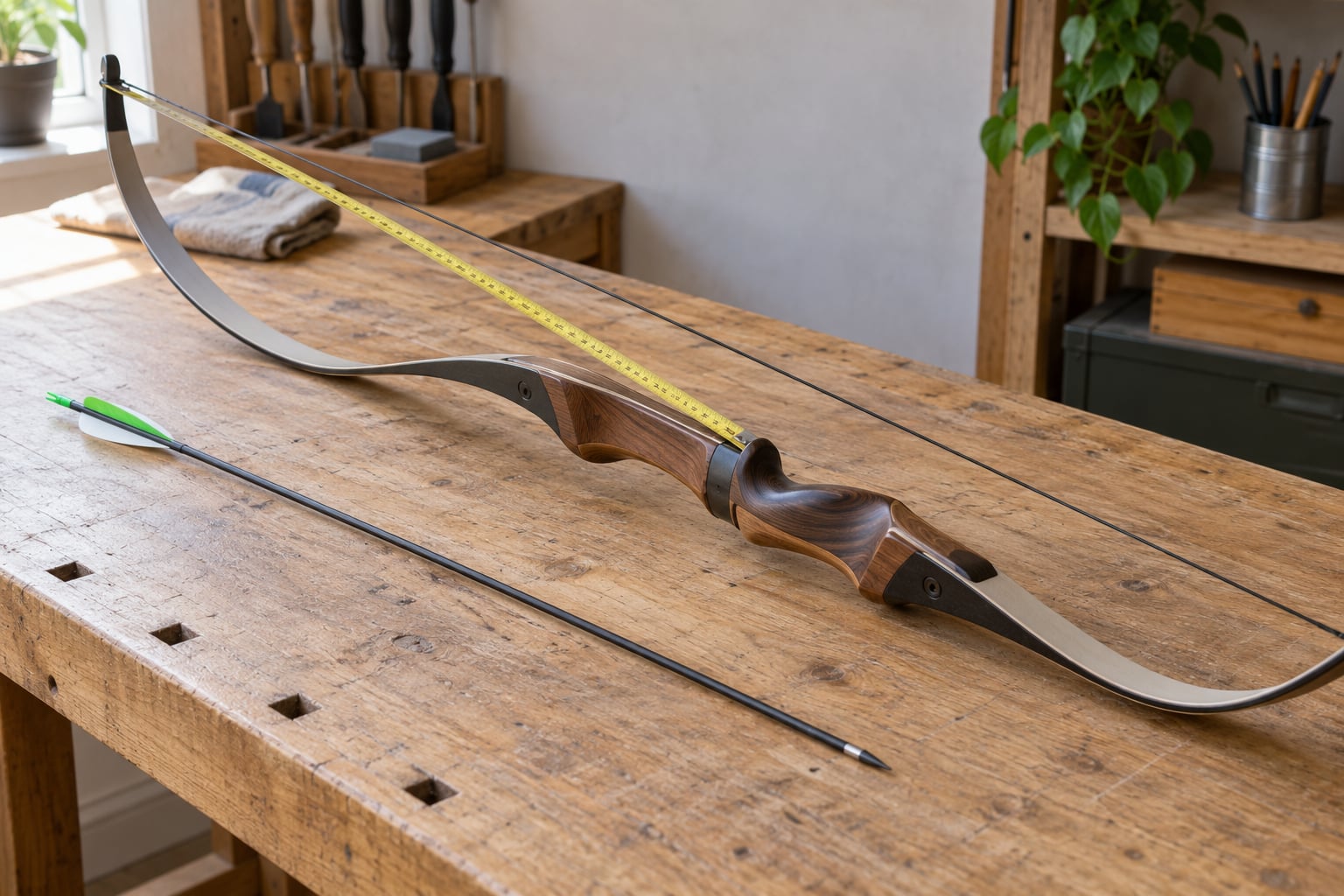
- Measure from the nock point, not the arrow. Start the tape at the center of the nocking point where the arrow nock engages the string, and run it to the pivot point of the grip. That is your personal draw length.
- Take three readings. Let the bow settle, come off anchor, draw again, and repeat. If the numbers agree within a quarter inch, you have it.
A useful shortcut some archers use at full draw is to hook the metal end of the tape between your thumb and forefinger and pull it straight to the pivot point. It is less formal than the helper method and it reads the same number, but a second person is steadier.
Common Mistakes
- Measuring across the front of your body. Fingertip to fingertip, always. Chest-to-fingertip gives you a much shorter number and a bow that feels stubby.
- Arching your back against the wall. Leaning back to touch the wall with your heels stretches the measurement by an inch or more. Flat feet, flat back.
- Confusing draw length with draw weight. Draw length is a distance in inches. Draw weight is how many pounds it takes to pull the string. They are unrelated numbers and no amount of dividing fixes a weight.
- Adding the 1.75 inch allowance twice. Add it once, and only when you are quoting a bow number rather than your own draw.
- Using a bent or kinked tape. Straighten it before every reading. A tape that has been folded in a pocket is lying to you by a quarter inch.
- Checking with the string unbraced. A slack string changes the geometry and your reading is meaningless. Brace first.
- Trusting a single attempt. Do the wingspan measurement three times and compare. If they disagree by more than half an inch, you leaned or shrugged on one of them.
- Rounding up instead of down. It feels more precise and it puts you over the bow’s adjustment range.
How to Know When the Measurement Is Right
You know it is right when your full-draw measurement and your wingspan estimate land within about an inch of each other, and when the same full-draw reading repeats three times in a row.
A gap of more than an inch is information, not failure. A longer estimate usually means one of four things: the bow came set longer than you need, your wingspan measurement was taken with a shrugged shoulder, you are drawing to a deeper anchor than you think, or your draw fingers are pinching the string extra.
| Method | What you need | Typical accuracy | Best for |
|---|---|---|---|
| Wingspan divided by 2.5 | Tape and a wall | About plus or minus 1 inch | First bow, before you own one |
| Wingspan from a helper at full draw | Tape and a helper | About plus or minus half an inch | Confirming before ordering arrows |
| Direct bow measurement at full draw | Bow, tape, quiet space | The actual number | Setting up a bow you own |
| Bow shop or bow tech measurement | A local shop | The actual number, plus setup | Anything you are not sure about |
Compare the string measurement with your full-draw measurement using the bow’s own convention. If the manufacturer lists the bow at 29.75 inches, the nock point to pivot point distance at full draw should sit right around 28 inches. Some makers use a different reference point or a different allowance, so the spec sheet for your specific bow wins over any general rule.
When the two numbers agree, write the result down and take a photo of the tape at full draw. That photo is the argument you will need if a shop tries to talk you into something else.
Safety Before You Draw
Measuring is the easy part. Drawing a bow safely is the part that matters.
- Inspect the string, limbs, limb bolts, cams or gaf before every session on a bow you are not completely sure about.
- Keep the shooting area clear behind the target and make sure nobody walks into the line while the bow is at full draw.
- Wear a finger tab or release aid matched to the bow. Fingers through a bare string is how people get cut.
- For a compound, set the let-off to a point where you are still comfortable at full draw. Feeling comfortable at the end of the stroke is the setting that protects you.
- Stop immediately if the string shows fuzz, grooves or a serving kink, if a limb looks creased, or if a bolt will not torque to spec.
- Never adjust a compound’s draw length yourself beyond the manufacturer’s stated module range, and never work on a bow with a press you have not been shown how to use.
If the draw feels light in a way that surprises you, or heavy in a way that strains your back at anchor, that is a fitting problem, not a measurement problem. Take the number you just took to a shop and let them set the bow.
Frequently Asked Questions
Do I add 1.75 inches when measuring draw length?
Only when you want the bow number instead of your own. Your personal draw length is the distance from the center of the nock point to the pivot point of the grip. Bow makers quote the bow at full draw plus 1.75 inches to reach the string itself, so a 28 inch draw is a 29.75 inch bow. Adding it to your own draw length double-counts it.
What is the correct draw length for a compound bow?
There is no single correct number. Most adults settle between 26 and 31 inches, and the right figure is the one that gives you a repeatable anchor with an arrow fully supported on the rest. Take your wingspan divided by 2.5, round down to the nearest half inch, then confirm it at full draw before anything gets ordered.
Can I measure draw length without a helper?
Yes, for the estimate. Stand with your back to a wall, mark both middle fingertip positions with a pencil, then lay the tape across them and divide by 2.5. For the full-draw check, a helper makes it far steadier because they can hold the tape at the pivot point while you hold the anchor. You can also use the thumb-and-forefinger tape hook method alone.
Should I measure to the nocking point or the arrow tip?
Measure to the nocking point, at the center where the nock engages the string. Measuring to the arrow tip is an older shortcut and it puts the arrow length and the draw length into one confusing number. If you want to check arrow length as well, measure it separately from the point of support.
Why do my draw length measurements change each time?
Usually the anchor, not the tape. Deepening your anchor by a fraction, setting your draw fingers differently, or leaning the bow off line all change the reading. Stand flat, draw to the same spot every time, and take three readings. If they still drift by more than a quarter inch, have a bow tech check the bow itself.
When should I ask an archery shop to check my draw length?
Ask a shop whenever the estimate and your full-draw reading disagree by more than an inch, whenever you are ordering arrows, and whenever the bow is secondhand or inherited. Fitting and setup help is usually included with the purchase at most shops, and it turns a number into a working setup.
Conclusion: Check the Measurement Before You Shoot
Measure fingertip to fingertip against a wall, divide by 2.5, round down to the nearest half inch, and then confirm it at full draw from the nock point to the pivot point of the grip. Write the number down, take a photo of the tape, and only then order arrows or have the bow adjusted. If the two numbers disagree by more than an inch, take the photo to a bow tech rather than guessing.