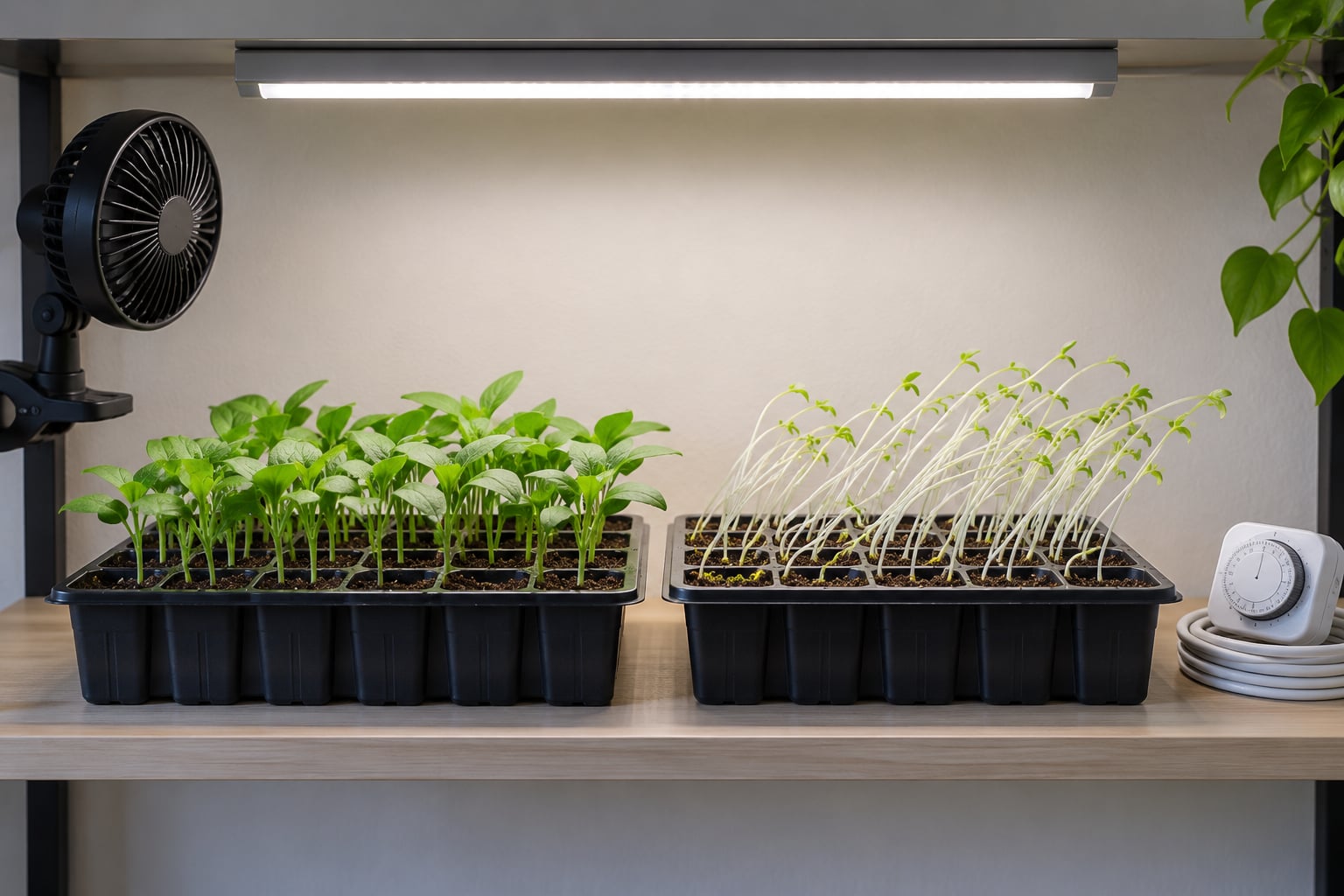
If you’re searching for why are my seedlings leggy, the answer is almost always light. A seedling that reaches for light it cannot get enough of pours energy into a tall, thin stem instead of building leaves and roots, and the result is a pale, floppy plant that transplants badly. Heat, crowding and still air make it worse, but weak or distant light is the root cause in most cases.
The good news is that a leggy seedling is usually a fixable problem. Move the light, extend the hours, let the air move, and most trays tighten up within a few days. This guide walks through the causes, how to spot them, what to do about a tray you already have, and what to change next time.
Table of Contents
- Why Are My Seedlings Leggy? Common Causes
- Causes at a glance
- How to Tell If Your Seedlings Are Leggy
- Legginess versus the problems that look like it
- What to Do About Leggy Seedlings
- How Much Light Do Seedlings Need?
- Can Leggy Seedlings Be Fixed?
- How to Prevent Leggy Seedlings Next Time
- When to Move Leggy Seedlings to Larger Pots
- Frequently Asked Questions
- Should I cut back a leggy seedling?
- Can I bury the stem of a leggy tomato seedling?
- Why are my seedlings stretching even with a grow light?
- Is a leggy seedling still healthy?
- How do I stop seedlings from leaning toward a window?
- Should I use fertilizer on leggy seedlings?
- What to Do First
Why Are My Seedlings Leggy? Common Causes
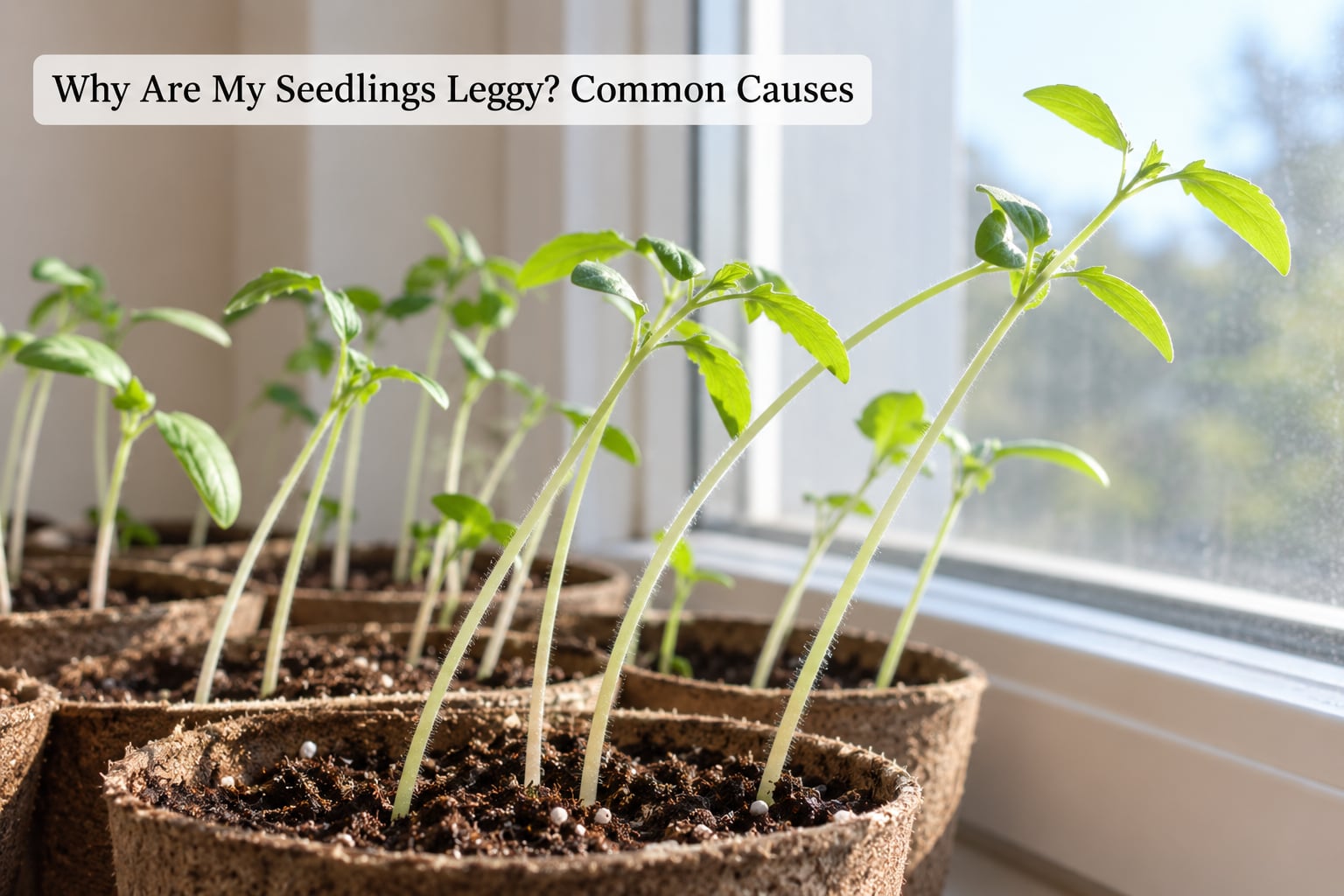
Seedlings are programmed to grow toward light. When the light reaching the leaves falls below what the plant needs, it shifts its resources into vertical stem growth, a stress response growers call etiolation. The stem stretches, thins and pales because the plant is spending its energy reserves on reaching rather than on building leaf and root tissue.
What makes that stretching worse is straightforward: light intensity drops with roughly the square of the distance from the fixture. A strip sitting 12 inches above a tray delivers roughly one ninth of the intensity it delivers at 4 inches. Many people set up a light at what feels like a sensible height and never think about it again, so the tray quietly stretches for two weeks.
Here are the causes, roughly in the order they show up:
- Light too far away. The single most common cause. A fixture hung at shelf height instead of a few inches above the canopy.
- Too few hours of light. Seedlings want 14 to 18 hours a day. Twelve hours, which feels like plenty, leaves them short on daily light.
- A windowsill in late winter. A south-facing window in February delivers a small fraction of what a fixture does, and the light falls off sharply away from the glass.
- Excess warmth. A heat mat or dome kept on after green shoots appear keeps the air warm and still, and warm, still air accelerates stretching. Above roughly 75°F seedlings race toward the light.
- Crowding. Dense sowing creates competition and shaded lower stems, and the seedlings shade each other out.
- Still air. Gentle air movement mechanically stimulates thicker stems; a sealed tray gets none.
- Old or weak seed. Older seed produces weaker seedlings that stretch more readily under the same conditions.
- Root or transplant stress. Seedlings held too long in small cells become root-bound, and stressed plants stretch.
Causes at a glance
| Cause | What it looks like | The correction |
|---|---|---|
| Light too far away | All stems stretched evenly, pale, leaning up | Lower the fixture to the recommended distance |
| Too few hours | Gradual stretch over one to two weeks | Run 14 to 18 hours on a timer |
| Windowsill only | Long lean toward the glass, weak at the back | Add a fixture or move off the sill |
| Excess warmth | Fast tall growth, soft stems, dry surface | Drop to 60 to 70°F, remove the dome |
| Crowding | Thin, pale, uneven stems, tall seedlings over short ones | Thin and space seedlings out |
| Still air | Long thin stems, weak and floppy | Add a fan on low or brush by hand |
How to Tell If Your Seedlings Are Leggy
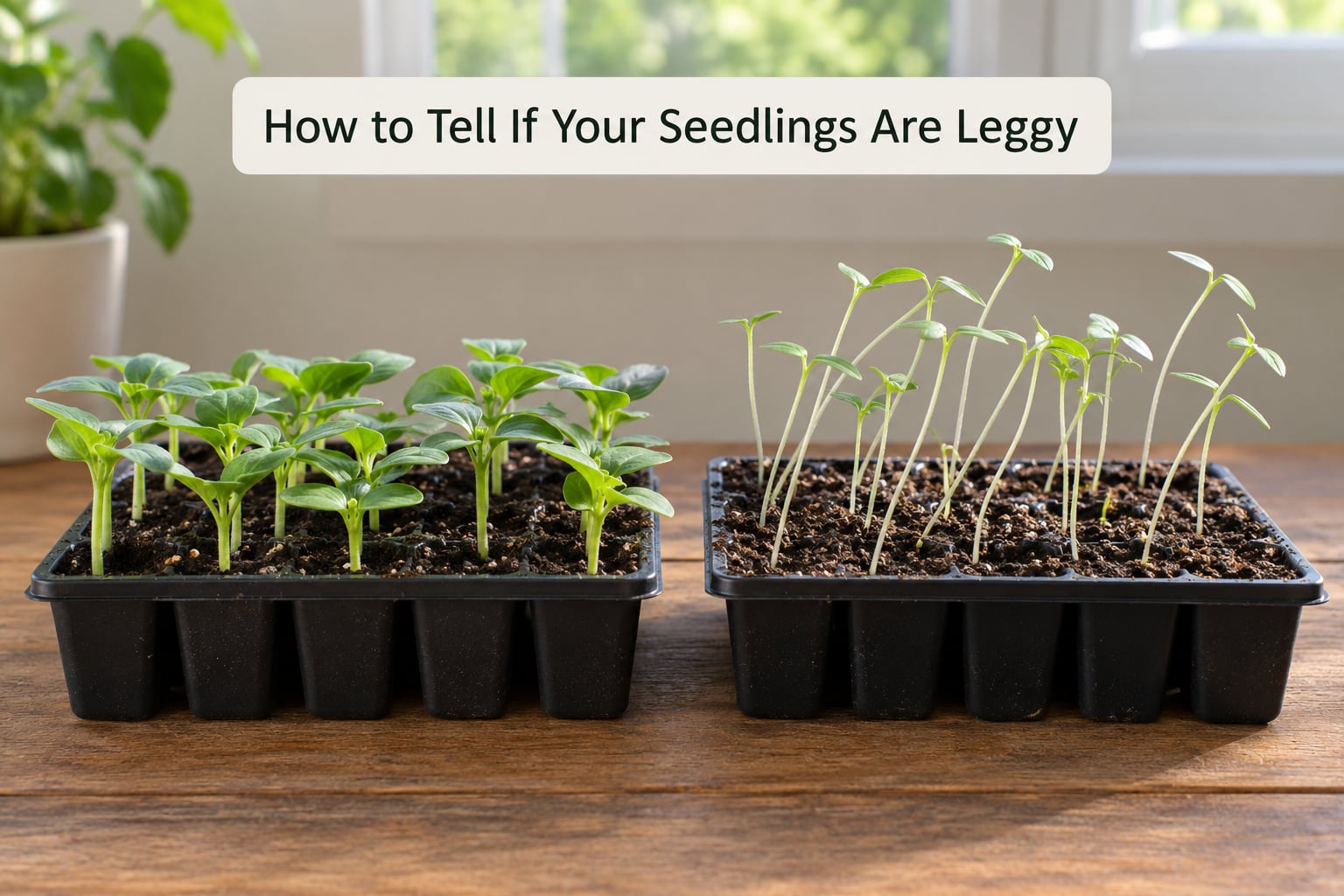
Healthy seedlings are short and stocky, with a stem you can barely pinch between two fingers, leaves that look proportionate to the plant, and a color that reads as a solid medium green. Leggy seedlings have all four of those turned around. Look at the stem first, then the leaf and root condition.
- Stem length. A tomato seedling taller than roughly 4 to 6 inches before its true leaves open is stretching.
- Stem diameter. Thin enough to see light through, or to snap between two fingers, means the stem never thickened.
- Leaf size. Small, undersized cotyledons or true leaves on a long stem point to the same light shortfall.
- Color. Pale yellow-green or washed-out stems are etiolated. Deep green is a good sign.
- Lean direction. A lean to one side is phototropism, a window problem. Even stretching on every stem is etiolation, a light-intensity problem. The fixes differ.
- Roots. Lift one gently. A healthy seedling holds a solid plug of medium. White, sparse roots or a stem that slides out of the soil point to root stress instead.
Legginess versus the problems that look like it
Several failures share the same look, and treating them as legginess wastes a week. Damping off shows up as seedlings collapsing at the soil line into a slimy, water-soaked failure, often in patches. Overwatering gives you yellowing lower leaves and limp, darkened stems near the mix. Light burn bleaches or whitens the tops of leaves directly under a fixture that’s too close. The giveaway across all three is that the stem isn’t stretched, while legginess always shows a long bare stem between the soil and the first leaves.
What to Do About Leggy Seedlings
Work through these in order, because the light fix changes everything downstream and the rest are cheap adjustments on top of it.
- Move the light down now. Lower the fixture to the correct distance for its type. If a dome will not fit under the light, remove the dome or prop the tray up on a shelf riser.
- Add hours. Put the light on a timer for 14 to 18 hours a day. Twelve hours is the number most people under-shoot without realizing it.
- Cool the air down. Aim for 60 to 70°F, with cooler nights. Take the heat mat off once seedlings have true leaves and leave the humidity dome off from the moment green shoots appear.
- Get air moving. A small clip-on fan on low, two to four hours a day, thickens stems. Brushing your hand gently back and forth across the tops once or twice a day does the same thing for free.
- Thin crowded cells. Remove the weakest seedlings so the survivors get full light and airflow. Leaving them crowded keeps the problem going.
- Support stems carefully. A bamboo stake, a buried chopstick, or a folded strip of cardboard upright in the mix holds a floppy seedling upright while it thickens. Do not pinch the stem.
- Hold off on fertilizer. Rich, nitrogen-heavy feeding pushes soft growth. A weak seedling needs light and airflow first; feed lightly only once true leaves are open and the plant is standing on its own.
How Much Light Do Seedlings Need?
Two numbers answer this properly. PPFD, measured in µmol/m²/s, is the light intensity hitting the leaves. DLI, in mol/m²/day, is the total light a plant receives across a full day. Seedlings want roughly 150 to 300 µmol/m²/s and a daily total of 12 to 20 mol/m²/day.
Work the daily total out by multiplying intensity by hours and dividing by one million. A fixture measuring 200 µmol/m²/s run for 16 hours gives about 3.2 mol/m²/day, which is low. Reaching 12 mol at that same intensity takes roughly 17 hours of light, right at the edge of what a normal photoperiod allows. The practical read is that a mediocre fixture has to be moved closer, run longer, or both, while a strong one needs fewer hours.
Photoperiod is the other half. 16 hours on and 8 hours off is the usual cycle. Running lights around the clock gives you no more growth, because the plant still needs a dark period to respire and reorganise.
Distance is where the biggest mistakes happen, because the correct number depends entirely on the fixture.
| Fixture type | Distance above the canopy |
|---|---|
| T5 or slim LED strips | 2 to 4 inches |
| LED shop lights | 6 to 12 inches |
| LED panels | 12 to 18 inches |
| Screw-in bulbs | Follow the maker’s chart, usually 6 to 12 inches |
The inverse-square rule explains why. Intensity roughly quarters each time you double the distance, so 12 inches gives you about one ninth the intensity of 4 inches. A single shop light that reads fine at the center of the tray can leave the outer cells a quarter as bright, and those edge seedlings stretch first. Lift a hand into the canopy and check: if you cannot comfortably hold your hand there under the fixture, it is close enough.
Can Leggy Seedlings Be Fixed?
The stretched section of stem will never get shorter. What you can do is stop further stretching, thicken the existing stem, and give the plant a strong root system so it carries itself. A mildly stretched tomato that is still standing usually recovers. A seedling whose stem has flopped over, kinked or gone translucent at the base usually will not.
Crop type decides how much of the length you can hide. Tomatoes, tomatillos and eggplant root along a buried stem, so excess length becomes extra roots. Most other crops rot if you bury a stem deep.
| Crop | Verdict | What to do |
|---|---|---|
| Tomato, tomatillo, eggplant | Usually salvageable | Bury the stem up to the first true leaves, or lay it in a trench and pin it down |
| Brassicas, kale, cabbage | Partly | Bury only to the first leaves and support the stem |
| Peppers | Partly | Bury shallowly and stake; peppers sulk if buried deep |
| Lettuce, basil, herbs | Poor | Thin and hope; resow if most of the tray is affected |
| Cucurbits, squash, cucumber | Resow | They collapse under their own weight and dislike disturbance |
For tomatoes, the trench method works well: dig a trench a few inches deep, lay the long stem horizontally along it, pin it down at the nodes, and cover with mix. Those buried nodes root within about two weeks. On a windowsill with no fixture, growers report the same thing over and over, and the advice is always the same: the light was simply mounted too high.
How to Prevent Leggy Seedlings Next Time
Prevention is a short checklist, and every item is something that costs nothing but attention:
- Use a fresh, sterile seed starting mix that holds moisture without staying waterlogged.
- Sow at the depth printed on the seed packet. Seeds buried too deeply push up through the soil and stretch themselves.
- Have the light ready before the first green shoot appears, and turn it on that same day.
- Run 14 to 18 hours a day from a timer rather than guessing.
- Remove the humidity dome as soon as you see green, and keep temperatures at 60 to 70°F.
- Space seedlings so leaves do not overlap. Sowing thick is the second most common reason for stretch.
- Run air movement across the tray from the day the seedlings emerge.
- Do not start tomatoes too early. Seedlings that sit root-bound while you wait for the last frost date have already lost the fight.
- Turn windowsill trays a quarter turn daily so growth stays even, and move them out of cold drafts.
- Harden off gradually over a week before planting outdoors.
One more myth worth clearing up: colour temperature is not the lever here. Swapping a 5000K bulb for a 6500K one changes the look slightly but not the intensity, and intensity is what governs stretching.
When to Move Leggy Seedlings to Larger Pots
Wait until true leaves have opened, not just the cotyledons, and until the seedling lifts out with a solid root plug. Seedlings potted too early in rich mix respond to the extra room by stretching harder, which is the opposite of what you want.
Move a leggy seedling up when the roots circle the bottom of the cell, when the medium dries out within a day of watering, or when the stem is bending under its own weight. At that point, bury only as deep as the crop allows: up to the first true leaves for tomatoes, and only a shallow inch for peppers, brassicas and herbs. After that, harden off over several days rather than moving a plant straight into full sun and wind.
Frequently Asked Questions
Should I cut back a leggy seedling?
No. Cutting or pinching a leggy seedling does not shorten the stretched stem, and the wound often invites rot at the soil line. Support the stem instead with a small stake or a buried chopstick so the seedling stands upright, then fix the light so it stops stretching. Only prune a seedling once it has healthy new growth above the damaged section.
Can I bury the stem of a leggy tomato seedling?
Yes, tomatoes are the exception. Tomato, tomatillo and eggplant stems root from the buried nodes, so extra length becomes extra roots. Bury up to the first true leaves, or lay the stem in a shallow trench, pin the nodes down and cover them with mix. New roots usually appear within two weeks. Most other crops will rot if you bury the stem that deep.
Why are my seedlings stretching even with a grow light?
Three things usually explain it. The fixture is mounted too high, so check the recommended distance for your fixture type. Or the photoperiod is short, since twelve hours a day is well under the 14 to 18 hours seedlings want. Or intensity is uneven, so measure at the tray edge rather than the center. Warm air above 75°F and still air both speed up the same stretch.
Is a leggy seedling still healthy?
Sometimes. A seedling that is stretched but green, standing on its own and rooting well will usually recover once the light is corrected. One that is pale, bent, kinked at the base or translucent where it meets the soil is in trouble. A seedling whose stem has flopped flat rarely recovers, no matter how much you correct the lighting.
How do I stop seedlings from leaning toward a window?
Rotate the tray a quarter turn every day so no side gets a permanent advantage, and move it as close to the glass as the sill allows. That evens out a lean, but it does not fix it, because a winter windowsill delivers far less light than seedlings need. Add a grow light above the tray for the main hours of the day and use the window as a bonus rather than the source.
Should I use fertilizer on leggy seedlings?
Not yet. Fertilizer feeds whatever growth is already happening, so feeding a stretched seedling usually makes it taller and weaker. Fix the light, temperature and airflow first and hold off until true leaves are open and the stem can support itself. Once growth is compact, a dilute balanced feed every week or two is plenty for a seedling.
What to Do First
Get the light closer tonight, add a timer so the seedlings get 14 to 18 hours, and check the temperature. Then look at airflow, crowding and whether the roots have space, because those three turn a recoverable stretch into a lost tray.
Act on the cause instead of the symptom. A leggy seedling is a plant telling you the conditions are wrong, and once those conditions are right it stops reaching and starts filling out. If the tray is past saving, note the crop and the setup, then resow with the light already in position.