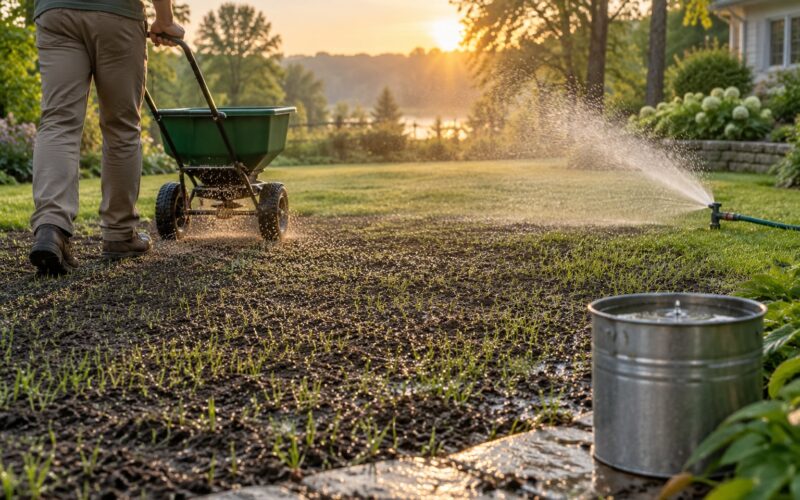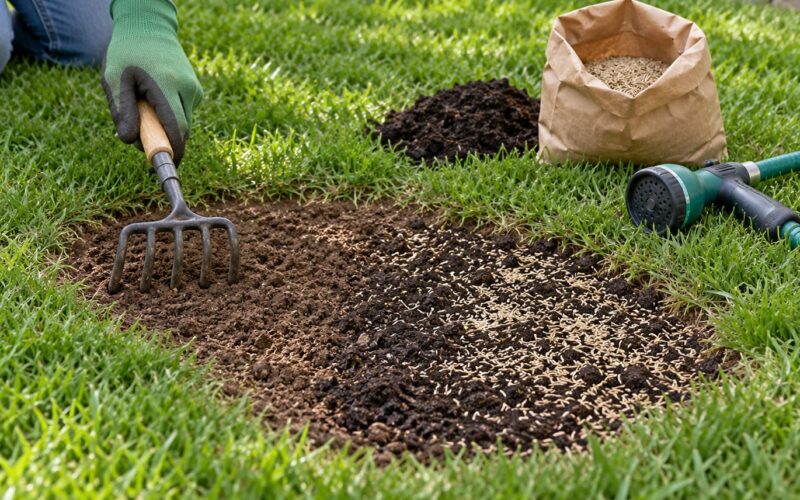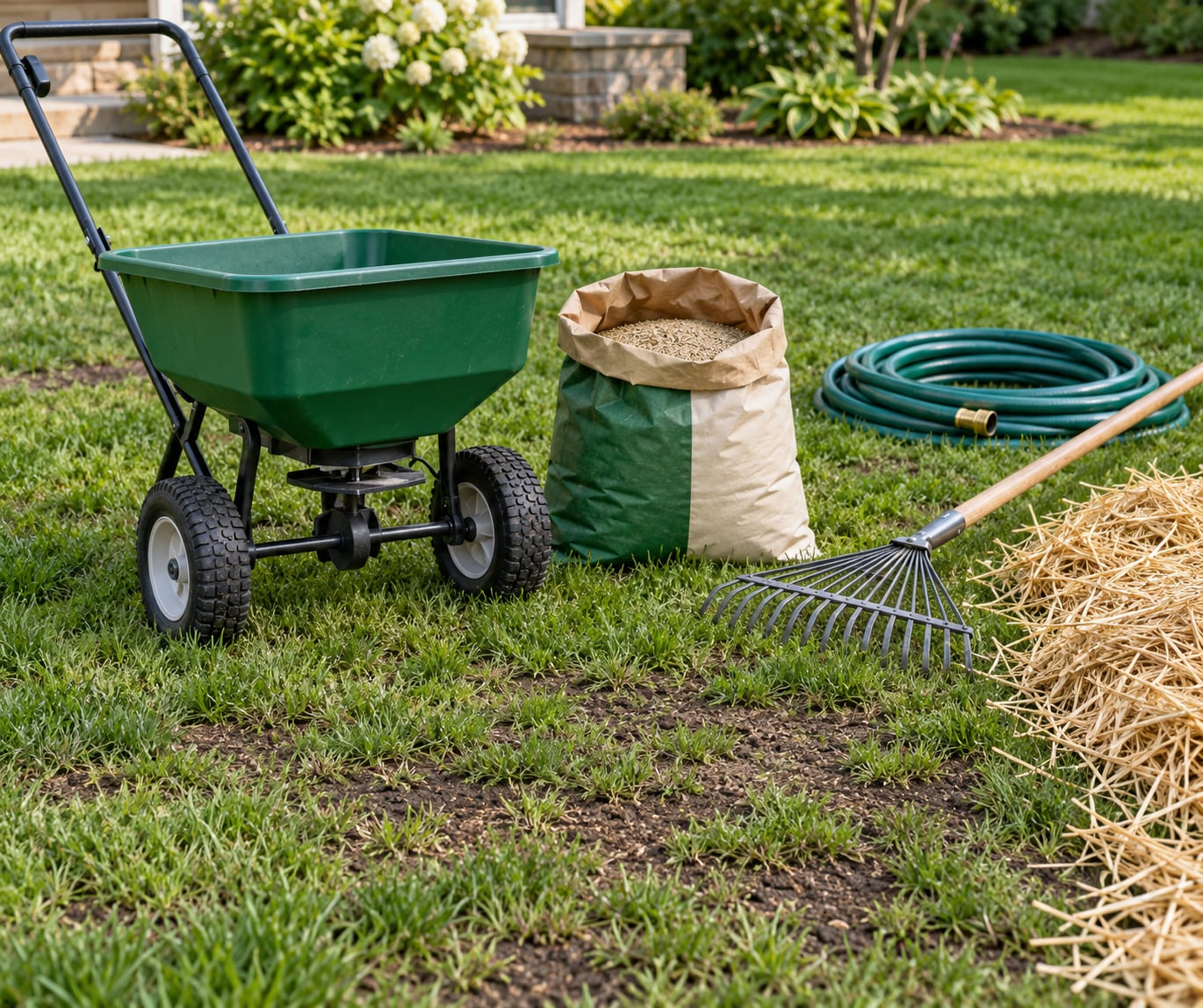
Overseeding is just what it sounds like: scattering new grass seed across a lawn you already have, on top of the existing turf, so thin patches fill in and the grass grows denser. The whole job takes a weekend, and the sequence is simple. Mow low, clear the debris, loosen the soil, spread the seed evenly, keep it moist, then stay off it until the seedlings take hold.
If you have never done it, how to overseed a lawn step by step comes down to six stages, and this guide walks through all of them with the numbers that matter: seeding rates per 1,000 square feet, watering durations, and the day each milestone usually shows up. Updated for 2026. If your lawn is already thick, skip ahead and read when overseeding is a waste of seed.
Table of Contents
- What Overseeding Means
- What You Need
- How to Overseed a Lawn Step by Step
- 1. Choose the Right Time to Overseed
- 2. Test and Prepare the Existing Lawn
- 3. Select Seed That Matches the Lawn
- 4. Calculate the Seed and Spread It Evenly
- 5. Cover, Water, and Protect the Seed
- 6. Mow Carefully While the Grass Establishes
- Common Mistakes
- Frequently Asked Questions
- Is it better to overseed or reseed?
- Should I water immediately after putting grass seed down?
- How long does grass seed take to germinate when overseeding?
- Can you walk on grass seed while it germinates?
- Can you just throw grass seed down and will it grow?
- Do I need to aerate before overseeding?
- Start With Timing and a Soil Check
What Overseeding Means
Overseeding means sowing grass seed onto an existing lawn, on top of the current turf rather than tearing it out, to thicken thin patches, fill bare spots, and introduce newer grass varieties without the weeks of recovery a full reseed costs. The old grass stays in place and the new seedlings fill the gaps between it.
An established lawn, by the way, is one whose grass has been mown regularly and grown dense enough to handle ordinary use. You are not aiming to replace an established lawn. You are adding plants to it.
What You Need
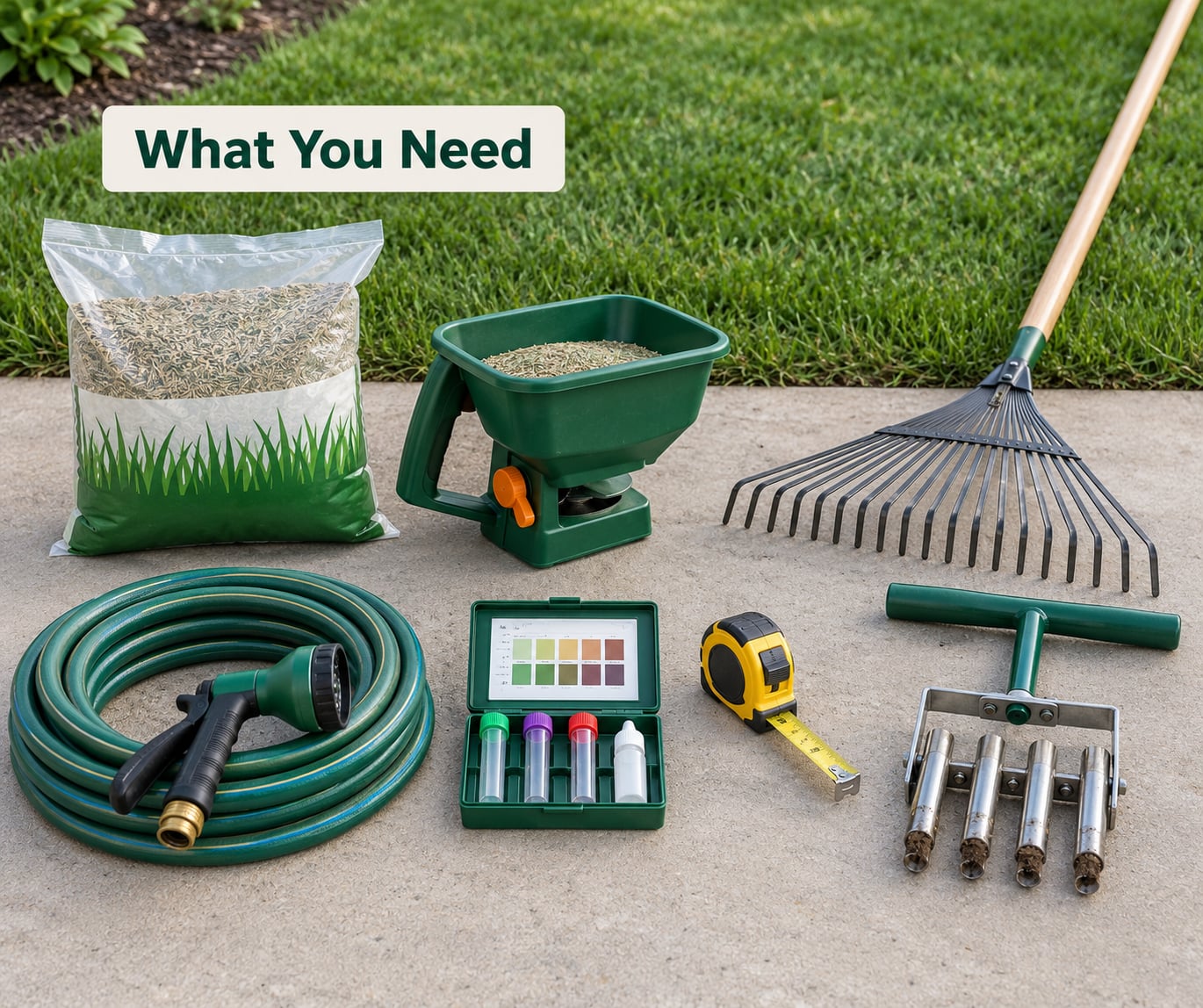
None of this is expensive, and most of it you may already own. The list below is ordered the same way you will use it.
- Grass seed matching your existing turf, in an amount calculated from your lawn size. Buy a bag with a stated germination rate and a date on it; old seed is the most common cause of failure.
- A drop spreader for an even, controlled pass. A broadcast spreader works on open, unbordered turf, but it throws seed past edges and into beds, and it is the usual reason people end up with heavy and bare strips side by side.
- A steel rake for light raking of the surface and for working seed in afterward.
- A core aerator if the ground feels hard underfoot or water puddles instead of soaking in. A rented walking aerator handles a normal yard; you can also hire a crew to do it.
- A hose with a spray nozzle or an irrigation head that puts out a fine mist. A shallow sprinkler head throws droplets too big to settle into the soil.
- Starter fertilizer with a high phosphorus number, applied at seeding or right after.
- Straw, seed cover or a light mulch blanket only for slopes and areas where water runs off. A lot of cover on flat ground causes more problems than it solves.
- A soil test kit if you have never tested the ground or the last test is more than three years old.
- A tape measure and a marker to divide the lawn into sections you can manage one at a time.
Matching seed to the lawn matters more than any other choice here. A blend of the same species already growing in your yard, or a blend of species with similar color and growth rate, will knit in almost invisibly. Different species seed side by side grow at different rates, and the fast one shades out the slow one before it establishes.
If you do not know what is growing in your lawn, take a sample blade to your local extension office. They identify it for free in most US counties, and knowing whether your turf is cool-season or warm-season decides your seeding window, your seed choice and your fertilizer plan. USDA plant hardiness zone tells you your average winter low, which is a useful second clue but the grass species itself is the one that matters.
How to Overseed a Lawn Step by Step
1. Choose the Right Time to Overseed
Overseed cool-season lawns from mid-August through mid-September in most of the US. The soil is still warm, nights are starting to cool, fall rain is usually close behind, and the new seedlings get a full growing season before their first winter. In the far north the window shifts earlier, into late August; in the deep south it stretches into early October.
Warm-season lawns take a different calendar. Seed bermudagrass, zoysia or centipede between late spring and midsummer, once soil temperatures hold above 65°F and there is no frost risk in the forecast. Seeding a warm-season lawn in fall means the seed sits dormant or fails, because the varieties that survive your winter are the ones that go dormant when the temperature drops.
Two rules cut across both cases. Do not overseed into a drought-stressed lawn, because the existing grass is competing with the seed for what little water there is, and fix the irrigation first. And skip the windows around a predicted heat wave or a stretch of rain with no sun, since seedlings that hit a hot dry spell in their first week often never recover.
| Lawn type | Best window | Soil temperature | Skip it when |
|---|---|---|---|
| Cool-season (bluegrass, fescue, ryegrass), northern US | Late August to late September | Above 50°F | Overnight lows still below 45°F |
| Cool-season, transition and southern US | Mid-September to early October | Above 50°F | Humidity is high and rain is forecast for days |
| Warm-season (bermudagrass, zoysia, centipede) | Late May to mid-July | Above 65°F | A cold front or a heat wave is in the 10-day forecast |
Below roughly 40°F, seed simply will not germinate. That is the number behind the advice to stop seeding cool-season lawns in late fall, and it is why October is comfortable in the south and already too late in Minnesota.
2. Test and Prepare the Existing Lawn
Walk the lawn and mark where the grass is thin. Wear paths, the strip under the air conditioner drip line, the corner the dog sleeps on and any area that stayed brown through August are the usual candidates, and seeding the whole lawn when two patches are the problem is a good way to spend three times what you needed to.
Test the soil if you have never done it or if the last test is more than three years old. Most turf grass wants a pH between 6.0 and 7.5, and seed sown into soil outside that range germinates poorly no matter how well the rest of the job goes done. A basic DIY test tells you where you stand; a lawn care company or extension office runs a proper test for a few dollars and tells you what to change.
Then work through the prep in this order.
- Pull the weeds first. If broadleaf weeds cover more than a small part of the lawn, do not overseed. Treat the weeds, wait, get onto a pre-emergent and seed the following season. Putting seed into a weedy lawn mostly wastes it, because the weeds you were trying to crowd out are already established and the seedlings lose that fight.
- Mow low and bag. Cut the grass about one to two notches below your normal height, to roughly 2 inches, and bag the clippings. Lower grass lets light reach the soil and shortens the drop the seed has to fall.
- Rake out debris. Bag or blow away anything that collects, including leaves, twigs and the mat of dead grass clippings.
- Check the thatch. Push a finger into the thatch layer at the soil line. If it is thicker than half an inch, it will block seed-to-soil contact and you should dethatch before seeding.
- Core aerate. Pull soil plugs two to three inches deep, making passes at right angles to each other. Leave the plugs on the surface and let them break down; that loose soil is exactly what the seed needs to sit in. If the ground is soft and full of earthworms, you can probably skip this step.
- Water the day before if the ground is dry, so the soil is soft and the seed is going into moisture rather than dust.
You will know the lawn is ready when you can see open soil between the existing plants and the surface has a bit of loose material from the aerator. That is the condition you want at the moment the seed hits the ground.
3. Select Seed That Matches the Lawn
Start by matching the species. Seed the same species that is already dominant in your lawn, and you get a uniform result. If the existing grass is tired or old, choose a newer cultivar of that same species, which is how most people introduce better disease resistance and deeper roots without changing the look of the yard.
Blends are useful when your lawn already mixes species, or when you want a mix of germination speeds so the lawn fills in gradually instead of all at once. A fast-germinating ryegrass alongside a slow bluegrass will show green in about a week and fill in over three. That uneven start is expected, not a mistake.
Check these before you buy.
- Species and color. Check the bag’s label against what is actually in your lawn. Seed sold for full sun in a shaded bed will disappoint you.
- Sun and shade suitability. Fine fescue handles shade better than most warm-season grasses; most bluegrass blends do poorly under tree cover.
- Traffic tolerance. Perennial ryegrass and tall fescue stand up to foot traffic. Kentucky bluegrass spreads aggressively and self-repairs, which is a genuine advantage, but it needs more water and takes longer to green up in spring.
- Germination rate and date. A stated germination rate above 80 percent is a good sign. Check the date on the bag and skip anything a year past it.
- Maintenance level. Match the seed to how much mowing, watering and fertilizing you actually want to do, not to the lawn next door.
You will not find a meaningful difference between brands of the same species and quality tier. The species, the freshness and the rate you apply matter far more than the name on the bag.
4. Calculate the Seed and Spread It Evenly
Calculate the amount before you open the bag. The standard rate for overseeding a thin existing lawn is about twice what you would use on bare ground, because the seed has to compete with established plants and germinate in uneven conditions. Plan on roughly double the bare-soil rate, and the extra seed is far cheaper than a second pass in three weeks.
| Grass type | Seeding rate per 1,000 sq ft (overseeding) | Metric equivalent per square meter |
|---|---|---|
| Kentucky bluegrass | 1 to 2 lb | 5 to 10 g |
| Perennial ryegrass | 2 to 3 lb | 10 to 15 g |
| Tall fescue and tall fescue blends | 4 to 6 lb | 20 to 30 g |
| Bermudagrass | 1 to 2 lb | 5 to 10 g |
| Zoysia | 2 to 3 lb | 10 to 15 g |
Multiply by your lawn size. For a 500-square-foot patch you need half the rate, for 2,500 square feet 2.5 times, and for a half-acre about 5 times. Weigh out only the seed for your first section and keep that in mind for the rest.
| Lawn size | Tall fescue blend at 5 lb per 1,000 sq ft | Perennial ryegrass at 2.5 lb per 1,000 sq ft |
|---|---|---|
| 500 sq ft | 2.5 lb | 1.25 lb |
| 1,000 sq ft | 5 lb | 2.5 lb |
| 2,500 sq ft | 12.5 lb | 6.25 lb |
| 5,000 sq ft | 25 lb | 12.5 lb |
Divide the lawn into sections you can cover before the setting runs down. Mark each one with a hose or a flag, apply the seed to a quarter or a third of the lawn, then move to the next. Set the spreader by following its own instructions, then check it over a measured area: weigh what comes out, adjust, and re-test. Starting with too much is easier to fix than starting with too little, but a doubled strip still shades out its neighbors.
Walk the perimeter first with the spreader open, then fill in the interior in straight, slightly overlapping passes. Shut the spreader off when you turn, or you will pile seed into a stripe at every corner.
Lightly rake the seed into the top half inch of soil, or walk it in with a light roller if you have one. You want the seed in contact with moist soil, not buried under a blanket. Seed that is covered too deeply never pushes through.
Apply starter fertilizer at the same pass or within a day of seeding, following the bag rate. High-phosphorus fertilizer is what the roots need in the first weeks, and a soil test that showed low phosphorus is the case where this matters most.
5. Cover, Water, and Protect the Seed
Water immediately after the seed goes down, and keep watering until the grass is established. This is the step people get wrong most often, so here are the specifics. Use a fine mist, not a hose at full flow, and water lightly and often rather than heavily and rarely. During the first two weeks, four short cycles a day of 10 to 15 minutes each beat one long soak.
The goal is the top inch of soil staying consistently moist, not saturated. Soggy soil drives off the germination percentage you paid for and invites fungal problems, and the most common self-inflicted failure I see is a lawn that was watered four times a day for eleven days with no result. If the surface stays wet and you can see standing water, cut back.
Skip the straw on flat ground. On slopes, along a water channel or anywhere else water runs, a light blanket of straw or a seed cover mat holds the seed in place, and you only apply it thin enough to see the soil through it. Cover applied heavily makes sprouts physically push the blanket up onto the lawn, which is a well-known complaint from people who used it. Remove any mat or blanket once the grass is up.
Keep people and pets off the lawn while it germinates. Three weeks is the minimum window; four is safer, and that is the window to plan your schedule around before you seed.
A pre-emergent weed preventer applied right after seeding keeps new weeds from filling the same bare ground the new grass is trying to claim. Do not apply one that is already active on the seed, and check the label for how long it blocks germination before you use it.
6. Mow Carefully While the Grass Establishes
Most cool-season seed shows visible green between 7 and 14 days, with Kentucky bluegrass and tall fescue at the slow end, closer to three weeks. If nothing has appeared by day 14, keep watering. Plenty of people see nothing for two weeks and then get a full stand.
Wait to mow until the new grass is about 3 inches tall, which usually lands around day 21 to 30. Set the mower one notch higher than your normal summer height and never remove more than a third of the blade in a single pass. Short cutting at this stage cuts the growing point off the seedling and you go back to bare ground. Bag clippings while the new grass is tall enough to be knocked flat by the mower, and switch to mulching once it is established enough to handle it.
Hold off on a second round of fertilizer for about four weeks after seeding, so the roots get established first. If the existing mature grass is outgrowing the seedlings, a plant growth regulator applied before seeding can slow the old grass down, though that is a step most people skip and most lawns do not need.
| Milestone | Typical timing | What to do |
|---|---|---|
| First seedlings | Day 7 to 14 | Keep the top inch moist; no mowing yet |
| No visible growth | Up to Day 21 | Normal for slow species; keep watering, check the soil is moist at depth |
| Full traffic window opens | Day 21 to 28 | Resume normal foot traffic; keep dogs off until the grass is 3 inches |
| First mow | Day 21 to 30 | Set one notch high, remove no more than one third of the blade, bag clippings |
| Second fertilizer | About 4 weeks after seeding | Apply at the bag rate; water it in |
| Weeds appearing | Week 3 to 5 | Hand pull broadleaf weeds while the roots are still shallow |
If new grass is coming through but patchy, the usual cause is uneven watering rather than bad seed. Walk the lawn with a stick every few days and note which areas dry out first; those are the areas to hit more often.
Common Mistakes
Overseeding a weedy lawn. Weeds that are already established win against new seedlings. Treat the weeds, get onto a pre-emergent, and seed the following season. This is the one mistake that reliably wastes both time and seed.
Seeding at the wrong time. Seed in summer heat, or in the cold of late fall for cool-season turf, and it sits there doing nothing. Check the temperature numbers in the table above before you open the bag.
Using too much seed. Yes, you can apply too much. Excess seed produces dense, shaggy, uneven growth that fights itself for light and encourages disease, and a heavy strip next to a bare one is the signature of a spreader that was never calibrated. Twice the bare-soil rate is the ceiling, not the default.
Skipping preparation. Seed thrown onto tall grass, clippings and a thick thatch layer will not reach the soil, and it will not germinate. Mow low, bag, and get the seed onto bare soil.
Watering like it is a flower bed. Constant saturation rots the seed. Light and frequent, every day, until you see green, then taper back.
Mowing too short or too soon. The new grass needs to reach 3 inches and be cut no more than a third. Cutting the seedling’s growing point off sets the lawn back weeks.
Ignoring a soil problem. A pH outside 6.0 to 7.5 caps your germination rate no matter how well everything else goes. Test first, fix the soil, seed second.
Seeding grass that does not match. Different species seed together and grow at different rates. The fast one shades the slow one out, and the lawn ends up patchier than it started.
Frequently Asked Questions
Is it better to overseed or reseed?
Overseed when the existing grass is healthy and only thin in spots, and roughly half the lawn is still good turf. Reseeding makes more sense when the lawn is more weeds than grass, when the soil is compacted or the grade is bad, or when the existing variety is old and declining. Reseeding takes more preparation and more seed, but it gives you a clean, uniform stand. Overseeding is the cheaper fix and the right first move for most patchy lawns.
Should I water immediately after putting grass seed down?
Yes. Water right away so the seed is delivered into moist soil instead of sitting on dry ground. Use a fine mist from a hose nozzle or a shallow sprinkler head for 10 to 15 minutes, then repeat several times a day for the first two weeks. Keep the top inch consistently moist, not soaked. Standing water washes seed into low spots and can rot what is left, so stop as soon as the soil stops accepting water.
How long does grass seed take to germinate when overseeding?
Perennial ryegrass usually shows green in 7 to 10 days, and tall fescue in 10 to 21. Kentucky bluegrass is the slow one, often three weeks. Seeing nothing at day 14 is normal, especially for bluegrass and for seed sown into thick thatch. Keep watering and resist the urge to reseed early. Give the slow species a full three weeks, and check the soil at a few inches deep to confirm it is still moist before you assume the seed failed.
Can you walk on grass seed while it germinates?
Try not to for the first three weeks, and four is safer. Foot traffic crushes seedlings before their roots are established, and it pushes seed into bare patches and smears wet soil into a crust. Walk the perimeter to check moisture instead of crossing the lawn, and keep dogs off until the new grass is about 3 inches tall, since they will lie on it and dig. After the first mow you can return to normal use.
Can you just throw grass seed down and will it grow?
Sometimes, but only on a small patch of thin, healthy grass where seed can reach open soil. On most lawns you need to mow low, bag the clippings, clear debris and core aerate first, because existing grass and thatch block seed-to-soil contact. If you skip prep, expect spotty results and spend more seed fixing it later. The exception is a very small bare spot, where you can rake the surface, sow, water and cover with a little compost or topsoil.
Do I need to aerate before overseeding?
Aerate when the soil is compacted, which you can feel: the ground is hard underfoot, water puddles instead of soaking in, or weeds grow in patches. Core plugs give the seed loose soil to fall into and are the single biggest difference between a lawn that fills in and one that does not. If the soil is soft, full of earthworms and drains well, you can skip the aerator and just rake the surface. Light raking alone is better than nothing on a small patch.
Start With Timing and a Soil Check
If you do one thing differently from this guide, make it the first two steps. Find out what grass you are growing, test the soil, and pick a date in the right window for it. Everything after that is preparation, arithmetic and watering, and it is hard to get wrong once the ground is ready.
Then seed at roughly double the bare-soil rate, keep the top inch lightly moist for two weeks, and stay off the lawn for three. That is how to overseed a lawn step by step, and it fills in thinner than most people expect.