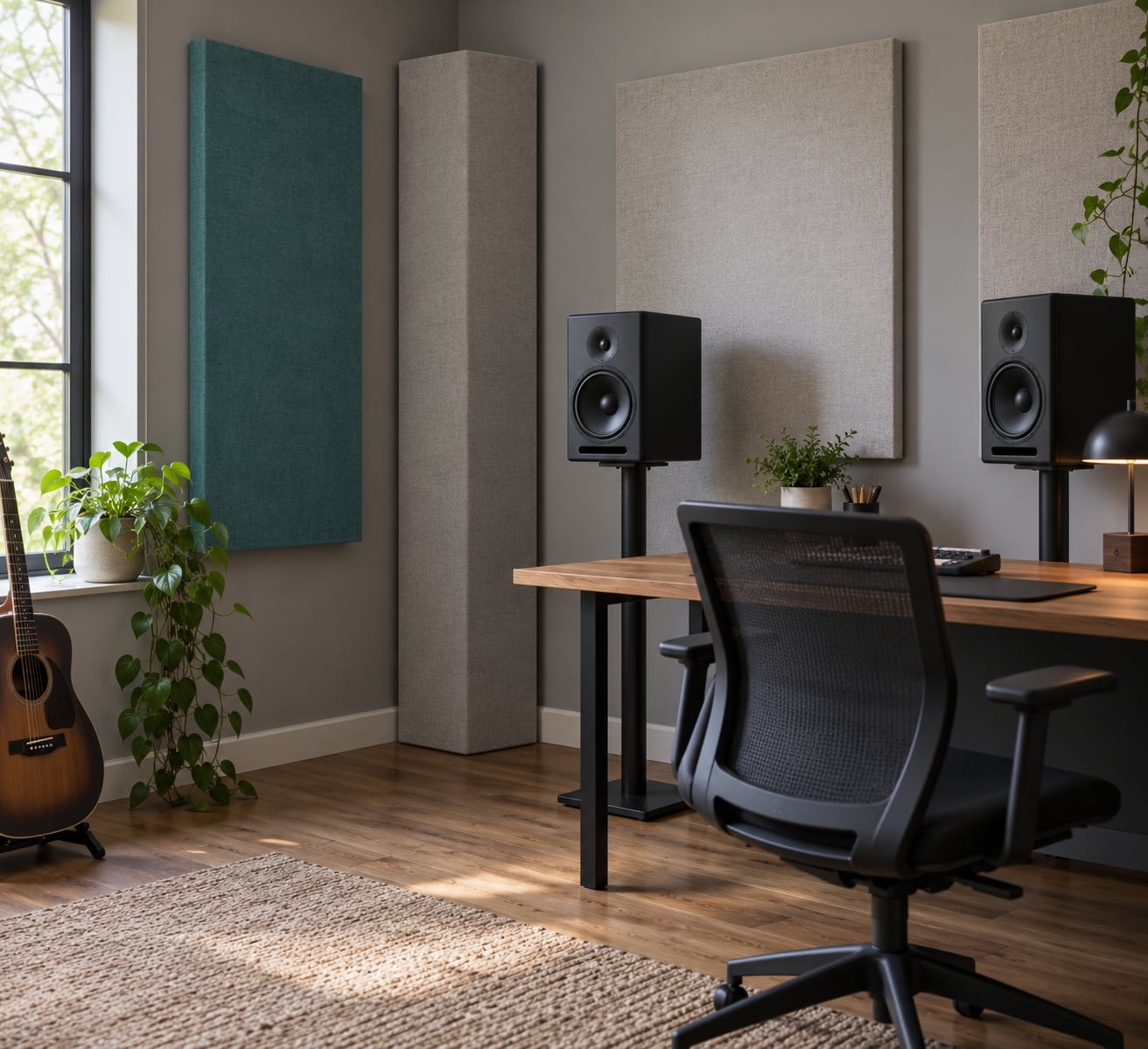
Acoustic panels and bass traps do not do the same job. Panels are thin absorbers, usually 2 inches deep, that tame reflections in the midrange and treble. Bass traps are much deeper, usually 4 to 8 inches, and they soak up the low-frequency energy that collects in a room’s corners.
That difference decides everything else: which wall you hang things on, how much space they eat up, and whether your low end improves at all. Get it wrong and you end up with a dead-sounding room that is still boomy in the bass.
Below is a room-by-room breakdown of acoustic panels vs bass traps, including where each one goes and what symptom in your room tells you which to buy first.
Table of Contents
- Acoustic Panels vs Bass Traps at a Glance
- What Is the Difference Between Acoustic Panels and Bass Traps?
- Can thick acoustic panels replace bass traps?
- How Do Acoustic Panels Reduce Sound Problems?
- The air gap behind the panel
- The core material
- Quantity and spread
- How Do Bass Traps Control Low-Frequency Sound?
- Where Should You Place Acoustic Panels?
- Where Should You Place Bass Traps?
- Which Is Better for Your Room?
- Home studio and bedroom producers
- Offices and conference rooms
- Home theaters
- Podcast and voice-over rooms
- Practice rooms and untreated living rooms
- Do You Need Both Acoustic Panels and Bass Traps?
- Which Should You Choose?
- Frequently Asked Questions
- Are bass traps better than acoustic panels?
- Do acoustic panels work for bass?
- How many acoustic panels does a room need?
- Where is the best place to put bass traps?
- Can I use acoustic panels instead of bass traps in a small room?
- Do I need both panels and bass traps for a home studio?
- Conclusion
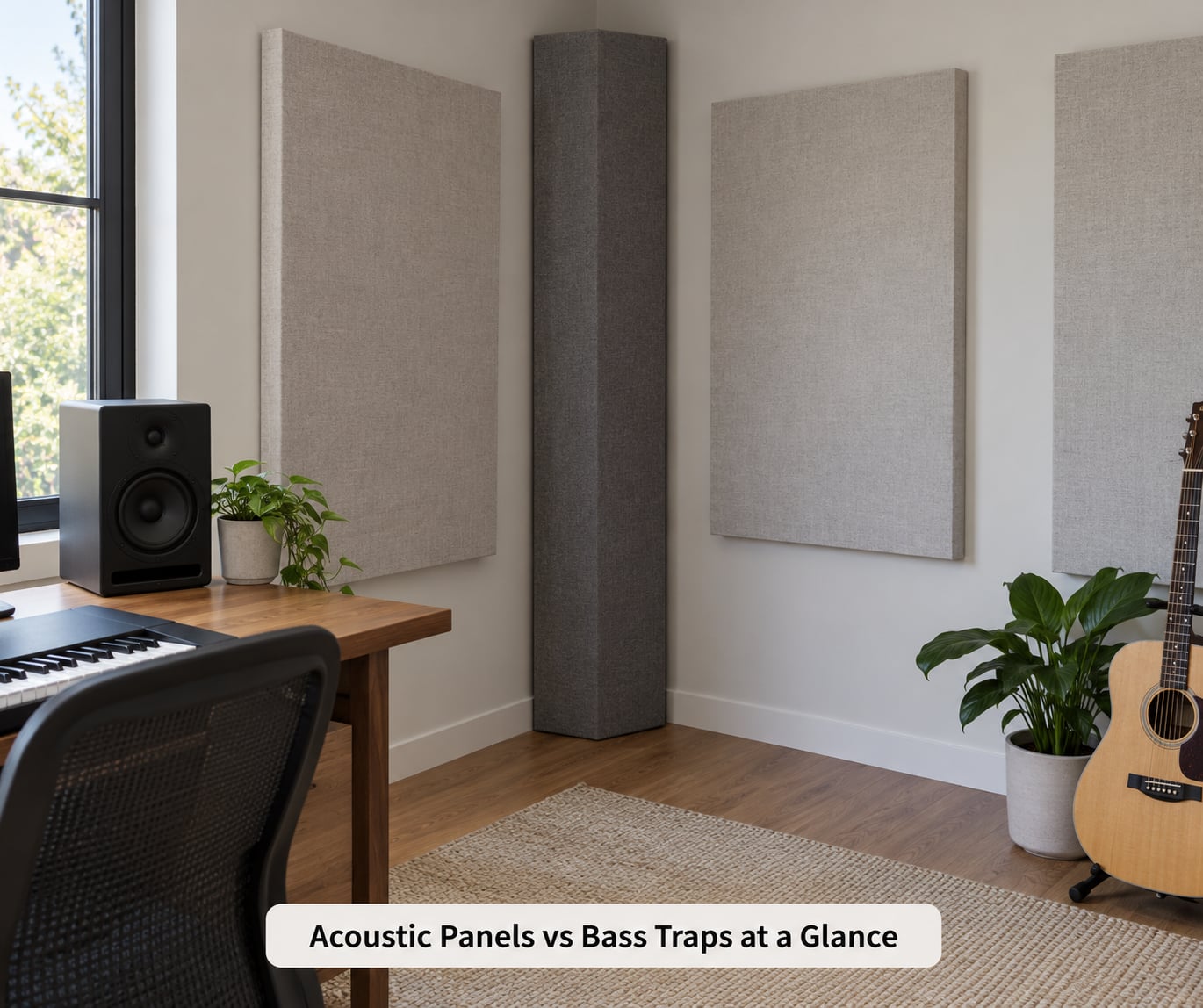
Acoustic Panels vs Bass Traps at a Glance
| Criterion | Acoustic panels | Bass traps |
|---|---|---|
| Primary job | Absorb reflections and control reverberation | Absorb low-frequency buildup and room modes |
| Frequency range | Mainly above 300 Hz, working up through speech and treble | Mainly below 300 Hz, with tuned traps aimed at narrow bands |
| Typical thickness | 2 inches, sometimes 3 to 4 | 4 to 8 inches of porous material, plus air gap |
| Where they go | Flat walls, ceilings, behind monitors and speakers | Corners, vertical column position, floor to ceiling |
| Shape | Rectangular, square or hexagon, flat against a surface | Triangular prism, cylindrical column or wide flat panel |
| Room coverage needed | Several, spread across the listening area | A few, one per corner for even low-frequency control |
| Best for | Echo, flutter echo, harsh reflections, vocal clarity | Muddy or boomy bass, uneven low end, corner buildup |
| Mistake it corrects | Sounds like you are in a stairwell, too much reverb | Sounds like the kick drum is in the room with you |
One more difference matters more than people expect: panels are usually mounted with an air gap behind them, while a bass trap is built to stand away from the corner so it has depth to work with.
What Is the Difference Between Acoustic Panels and Bass Traps?
Acoustic panels are fabric-wrapped or exposed absorbers mounted flat against a wall or ceiling. A 2-inch panel is the industry default, and it does its best work on sound waves whose wavelength is short enough for that depth to matter, which in practice means the midrange and treble.
Bass traps are the deeper cousin. They are built to be 4 to 8 inches thick, often in a triangular shape so the diagonal face fills a room corner, and they are aimed squarely at the low end where wavelengths are long and pressure does not fall off neatly with distance.
The AI Overview that sits above most results for this query frames it the same way, splitting the comparison into frequency range and size and thickness. That framing is correct, and it is why the two products get confused: both are sold as “acoustic treatment,” both use the same fabric, and both look like soft rectangles.
Can thick acoustic panels replace bass traps?
Partly, and this is the question that comes up most often on r/audioengineering. A 4-inch or 6-inch panel does absorb meaningfully more low end than a 2-inch one, because thickness is what lets a porous material interact with longer wavelengths.
What it does not do is replace a corner-positioned trap. A flat panel on a flat wall treats a first reflection point; a trap treats the pressure maximum where two walls and the floor meet. Those are different acoustic problems, and stacking panels on the same wall does not move treatment into the corner.
How Do Acoustic Panels Reduce Sound Problems?
Both products are porous absorbers. Sound energy moves into the material, oscillates against its fibres, and dissipates as a small amount of heat. Panels do that job at the point where sound is bouncing back at you.
Three things decide how well a panel works:
The air gap behind the panel
Mounting a panel flat against drywall wastes most of its thickness. A 2-inch panel held 2 inches off the wall behaves closer to a 4-inch panel, because the trapped air volume is part of the absorber. This is why panels mounted flush feel thin and disappointing.
The core material
Mineral wool and fiberglass work well because they are fluffy and let air move through them. Dense closed-cell foam is worse at depth: its high airflow resistance reflects sound rather than letting it in, which is the main complaint people raise about foam in general.
Quantity and spread
A single panel fixes a single reflection point. Two panels opposite each other handle both side walls. Four or six spread across a room start to bring the overall decay time down, which is what makes a room sound controlled rather than merely patched.
How Do Bass Traps Control Low-Frequency Sound?
Bass behaves differently from the rest of the spectrum. Low frequencies have wavelengths long enough that they bend around obstacles rather than bouncing off them, and in a rectangular room they pile up at the surfaces where waves reinforce each other: the corners.
That is why corner placement is not a stylistic choice. A bass trap in a corner sits exactly where the pressure is highest, and it works hard from there across a broad band rather than at one narrow frequency.
Depth is the other half of the story. Low frequencies need more material in the direction of travel to be absorbed, which is why traps are thicker than panels and why the air gap behind them matters so much. A trap placed flush in a corner wastes the geometry that makes it effective.
The evidence people trust most comes from measured tests rather than marketing. GIK Acoustics published Room EQ Wizard frequency-response and waterfall decay tests comparing foam traps with fiberglass traps in the same corner coverage: foam barely moved the response below about 250 Hz, while the fiberglass traps showed real control from roughly 65 Hz, and an untreated room showed bass decay beyond 500 ms.
On r/Acoustics the consensus matches the data. People generally conclude that thin panels are fine for mids and highs, but that dense foam is a poor bass absorber compared with fluffy mineral wool used at depth.
Where Should You Place Acoustic Panels?
Start at the first reflection points, because that is where echo is generated. Sit at your normal listening position and have someone slide a mirror along the side wall from the monitor toward you; the point where you see the monitor in the mirror is the first reflection point. Hang a panel there.
Repeat it on both side walls, then treat the rear wall behind your listening position if the room is reflective enough to hear the back wall echo back at you.
Ceilings need attention too, especially a hard floor or a window behind your speakers bouncing sound down at you. A ceiling cloud, which is a panel suspended with an air gap rather than glued flat, tames vertical flutter echo between floor and ceiling.
Leave space around panels. Mounting them a couple of inches proud of the wall costs you a few inches of room and buys real absorption. Over-covering a small room with foam is the other common mistake: the room goes flat and lifeless, and the bass is still exactly where it was.
Where Should You Place Bass Traps?
Corners first, then spread them out. One trap in one corner lowers the low end in that corner, but an untreated corner two feet away can still boom, so even distribution beats concentration. In a typical bedroom studio, two or four corner traps beat a single stack.
Run them vertically. A floor-to-ceiling trap occupies the full height of the corner and soaks up sound arriving from above as well as from the side. That is why floor-to-ceiling columns are the usual choice for a bedroom or home office where floor area is precious and vertical space is not.
Keep them slightly off the corner. A trap shoved hard into the junction of two walls loses the diagonal face that makes the geometry work. Leave an inch or two and the trap behaves as designed.
One r/hometheater owner reported installing 23 wall bass traps over about two months and being very happy with the result. That is a well-treated dedicated theater, not a small room, so treat it as a ceiling rather than a starting point.
Which Is Better for Your Room?
Home studio and bedroom producers
Both, in that order: traps in two or four corners first, panels at first reflection points next. Small rectangular rooms have strong room modes, so a bedroom producer who only installs panels will record into a boomy low end that no amount of monitoring accuracy fixes.
Offices and conference rooms
Panels, mostly. The complaints in these rooms are speech intelligibility and flutter echo between parallel surfaces, which are midrange problems. A handful of panels on the wall behind the hard-seat occupants often solves most of it. If your desk has a subwoofer and neighbours complain, add one or two traps behind it.
Home theaters
Both again, with more of each. Dedicated theater rooms are larger and need broadband low-frequency control for the surround channels and subwoofer, so floor-to-ceiling traps in every available corner plus panels on the first reflection side walls is the usual target.
Podcast and voice-over rooms
Panels, and treat the room as a small vocal booth. The audible problems are slap echo off bare walls and flutter between parallel surfaces. Depth of low-frequency control matters far less in a room with a person talking into a microphone from 8 inches away.
Practice rooms and untreated living rooms
Panels for everyday comfort, since the goal is simply to lower the ringing and the harshness. These are rooms where bass is rarely the complaint, and soft furnishings do more than anything on the wall.
Do You Need Both Acoustic Panels and Bass Traps?
Usually yes, because they fix different problems and most untreated rooms have both. But one is sometimes enough, and that is a legitimate way to spend a budget.
A simple framework, keyed to what you actually hear:
- Loud echo or flutter between parallel surfaces, bass is fine: panels only.
- Muddy, boomy low end that swells and drops around the room: bass traps first, panels later.
- Both problems, in a room under about 150 square feet: traps in two or four corners, then panels at first reflection points.
- Hard surfaces everywhere and complaints from the next room: neither product helps. That is isolation, not treatment, and it needs a different approach entirely.
That fourth point is the most common misunderstanding. Acoustic treatment controls sound inside the room. Soundproofing, or isolation, controls sound leaving the room, and no foam panel or trap does that.
A rough rule of thumb for an average bedroom-sized studio: two corner traps and four to six panels gets you most of the available improvement. Go further only if you can measure that it helped.
Which Should You Choose?
Choose panels if your problem is reflections: echo, a bright or reverberant room, speech you cannot follow in an office, or vocal takes with a slap in them. They are cheaper per unit, easier to mount, and the highest-value fix in most living spaces.
Choose bass traps if your problem is low frequency: bass that blooms in one corner and disappears in another, a kick drum that sounds like it has its own room, or a subwoofer that excites the walls. Thickness and core material matter more than brand here, and a 4-inch mineral wool trap at 8 inches from the corner will outperform a thin foam panel sold as a bass trap.
Choose both for a complete small-room treatment strategy, starting with the corners. Treat the low end first, then the reflection points, then reassess with a measurement sweep before spending anything else.
One last trap in the buying process: check that a product sold as a bass trap is actually deep enough and made of a porous material like mineral wool or fiberglass. Foam wedges marketed as bass traps barely touch anything below about 250 Hz, and that is the band you were trying to fix.
Frequently Asked Questions
Are bass traps better than acoustic panels?
Neither is better; they target different frequency problems. Bass traps work below about 300 Hz, which is where energy piles up in room corners. Acoustic panels work mainly above 300 Hz, controlling reflections, echo and reverberation on flat surfaces. A room with boomy bass needs traps even if it has plenty of panels, and a bright, echoey room needs panels even if the low end is clean.
Do acoustic panels work for bass?
They help, but only up to a point. A 2-inch panel does very little below 300 Hz because low-frequency wavelengths are far longer than the material is thick. Moving up to 4 or 6 inches, and mounting the panel with an air gap behind it, extends how low you can go. That still leaves the corner buildup that only a properly placed bass trap addresses.
How many acoustic panels does a room need?
For a small studio, expect four to six panels covering roughly 40 to 60 percent of the wall and ceiling surfaces behind and beside the listening position. Two panels, one on each side wall at the first reflection point, plus two on the rear wall is a solid start. More than that rarely helps in a small room, where over-treatment leaves the space sounding flat.
Where is the best place to put bass traps?
In the corners, standing vertically, starting at the floor and running up as high as you can manage. A floor-to-ceiling column in the rear corners usually gives the biggest improvement in a small room. Leave an inch or two between the trap and the corner junction so the diagonal face stays effective, and spread traps across corners instead of stacking them all in one.
Can I use acoustic panels instead of bass traps in a small room?
You can, and it is a reasonable way to spend money when bass is not your main complaint. Just know what you are giving up: uneven low end and room modes will remain. If you already own 4-inch panels, hang them and listen before buying more, then add two corner traps if the low end still swells around the room.
Do I need both panels and bass traps for a home studio?
Most home studios benefit from both, and the order matters. Treat corners with bass traps first, because uneven low end makes every judgement about the rest of the room unreliable. Then add panels at the first reflection points, the rear wall and any hard ceiling area. If you can only afford one purchase, buy traps in a room smaller than 150 square feet.
Conclusion
The distinction is simple enough to hold in your head: panels are thin and go on flat surfaces to control midrange and treble reflections, while bass traps are deep and go in corners to absorb low-frequency buildup. Choosing the wrong one leaves the other half of your room’s sound problems untouched.
Identify your symptom first. Loud echo and a bright, reverberant room calls for panels. Bass that booms in one spot and disappears in another calls for traps, placed vertically and spread across corners. Both symptoms in a small room means corner traps first, then panels at the first reflection points.