Fishing from shore works when you pick the right water, match your tackle to it, and read what the fish are doing before you cast. Most trips fall apart for boring reasons: casting into open water, using the wrong leader, or setting the hook a second too early. Learn how to fish from shore effectively and a bank, jetty, or pier becomes productive water all year.
It takes about an hour of setup and a few trips to get comfortable, and the whole thing runs on gear you can carry. You do not need a boat, a trailer, or a cart full of lures. You need a rod that reaches, a rig that holds, and the patience to stay put a little longer than feels comfortable.
Table of Contents
- What You Need to Fish from Shore Effectively
- Step-by-Step: How to Fish from Shore Effectively
- How to Choose a Productive Shore Fishing Spot
- How to Match Your Rod, Reel, and Line to the Conditions
- How to Choose Bait and Lures from Shore
- How to Cast Accurately and Avoid Tangled Line
- How to Read the Water and Set the Hook
- How to Land, Handle, and Release Fish Responsibly
- Common Mistakes
- Frequently Asked Questions
- What tackle do beginners need for shore fishing?
- How do I fish in the wind from shore?
- Is shore fishing good for saltwater beginners?
- How do I cast further from shore?
- What is the best rig for shore fishing?
- How do I stop shore fishing damage to the shoreline and fish?
- Conclusion
What You Need to Fish from Shore Effectively
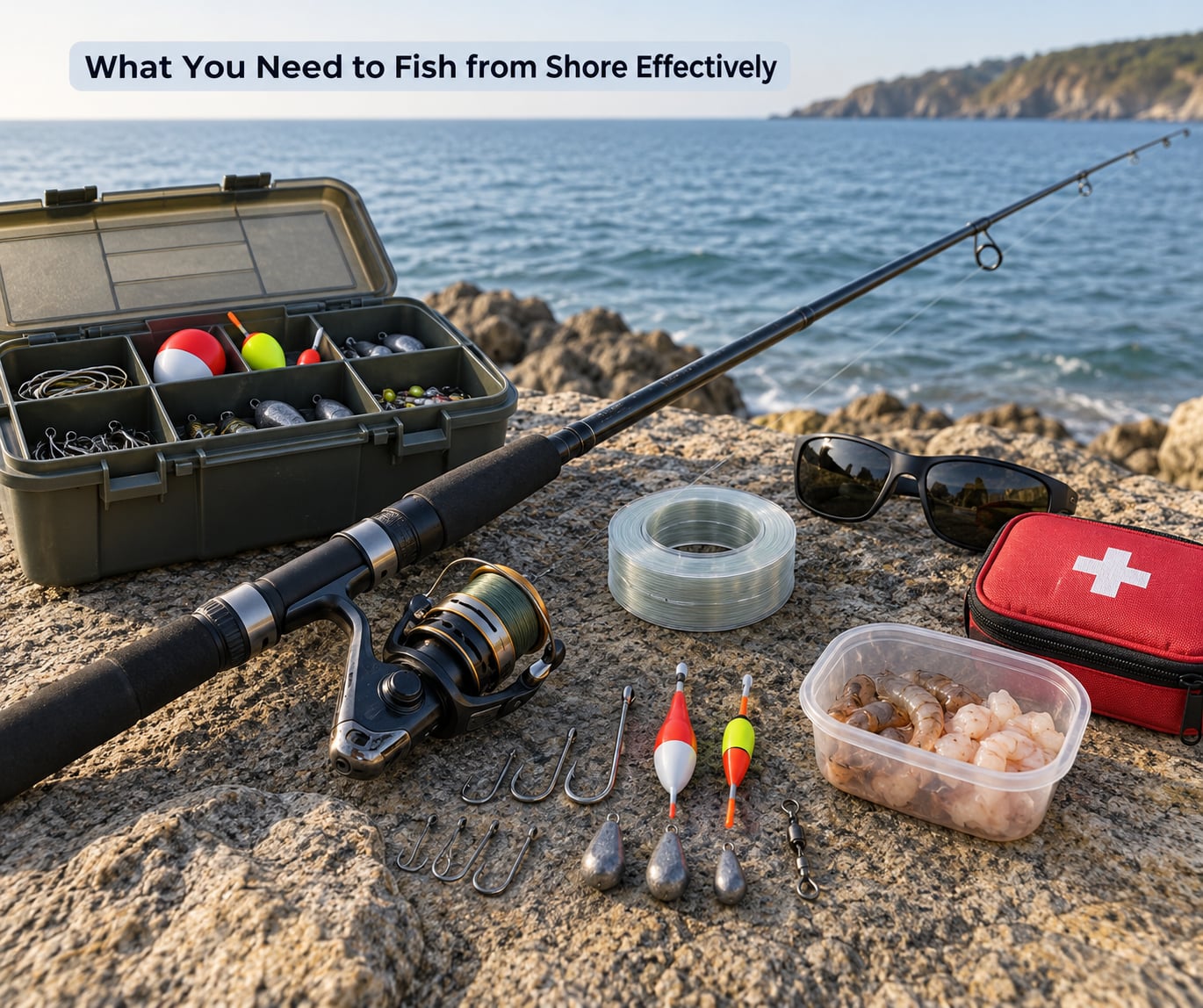
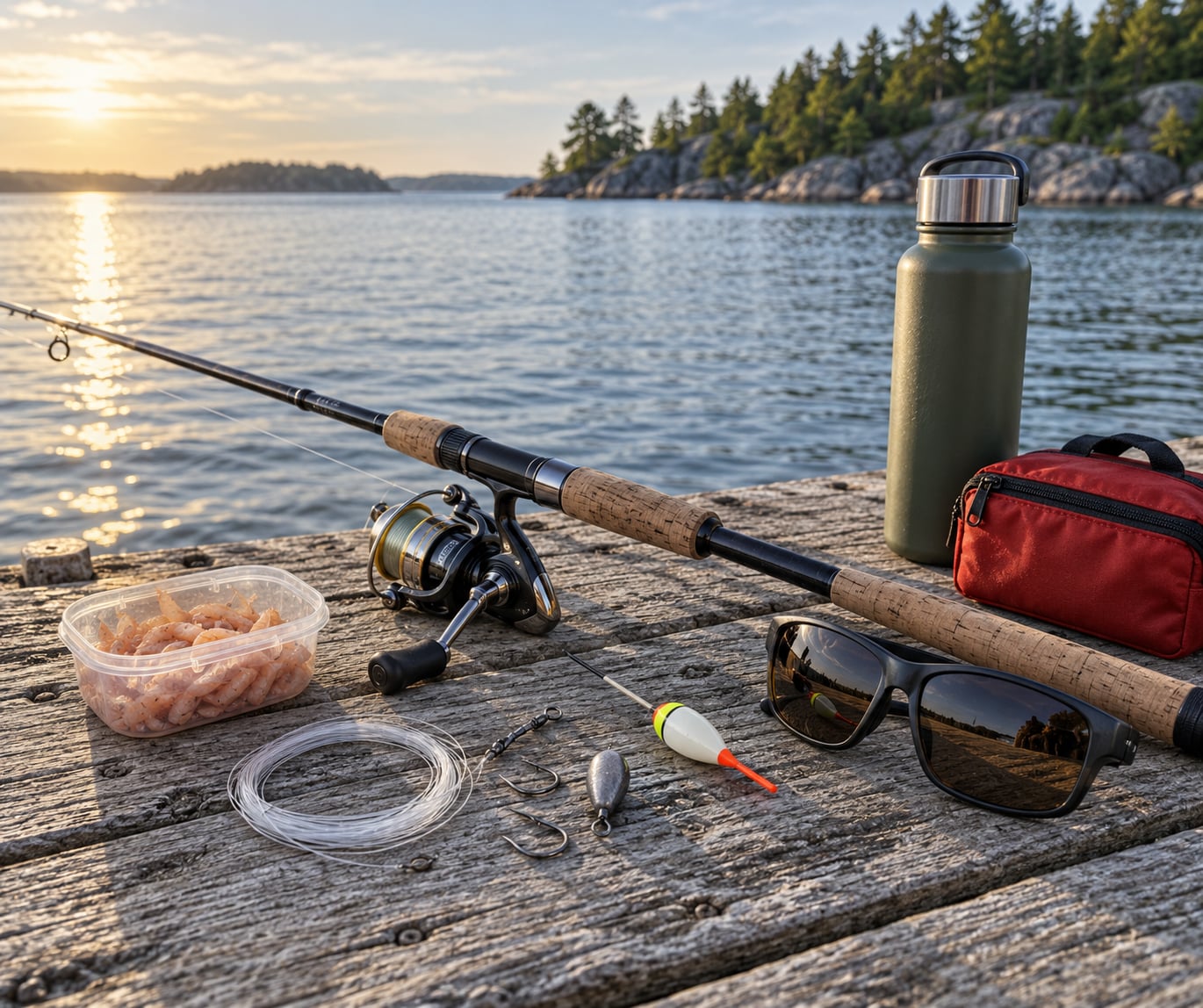
The core kit is short, and you can carry all of it in a backpack. Everything past that list depends on whether you are fishing fresh or salt water.
| Gear item | What it does for you | Fresh or salt |
|---|---|---|
| Rod, 7 to 9 ft | Covers panfish, trout, and most inshore work from a bank or pier | Both |
| Rod, 10 to 12 ft | Pushes lures and baits past surf breakers and into deeper water | Both, heavier end |
| Spinning reel, size 2000 to 4000 | Handles light line and small bait with an easy drag | Both |
| Braid with a fluorocarbon leader | Low stretch for bite feel, leader for abrasion and tooth protection | Both |
| Egg, pyramid, or sinker weights | Holds bait on the bottom in current and surf | Both |
| Circle hooks in 1/0 to 2/0 | Work well for live bait and release well for trout and bass | Both |
| Swivels and split shot | Prevent line twist and control bait depth | Both |
| Pliers, line cutter, spare hooks | Fix stripped line on the bank instead of ending the trip | Both |
| Polarized sunglasses | Cut glare so you can see structure and moving fish | Both |
| PFD, water, layers | Keeps you safe on slick rock and in cold water | Both |
A life jacket matters most on rocks and jetties, and it costs nothing to wear it every trip. Anglers fishing from a pier over moving water should treat it the same way.
Fresh and salt water split mostly at the terminal tackle and the line. Salt eats steel, so stainless hooks and corrosion-resistant swivels are worth the upgrade, and mono line in surf goes cloudy and brittle fast. Fresh water anglers can get away with cheaper hardware, especially on a lake or a slow river.
Step-by-Step: How to Fish from Shore Effectively
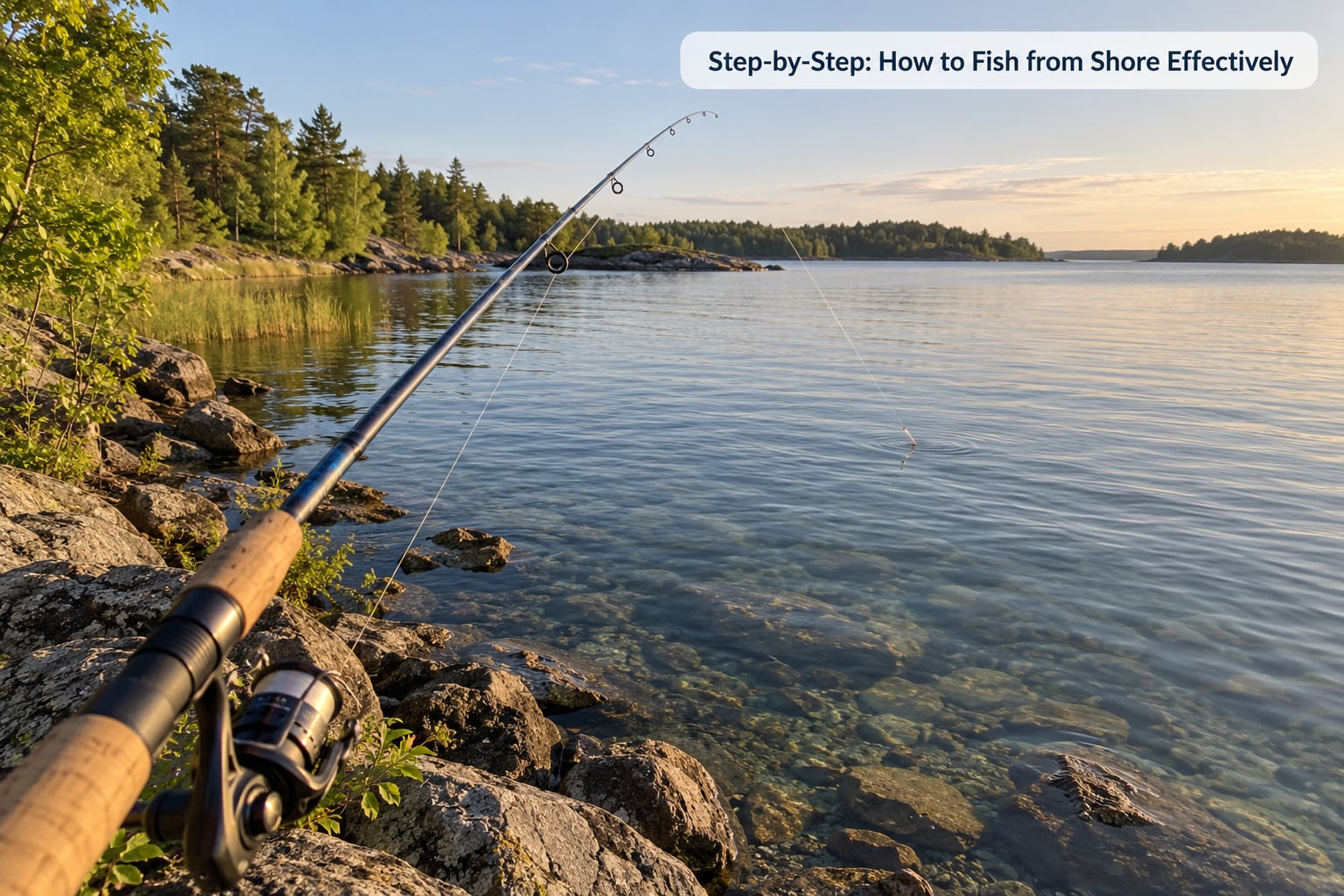
The eight steps below run in the order they happen on a real trip. Follow them in sequence the first few times, and the process stops feeling like guesswork.
How to Choose a Productive Shore Fishing Spot
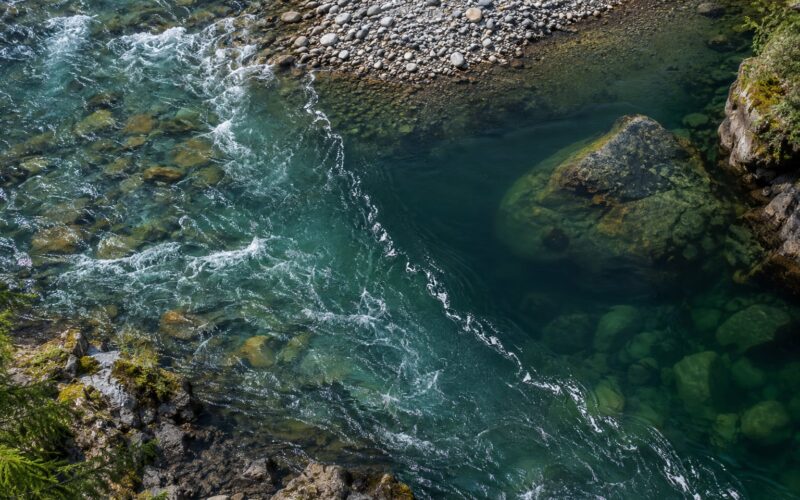
Look for the seam where two different things meet: a channel edge beside a shallow flat, a rock that interrupts a sandbar, the shadow side of a current break, or the drop where a bank goes from deep to shallow. Fish stack at those transitions because food gets pushed and held there.
Four things to look at before you make the first cast. Structure that extends into deeper water, because a point or a fallen tree reaches out past the comfortable shallow and fish use it as a highway. Depth change, which you can often read from the color of the water. Current seams in rivers, where the fast water slides past the slow water and eddies spin off downstream. And feeding signs: birds diving, surface swirls, or a bait school visibly breaking.
Before you commit, spend ten minutes scouting rather than fishing. Walk the bank first and fish it second. Beginners who walk a spot, cast into three places, and leave get more fish per hour than those who never stop.
Check the access and the rules before you unpack. Confirm the license and any species-specific permit, look for posted closures or private property lines, and note the footing. A slick boulder that looks like a five-minute cast from the parking lot can be a thirty-minute scramble back in the dark.
How to Match Your Rod, Reel, and Line to the Conditions
Match the rod to the distance you need and the water you are standing in. A 7-foot spinning rod handles a creek bank and a pier; a 10-foot rod with medium power covers surf and rock; a 12-foot heavy rod reaches jetties and structure where fish get big and heavy.
| Rod length | Typical reach | Best water type | Reel pairing |
|---|---|---|---|
| 6 to 7 ft | Under 25 yards | Creek banks, small ponds, close pier work | Size 2000 or 2500 spinning |
| 8 to 9 ft | 25 to 40 yards | Lakes, river banks, docks | Size 2500 or 3000 spinning |
| 10 ft | 40 to 60 yards | River bends, inlet edges, jetty sand | Size 3000 to 4000 spinning |
| 11 to 12 ft | 60 yards and beyond | Surf, rocks, open shoreline | Size 4000 spinning or a small conventional reel |
Line choice follows the bite detection you need. Braid stretches almost not at all, which makes it excellent for feeling a tap on the bottom in heavy current, and it cuts through algae and shells where mono frays. The trade is visibility and shock. Tie a 2 to 4 foot fluorocarbon leader on the end and you get both bite feel and abrasion resistance.
Monofilament is easier to see and handles casting weight more kindly on a light rod, which makes it a fair first choice on calm water. Fluorocarbon disappears underwater and works well as a leader material, but it is stiff and costs more, so it rarely makes sense as the main line for a beginner.
Line test is simply the weight the line is rated to hold. Somewhere between 8 and 20 pound covers most freshwater shore work. For surf casting in rocks, many anglers run 30 to 50 pound braid with a shock leader of 60 to 100 pound, because that stretch-free line needs something stronger behind it to survive the drag and the structure.
How to Choose Bait and Lures from Shore
Fresh bait beats frozen bait more often than not. Shrimp, squid, and sand fleas work better when they still smell like the water, and oily fish like mackerel, sardine, or pilchard make strong cut bait. Fresh over frozen is the simplest upgrade available to a beginner.
Match the bait to what the fish are eating right now, not to what is generally popular. If you see birds working over a school, look at what the birds are chasing. Cut bait is more forgiving than live bait because nothing has to be kept alive for the trip.
On open water with no visible feed, reach for a soft plastic worked slow along the bottom or a spoon retrieved with pauses, since both produce their own vibration in water that has no current. Near a current seam, a jig head with a soft plastic dropped and pulled across the seam works because it crosses the break at an angle. For panfish, a small jig or a plain hook under a bobber is faster than anything else, and it lets kids catch fish on the same spot the adults are working.
Keep bait sizes modest. A hook dressed with an oversized piece of bait mostly catches the bait, and a hook too large for the fish you are after is the single most common reason beginners come back empty.
How to Cast Accurately and Avoid Tangled Line
The overhead cast covers the most ground and suits a clear area behind you. Move the rod tip back over your shoulder, pause at the top of the backcast to let the line straighten, then accelerate forward and stop the rod at shoulder height when the lure reaches the water.
The pendulum cast works where you cannot turn around, near a wall or a tree, or on a bank with a drop behind you. Let the lure hang, pull the rod up from the tip until the line is straight, then swing it forward under your arm like a pendulum. The lure lands softly and quietly, which is exactly what you want near feeding fish.
The sidearm cast is the flattest of the three and the hardest to master, so treat it as a later upgrade. The off-the-ground cast keeps the line in the air and is worth learning in strong wind, where a low line slaps into the water.
Wind decides everything about your cast. A tailwind adds distance and lets you use a lighter lure. A headwind cuts distance and blows the line sideways into loops, so cast lower and lean into it, or work on an angle. When the wind is behind you, the line straightens out on its own and you will feel the lure carry.
To prevent wind knots and backlash, clear the line behind you before you load it. Ankle-deep loops and mats of line are almost always a tangled mess waiting to lock up in the guides. Re-lay them in long straight runs with fingers spread, and check the spool is not reversed.
Practice the motion without a lure for five minutes before you fish. Distance comes from the stop in the rod motion, not from more power.
How to Read the Water and Set the Hook
Watch where the line enters the water and what it does next. Line that moves sideways, steadily, is being pushed by current. Line that slackens is over a drop or a hole. Line that stays still while the surface moves around it is on the bottom in flat water.
Choose a presentation from that reading. In current, let the rig drift and feel for a slow stop or a pickup, then give slack line back as it moves. On the flat bottom, hold still and let a bobber tell you when something eats. Near a seam, work the lure across the break so it changes depth as it passes.
Watch the bobber and the rod tip, not your hands. A bobber that dips under and keeps pulling is a fish. A bobber that twitches a quarter inch and settles is often a fin or a current change, but a twitch that repeats is worth setting the hook on. On braid with no float, any sudden tap that goes quiet deserves a lift.
Wait long enough before you set the hook, because a fast strike means the fish is swimming away with the bait and a slow one means it is still on the line. Use a firm, short sweep rather than a big arm motion. Pull hard enough to drive the hook past the mouth, then stop lifting and let the reel take over, because continuing to pull only pulls the hook back out.
Once the hook is set, keep light pressure and do not give slack. From shore, the biggest risk is a snag in structure above or beside the fish.
How to Land, Handle, and Release Fish Responsibly
Land fish on a net whenever you can, and if you lift one by hand, wet your hands first. A dry grip damages the slime coat that protects the skin and scale, and that shows in survival rates and in how the fish looks when you release it.
Keep handling time short and keep the fish in the water while you remove the hook. A long nose plier or a fish gripper does less damage than squeezing the body, and a barbless hook or circle hook usually comes out without a tool at all. If the rules require the fish to stay, put it in a bucket or a livewell with river water rather than a livewell on a hot shore.
Check the local size and bag limits before you fish, not after. Many species are under a minimum or over a maximum, and a few carry seasonal closures, so the answer changes by month. Keep only what you will eat, and release breeding fish quickly regardless.
Take your rubbish with you, including line and hooks. Monofilament left on the bank is a hazard for birds and everything else after it, and cut line fragments are the most commonly ingested plastic in the ocean. Stay on durable surfaces and off spawning gravel and marsh grass, and you leave the spot better than you found it.
Common Mistakes
Most skunked trips come from a short list of avoidable errors. Here they are with the fix.
Casting into open water. Nothing holds bait in a void. Pick a piece of structure and put your lure on the edge of it, not past it.
Ignoring wind and tide. A rising tide pushes fresh bait into an inlet and moving water pushes fish onto structure. Check the tide table before the drive, then fish the stage that suits your target rather than the stage that suits your schedule.
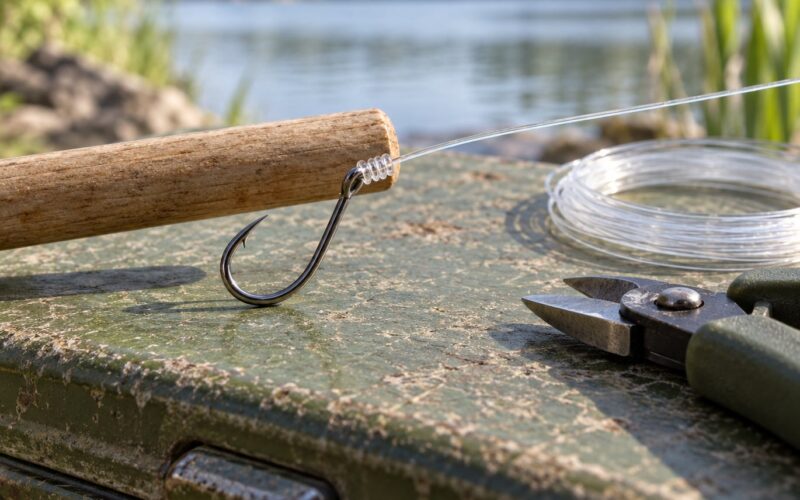
Using line with no leader. Braid straight to a hook abrades and breaks. Two feet of fluorocarbon costs almost nothing and saves the trip.
Casting into heavy cover. Fishing a snag-filled rock means losing tackle. Fish the surface edge and let the retrieve carry the bait out before it enters the structure.
Pulling too quickly or setting too late. Give the fish time to swallow the bait, then set with a firm sweep and stop pulling.
Failing to check local rules. Licenses, size limits, and seasonal closures are enforced, and the fine is far more expensive than a good day of fishing.
Being loud and visible. Fish notice shadows long before they notice people. Approach quietly, avoid bright white clothing, and skip stones in shallow water rather than splashing through it.
Frequently Asked Questions
What tackle do beginners need for shore fishing?
Most beginners do fine with a 7 to 9 foot medium-power spinning rod, a size 2500 or 3000 spinning reel, 10 to 15 pound braid, and a 2 to 3 foot fluorocarbon leader. Add a sinker that matches the current, circle hooks, and a float for shallow water. That list covers panfish, trout, bass, and most inshore species without a single specialized piece of gear.
How do I fish in the wind from shore?
Put the wind at your back whenever the spot allows. A tailwind adds casting distance and straightens your line. In a headwind, cast lower and to one side, lean into it, and use a slightly heavier lure so it blows less. Reel in before the line piles behind you, and re-lay wind knots in long straight runs rather than trying to cast through them.
Is shore fishing good for saltwater beginners?
Yes, and it is one of the easiest ways to start in salt water. The surf and inshore species feed close to structure that a boat angler has to reach for. Bring a rod rated for salt water, stainless hooks, corrosion-resistant swivels, and expect to lose some tackle to rocks. Fishing an incoming tide at night near an inlet is a classic productive spot.
How do I cast further from shore?
Distance comes from a smooth load and a hard stop, not from brute force. Clear long straight runs of line behind you, use a rod length that suits the water, and stop the rod forward motion when the lure reaches the water. Practice the timing without a lure until the backcast and the stop feel the same every time. An off-the-ground cast also helps in crosswind conditions.
What is the best rig for shore fishing?
The fish finder rig is the best general shore rig because the sinker sits on the bottom and the leader keeps the bait above it where fish can see and feel it. The high-low rig offers more bait movement for surf and sand, and the Carolina rig works well when you want the bait off the bottom. A sliding weight or egg sinker is the simplest option for calm water and still water fishing.
How do I stop shore fishing damage to the shoreline and fish?
Keep hands wet when you touch a fish, limit air time on the bank, and release anything you are not keeping. Do not build a rig around submerged vegetation, and skip spawning gravel in the spring. Pack out every scrap of line, hooks, and rubbish, and stay on durable surfaces instead of trampling marsh grass that holds the shoreline together.
Conclusion
On your next trip, do five things in this order. Check the local license, size limits, and closures. Walk the spot and find the seam between deep water and something that holds bait. Watch the wind and the tide, then pick a side that puts the wind behind you. Match a rod to that water and add a 2 to 4 foot fluorocarbon leader to any braid. Make your first cast a deliberate one at the edge of structure rather than at open water.
Stay a little longer than feels productive. The improvement in how to fish from shore effectively comes from reading the water and reacting to it, and both take trips you have to finish.