How much protein do you actually need? For most adults, at least 0.8 grams of protein per kilogram of body weight each day, and roughly 1.2 to 2.0 g/kg if you are active, over 65, or eating in a calorie deficit. That first number is a floor set to prevent deficiency, not a finish line. This guide explains where the numbers come from, how to turn your own body weight into a starting range, and which foods make that range easy to hit.
Protein is the only macronutrient your body cannot store in a meaningful reserve. Carbs sit in your liver and muscles as glycogen, fat sits all over you as adipose tissue, and amino acids have nowhere to hide. So what you eat today gets used today, and the rest is broken down and burned or rebuilt.
That single fact explains almost every piece of conflicting protein advice you have read. Some people are quoting a minimum to stay healthy. Others are quoting a target for a specific goal. Both are right, and they answer different questions.
Table of Contents
- What Is a Good Daily Protein Target?
- How Much Protein Do Older Adults Need?
- Do Athletes and Very Active People Need More Protein?
- How much protein do you actually need per workout?
- What About Protein for Weight Loss and Satiety?
- How Do You Calculate Your Protein Needs?
- Which Protein Sources Are Best to Eat Each Day?
- What is a complete protein, and do plant eaters need to combine foods?
- How Can You Tell If You Are Getting Enough Protein?
- Protein Myths, Warnings, and When to Ask a Professional
- When to talk to a clinician instead of a calculator
- Frequently Asked Questions
- Do vegetarians and vegans need more protein?
- Should I spread protein across meals or eat it all at once?
- Do I need protein powder to hit my protein target?
- How much protein do I need during pregnancy?
- Is more protein always better?
- Conclusion
What Is a Good Daily Protein Target?
A good daily protein target is one that sits above the deficiency floor and matches what your body is actually doing. For most adults doing ordinary daily life, that lands somewhere between 0.8 and 1.2 grams per kilogram of body weight.
The 0.8 g/kg figure is the Recommended Dietary Allowance, or RDA, set by health authorities such as the Institute of Medicine in the United States. It is estimated from the point where most healthy adults stop losing nitrogen balance, meaning the rate protein is broken down starts to match the rate new protein is built. It is a deliberately cautious number, calculated to cover nearly everyone in a population.
Here are the reference ranges that come up most often. Treat them as educational context, not a prescription for your body.
| Group | Grams per kilogram | Grams per pound | Example at 75 kg (165 lb) |
|---|---|---|---|
| Sedentary adult, no specific goal | 0.8-1.0 g/kg | 0.36-0.45 g/lb | 60-75 g |
| Regularly active adult | 1.2-1.6 g/kg | 0.55-0.73 g/lb | 90-120 g |
| Strength training or muscle gain | 1.6-2.2 g/kg | 0.73-1.0 g/lb | 120-165 g |
| Endurance training, long sessions | 1.2-1.7 g/kg | 0.55-0.77 g/lb | 90-128 g |
| Adults 65 and older | 1.2-1.6 g/kg | 0.55-0.73 g/lb | 90-120 g |
| During a calorie deficit | 1.2-1.6 g/kg | 0.55-0.73 g/lb | 90-120 g |
Two things change the picture. Body weight sets the base number, and your goal and activity set the multiplier. Someone at 75 kg lifting four times a week needs a different range than someone at 75 kg sitting at a desk all day, and neither of them needs a 300 g athlete’s intake.
A useful second reference point is share of calories. Many public health bodies suggest protein makes up roughly 10 to 35 percent of daily calories. If you eat around 2,000 calories a day, that works out to about 50 to 175 grams. It is a sanity check rather than a target, since it moves with your total intake.
How Much Protein Do Older Adults Need?
Adults over 65 generally need more protein per kilogram than younger adults, most often in the 1.2 to 1.6 g/kg range, and the reason is about how muscle responds to food.
After roughly age 30, adults lose muscle mass at a rate of about 3 to 8 percent per decade. The pace speeds up later in life. The condition of losing meaningful muscle and strength with age is called sarcopenia, and it is a real risk for falls, loss of independence, and slower recovery from illness or surgery.
The interesting part is not just that muscle disappears. Aging muscle becomes less responsive to protein. The anabolic response, meaning the signal that tells your body to build new muscle after you eat or lift, is blunted. Older adults can eat the same meal as their twenty-five-year-old neighbour and mount a smaller muscle protein synthesis response. That is why per-meal spread and consistent daily intake matter more with age, not less.
Older lifters in fitness forums frequently report needing more protein for recovery and maintenance than they did in their twenties, and the same pattern shows up in the research literature on protein and healthy aging.
Two practical notes. First, resistance training matters as much as the number on the plate: older adults who do progressive resistance work retain more muscle than those who do not, even at similar protein intakes. Second, illness and recovery from injury raise requirements temporarily, and during those periods appetite often drops, which is when protein density in a small volume of food helps.
If you are over 65 and live with a chronic condition, especially kidney disease, do not adjust your intake from a general article. Talk with your doctor or a registered dietitian first.
Do Athletes and Very Active People Need More Protein?
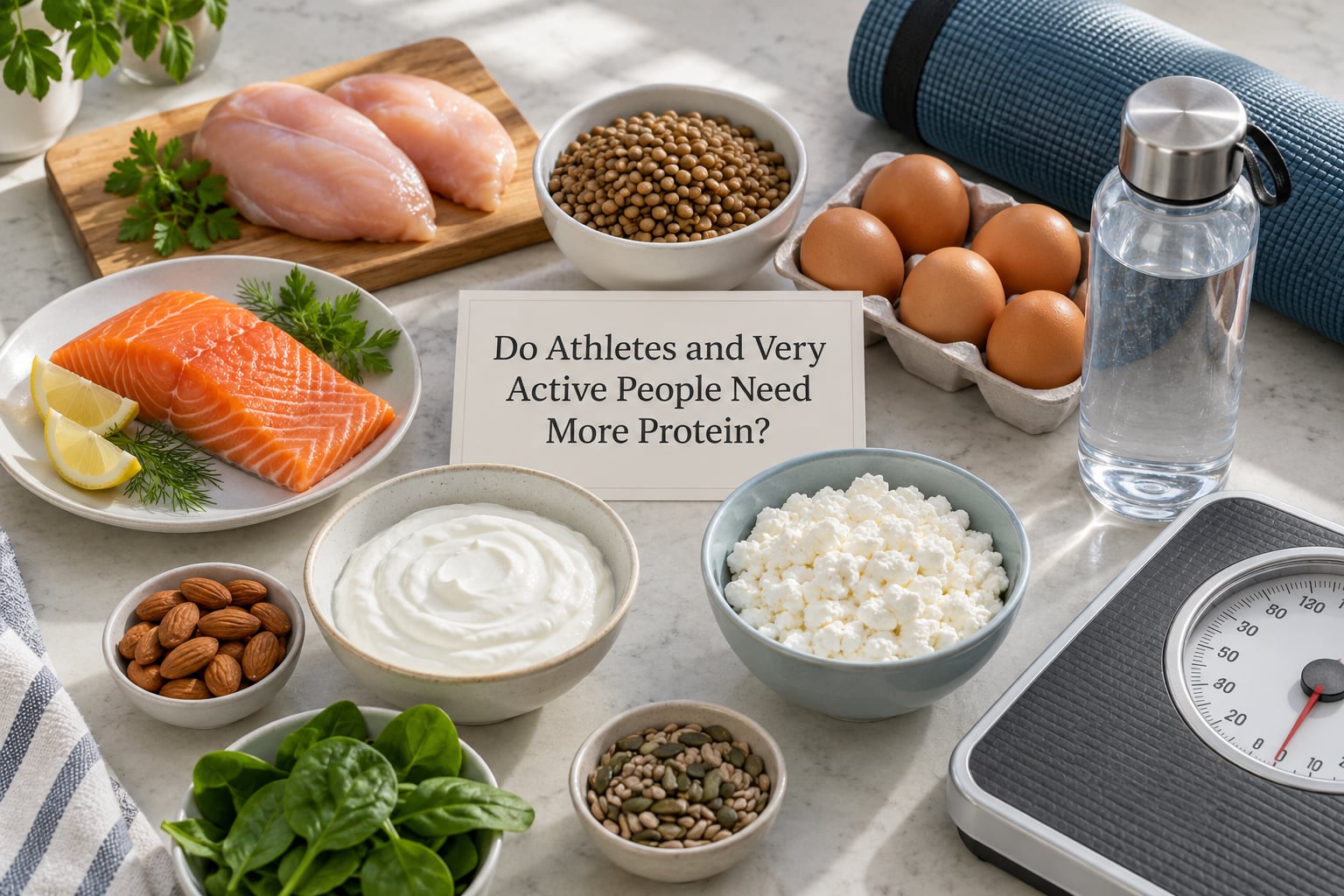
Yes, and the reason is repair demand. Training breaks tissue down, and protein is the raw material that puts it back together. Athletes training hard generally sit at 1.6 to 2.2 g/kg for muscle gain, with endurance athletes and mixed-sport athletes a little lower, around 1.2 to 1.7 g/kg.
Across the fitness communities people consistently describe somewhere between 0.7 and 0.8 g/lb (1.6 to 1.8 g/kg) as the sweet spot for muscle growth, while 1 g/lb is usually called overkill but kept around as an easy-to-remember ceiling. The research ranges above sit in the same neighborhood.
How much protein do you actually need per workout?
Per-session dosing usually scales with body weight too. The common guideline is roughly 0.25 g/kg per meal, landing near 20 to 40 grams for most adults, and it does not matter much whether you hit that with food or a shake.
Timing is the part beginners worry about most and it is the part that matters least. Total daily intake beats timing for nearly everyone outside of elite competition. What does help is splitting protein across three to five feedings rather than eating 90 percent of it at dinner, which is the single pattern most likely to underperform.
Vegetarian athletes face a practical version of the same problem: hitting 160 grams from whole foods alone takes planning, and soy protein, seitan, legumes and a plant powder are what most people in those communities actually rely on.
What About Protein for Weight Loss and Satiety?
Protein is the most satiating macronutrient per calorie, and that is the main reason it helps during a calorie deficit. High-protein weight loss stories almost always mention hunger control rather than muscle growth, and that is not a coincidence.
Protein digestes slowly and delivers amino acids, which interact with fullness signalling in the gut and hypothalamus. It also tends to blunt the hunger that shows up a few hours after a meal built mostly from refined carbohydrates. In practice, people eating a higher-protein diet at the same calorie total tend to report being less hungry, which makes a deficit easier to hold.
The second reason matters just as much. When you lose weight, part of what leaves is lean mass, and higher protein intakes during a deficit reduce how much of that happens. Fitness communities consistently report better body composition results at equal calorie deficits when protein is not low.
There is no single protein target for weight loss, because there is no single weight-loss plan. A reasonable general range is 1.2 to 1.6 g/kg, and it works best with resistance training and enough total protein spread across the day. But calorie balance still decides whether you lose weight. Protein shapes what you lose alongside the fat, not whether you lose it.
How Do You Calculate Your Protein Needs?
Here is a simple non-medical method for turning your body weight into a starting range. It is arithmetic, not a diagnosis, so if you have a medical condition or a specific training goal, treat the result as a first estimate.
- Convert to kilograms if needed. Divide pounds by 2.2. A 165 lb person is about 75 kg.
- Pick a multiplier from the table above. Sedentary 0.8 to 1.0, active 1.2 to 1.6, strength training 1.6 to 2.2, over 65 1.2 to 1.6.
- Multiply. Body weight in kg times the low end, then again with the high end.
- Split across meals. Divide by three to five feedings, aiming for 20 to 40 grams each.
- Check against real food for a week. Tracking apps are wrong often enough that your estimate is usually better.
Worked example: a 75 kg adult who lifts three times a week. At the low end, 75 times 1.6 is 120 grams. At the high end, 75 times 2.2 is 165 grams. Across four meals, that is 30 to 41 grams per meal, which is a plate of chicken and rice plus a yogurt, not four steaks.
If you carry a lot of body fat, using total body weight will overshoot. The usual adjustment is to calculate from a goal weight or from an estimated lean mass, which is what higher-body-fat lifters in these communities tend to do rather than using the number on the scale.
This method is a general tool. Anyone with kidney disease, liver disease, a history of disordered eating, diabetes, or a condition affected by diet change should work with a doctor or registered dietitian instead of a spreadsheet.
Which Protein Sources Are Best to Eat Each Day?
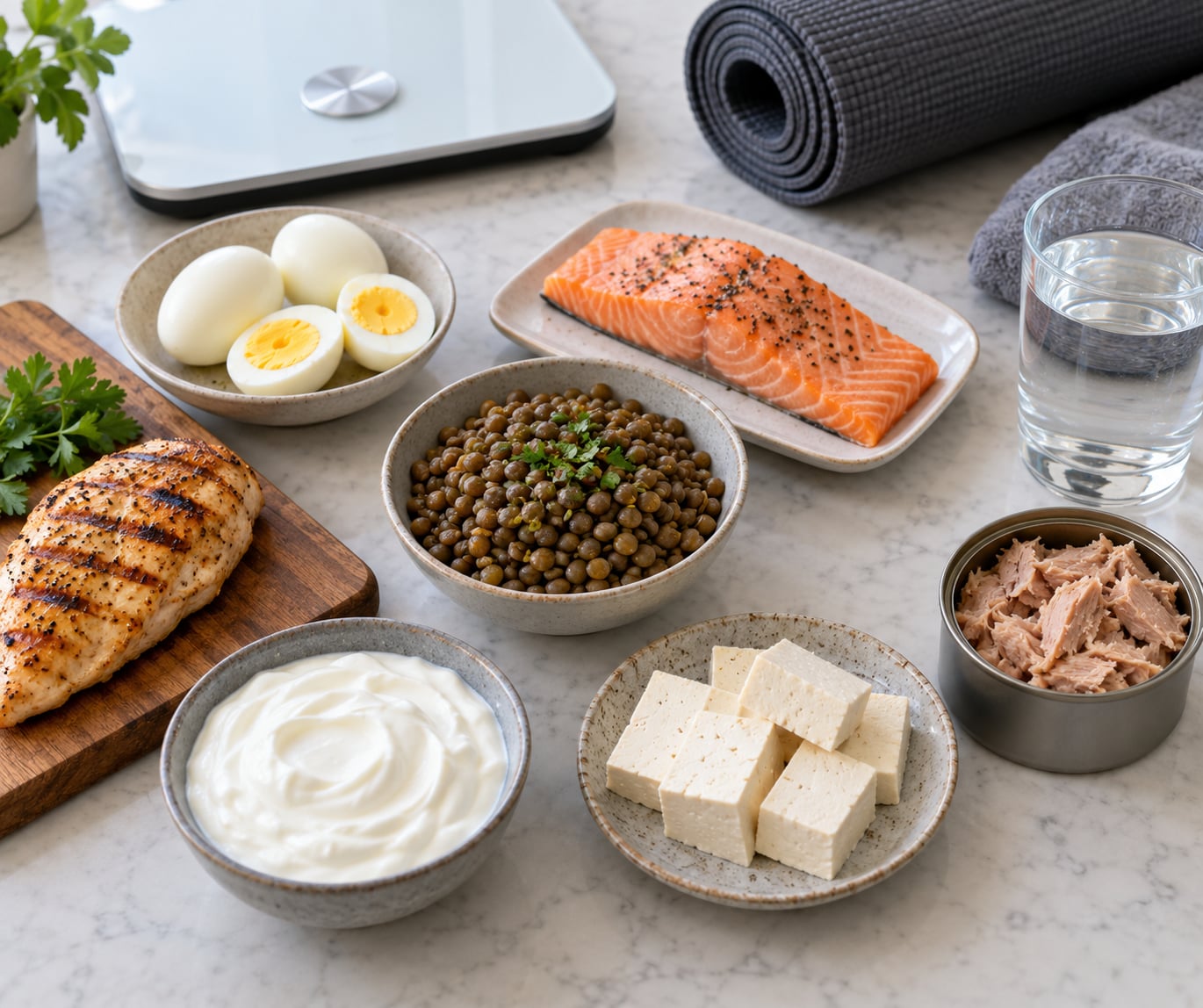
There is no single best source. What matters is protein per calorie, protein per serving of effort, and whether you actually like it enough to eat it every day. The table below covers common everyday foods, using typical household servings.
| Food | Typical serving | Protein | Notes |
|---|---|---|---|
| Large egg | 1 whole | 6 g | Cheap, versatile, complete |
| Chicken breast | 100 g cooked | 31 g | Lean, very protein dense |
| Salmon fillet | 100 g | 22-25 g | Fattier, omega-3 fats |
| Lean beef | 100 g cooked | 26-28 g | Iron and zinc as well |
| Greek yogurt, plain | 1 cup (200 g) | 18-20 g | Also a calcium source |
| Cottage cheese | 1 cup (200 g) | 25-28 g | Very high protein for a dairy food |
| Whole milk | 1 cup (250 ml) | 8 g | Easy daily habit |
| Cooked lentils | 1 cup (200 g) | 18 g | Cheap, high fibre |
| Cooked black beans | 1 cup (200 g) | 15 g | Versatile, cheap |
| Firm tofu | 150 g | 18-20 g | Soy, a complete plant protein |
| Tempeh | 100 g | 19-20 g | Fermented soy, nutty |
| Soy milk, unsweetened | 1 cup (250 ml) | 7-8 g | Drinkable daily protein |
| Peanut butter | 2 tbsp (32 g) | 8 g | Calorie dense, easy to add |
| Almonds | 1 oz (28 g) | 6 g | Snack with some fibre |
| Pumpkin seeds | 1 oz (28 g) | 9 g | Higher protein seed option |
| Canned tuna in water | 1 can (120 g) | 26-30 g | Shelf stable, no prep |
What is a complete protein, and do plant eaters need to combine foods?
A complete protein contains all nine essential amino acids in amounts your body can use, in roughly the right proportions. Animal proteins are complete as eaten. Of plant foods, soy and quinoa are complete on their own.
The old advice that plant proteins must be combined at every single meal, that beans with rice and nothing else is not enough, does not hold up against current evidence. People who eat a varied diet across a day get enough of each amino acid without pairing anything in a specific way. It is the overall pattern that matters, not the plate.
Still, the practical reason people combine is a good one. Beans and lentils are cheap and filling but low in the amino acid most limited in plant diets, and a grain or a spoon of nuts alongside raises the overall profile without anyone having to think about it.
How Can You Tell If You Are Getting Enough Protein?
The honest answer is that there is no at-home test. No feeling, look, or gym result confirms or rules out a shortfall, and fatigue, slow recovery, and weakness have far more common causes than low protein. Blood and urine measures exist, but they are ordered and interpreted by clinicians.
What you can do is measure the input instead of guessing at the output. Most people underestimate what they eat, and trackers in these communities say the same thing: people who log their food for the first time almost always find they are eating less protein than they assumed.
A workable method takes about fifteen minutes. Pick three ordinary days, including one weekend day, and log what you eat. Then look at three things: total grams across the day, how many meals carried 20 grams or more, and whether protein was missing from one meal entirely, usually breakfast. Adjust one variable at a time rather than rebuilding the whole diet.
Generic signals that your intake is low for a while include constantly feeling hungry between meals, taking longer to recover from hard training, losing muscle during a cut, and getting full quickly. None of them prove anything on their own. If several show up at once and you have also changed how you eat, it is worth a conversation with a professional rather than a guess.
Protein Myths, Warnings, and When to Ask a Professional
Most protein confusion comes from mixing a minimum, a muscle target, and a supplement marketing claim into one conversation. A few corrections help.
- The RDA is the amount you need. It is the amount estimated to prevent deficiency in nearly all healthy adults. People building muscle, aging, or cutting calories operate on a different range entirely.
- You can only absorb 30 grams of protein per meal. That number keeps circulating. Studies have found the body uses larger amounts from a single meal, with the rest spread over the rest of the day. The practical advice to keep per-meal protein in the 20 to 40 g range is sound, but the hard ceiling is not real.
- You must eat protein immediately after training. The anabolic window is far wider than old claims suggested. Total daily intake is what determines results.
- High protein damages healthy kidneys. This is the myth that worries healthy lifters most. Research in people with healthy kidneys has generally not shown harm at normal high intakes, but the evidence does not cover every level, and people with existing kidney disease are a different category entirely.
- More protein is always better. Benefits taper as intake rises, and very high intakes displace fibre, micronutrients, and calories from foods that matter.
When to talk to a clinician instead of a calculator
Ask your doctor or a registered dietitian before changing your protein intake if you have chronic kidney disease, liver disease or cirrhosis, diabetes, a history of disordered eating, or you are pregnant, breastfeeding, or caring for an infant with special needs. The same applies if someone else has set a protein limit for you as part of a treatment plan.
For people who are otherwise healthy, the practical risks of a high intake are unglamorous: bloating, constipation, thirst, and a diet crowded out of fibre and micronutrients. Persistent digestive symptoms on a high-protein diet are a good reason to check in with someone, especially if they change how you eat day to day.
Frequently Asked Questions
Do vegetarians and vegans need more protein?
Most guidance puts vegetarian and vegan needs slightly higher than the general adult range, often around 1.1 to 1.6 g/kg, mainly because plant protein is digested a little less efficiently and some plant foods are low in the amino acid most limited in plant diets. You do not need to combine specific foods at each meal. Eating a varied mix of legumes, soy foods, whole grains, nuts and seeds across the day covers it. Soy, tofu, tempeh, lentils, seitan and protein powders are what most plant-based lifters rely on to hit higher numbers.
Should I spread protein across meals or eat it all at once?
Spread it out. Three to five feedings with roughly 20 to 40 grams of protein each is the pattern most often recommended, and it works reasonably well for most adults at every age. Muscle protein synthesis responds to per-meal doses more than to daily totals, and older adults in particular build muscle better with that pattern. Eating your whole daily target in one sitting is not harmful, but it wastes some of the opportunity and often means the rest of the day is protein poor.
Do I need protein powder to hit my protein target?
No. Powder is a convenience food, not a requirement, and whole foods like chicken, eggs, Greek yogurt, cottage cheese, canned tuna, tofu, lentils and milk can carry most targets on their own. It earns its place when you are short on time, struggling to eat enough volume, following a plant-based diet with a high target, or training a sport with very high requirements. Choose third-party tested products, and treat a shake as a food in your day rather than a replacement for meals.
How much protein do I need during pregnancy?
Pregnancy raises protein needs because the body is building tissue and producing milk. Standard adult guidance often falls short here, and typical figures sit around 1.1 to 1.3 g/kg or higher in the later trimesters, with some guidance going further. The exact number depends on your weight, your activity, and whether you are carrying multiples. Because this one changes with medical circumstances, it is worth confirming your own target with your midwife, doctor or a registered dietitian.
Is more protein always better?
No. Benefits taper as intake rises, and past roughly 1.6 to 2.2 g/kg for most people there is little extra return unless you are elite, gaining mass, or in a hard cut. Going far higher can crowd out fibre, vitamins and minerals, and often brings constipation, bloating and thirst with it. There is also no good evidence that pushing protein far past your needs protects muscle or speeds fat loss. A range you can hit consistently beats a number you chase and miss.
Conclusion
The honest answer to how much protein do you actually need is a range rather than a single number. Start with food, not a calculator: eat normally for a few days and note roughly what you get, then compare that total with the range that matches your weight and goal. That is 0.8 to 1.0 g/kg if you are sedentary, 1.2 to 1.6 g/kg if you are active, over 65, or cutting calories, and 1.6 to 2.2 g/kg if you are training for muscle.
Spread it across three to five meals with 20 to 40 grams each, and pick the sources you will actually eat. If you have a medical condition or a set limit from a clinician, that conversation comes before any of this.