You can track workouts without an app with a notebook, a pen and a kitchen timer. Write down the date, the exercise, the sets and reps or minutes, then add one note about how hard the session felt. That takes about five minutes and gives you a record you can actually read back.
Most people who want to track workouts without an app don’t want less data. They want less friction. Nobody enjoys unlocking a phone mid-set, scrolling through a feed of other people’s sessions, or trying to remember three months later what load they used.
Paper works because the record sits where you train. A notebook in a gym bag or a clipboard by the treadmill can’t run out of battery, doesn’t ask for an account, and stays readable in five years. The trick is a fixed layout, which is what the steps below give you.
Table of Contents
- What You Need to Track Workouts Without an App
- Step-by-Step: How to Track Workouts Without an App
- 1. Choose a Consistent Workout Log
- 2. Record the Basics Before You Begin
- 3. Measure Sets, Reps, Time, or Distance
- 4. Add Intensity, Completion, and Recovery Notes
- 5. Review Your Log and Set the Next Workout
- Common Mistakes
- Frequently Asked Questions
- Is pen and paper better than a fitness app?
- What should I record for different types of exercise?
- Do I need a smartwatch to track workouts without an app?
- How do I stay consistent with a paper workout log?
- How can I track progress without measuring anything?
- When should I stop tracking and see a clinician?
- Conclusion
What You Need to Track Workouts Without an App
The whole setup costs almost nothing and fits in a drawer. Everything in the first group is enough to run a full program.
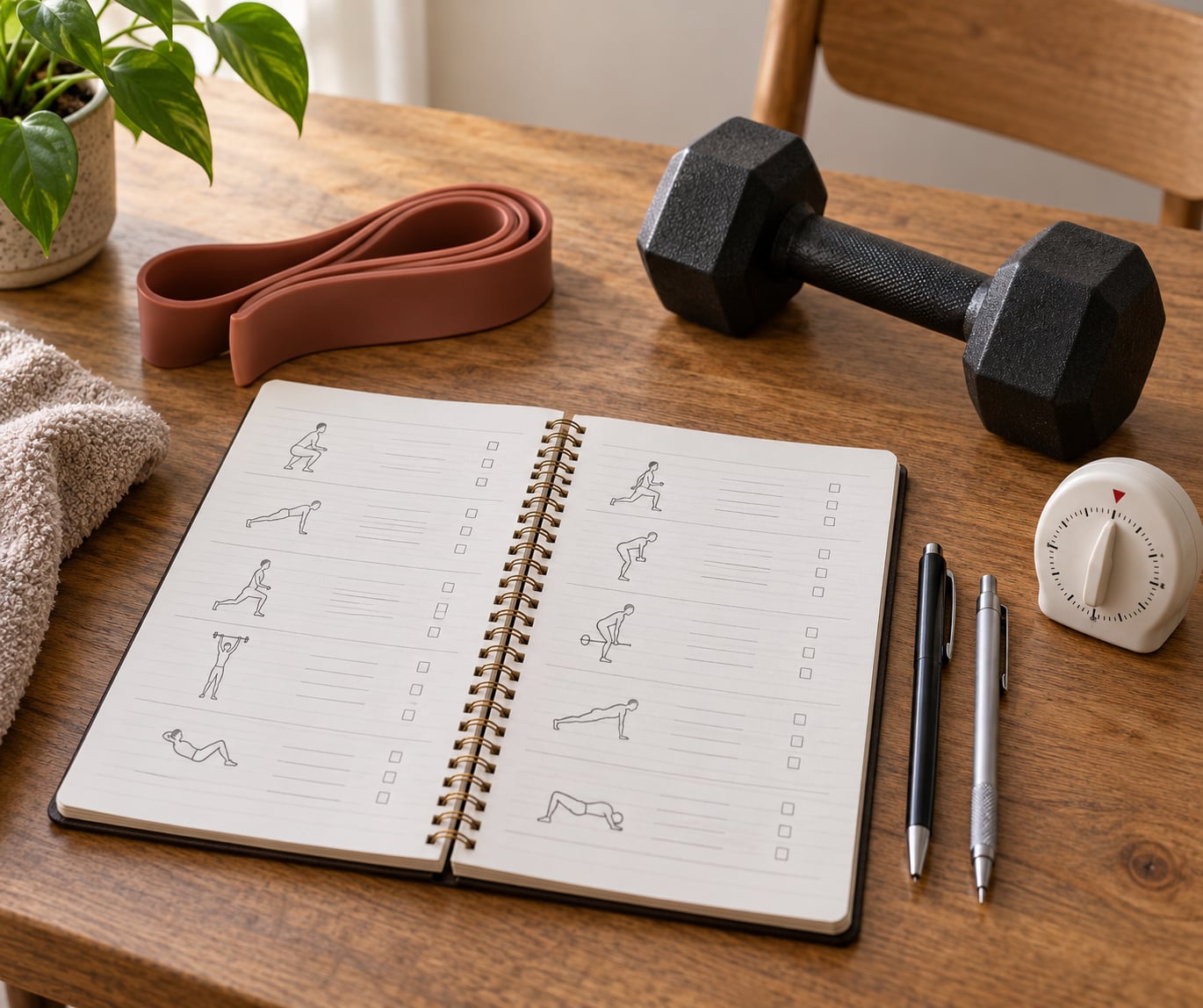
- Paper log or notebook. A cheap spiral notebook works better than a fancy journal, because it opens flat on a bench. Grid paper helps if you want to add columns later.
- A pen that works on the spot. Keep it clipped to the log. A pen in a jacket pocket is the reason half of all logs go blank.
- A timer. A cheap kitchen timer or a stopwatch handles intervals, rest periods and mobility holds. The timer app on a phone is fine too, but a physical one is harder to ignore.
- A wall calendar or index cards. Good for logging a single session without opening a whole notebook.
Optional tools add detail without adding effort. A basic pedometer turns walking and stairs into a number. A heart-rate monitor or chest strap shows effort across a whole session, and most watches read from the strap rather than the wrist. A tape measure handles body measurements every four to six weeks.
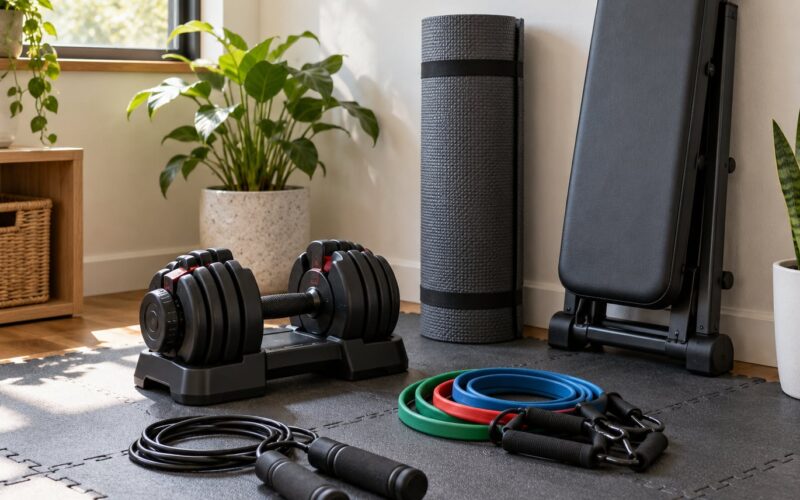
For resistance work, mark the bands once with a pen so you know which is which. A marker on the handle of each band beats guessing. Those five items are the entire kit.
Step-by-Step: How to Track Workouts Without an App
1. Choose a Consistent Workout Log
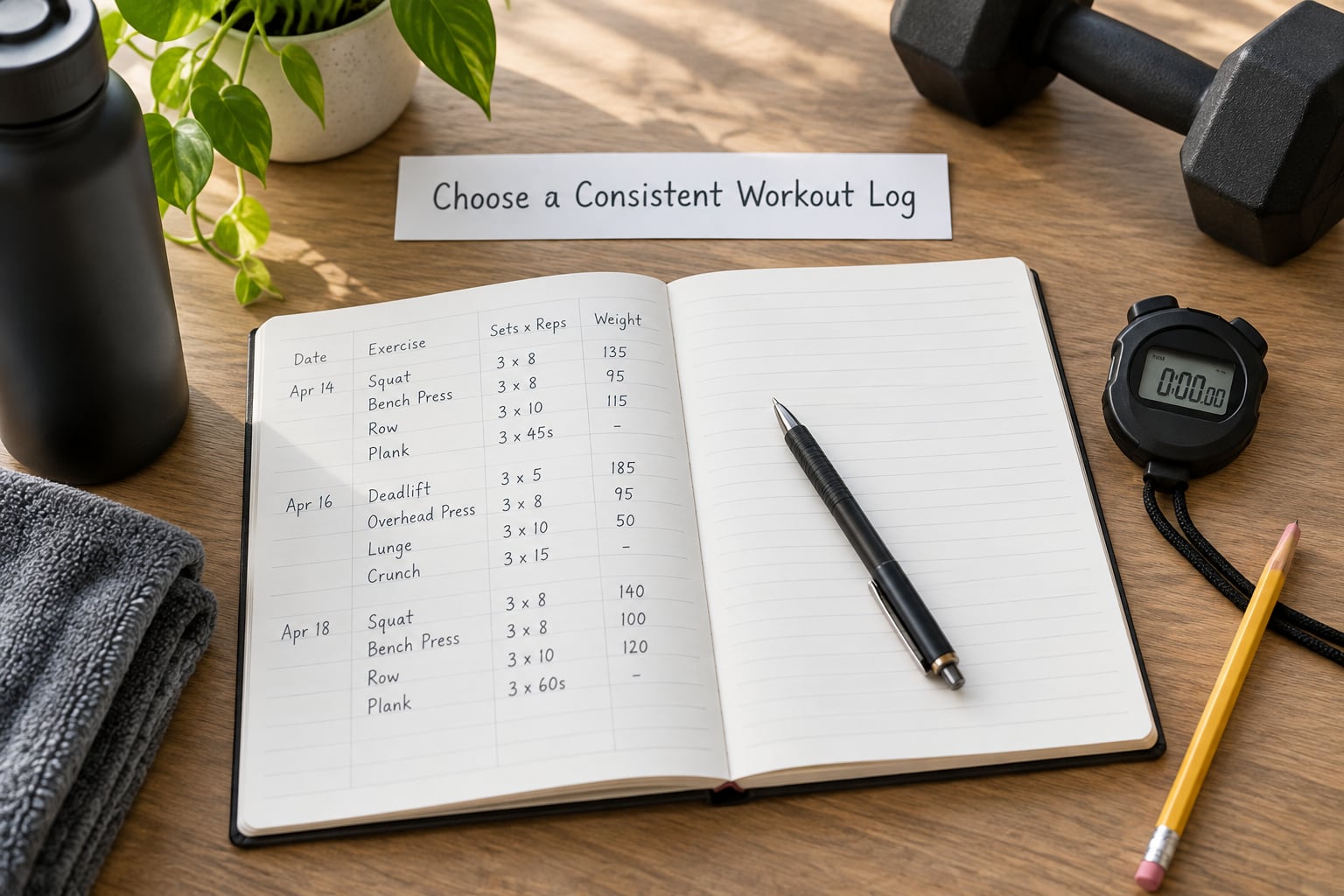
Pick one format and never change it. People often try pen and paper, find it disorganised, and give up. The problem is usually the format, not the method.
Draw the same six fields on every page, in this order:
- Date
- Activity
- Duration
- Intensity
- Notes
- Plan for next session
Index cards are ideal for one session a day. A printed log sheet is ideal if you train three to five times a week and want one page per workout. A wall calendar suits daily mobility or walking. Runners often prefer a planner with a page per week or month, so a month of training sits on two pages.
Write the layout once, then photocopy or copy it. A consistent page means you can read last March without translating your own handwriting.
2. Record the Basics Before You Begin
Fill in the top fields while you set up, not after. It takes thirty seconds and it forces you to decide what this session is for.
Record the date, the activity and the planned duration. Add the equipment and starting weight or band level for each lift. If you are following a plan, write the target, such as 3 sets of 8 at 60 lb.
One more line is worth it: the goal for the session. Two words are enough, like “add weight” or “deload”. When a session goes sideways, that line tells you whether the problem was the plan or the execution.
3. Measure Sets, Reps, Time, or Distance
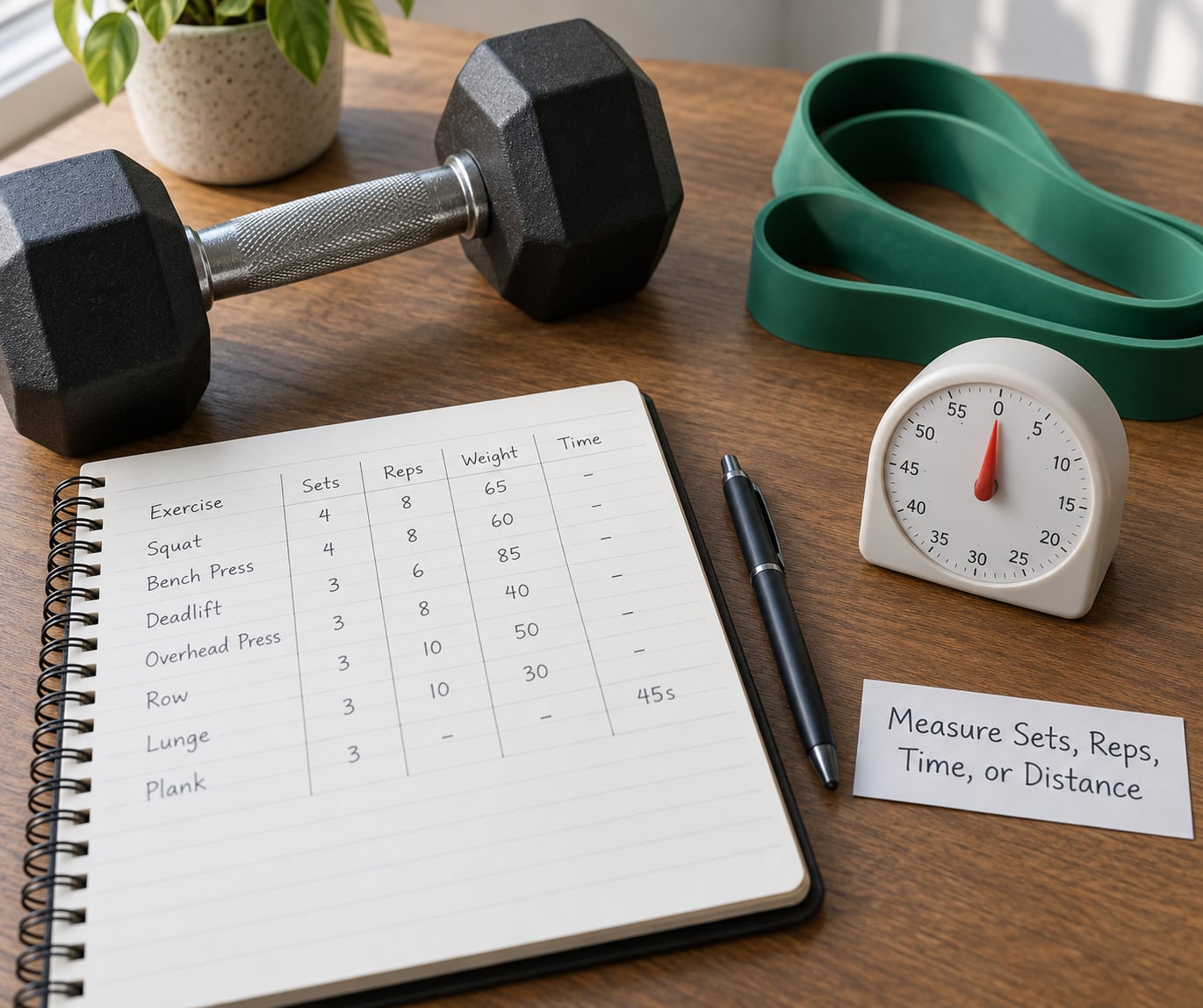
Log the measure that matches the activity. Trying to force every workout into sets and reps is where paper logs break down.
Strength training. Write the exercise, then sets, reps and load for each set on one line: 135 lb x 8, 135 lb x 8, 125 lb x 7. Add the band level for bodyweight work, and tape or a notch for ring work.
Walking and cycling. Record distance and time, plus the pace you held. “2.4 miles in 32 minutes, steady” is a complete entry.
Intervals and circuits. Write the structure as you ran it: 6 rounds of 30 seconds hard, 90 seconds easy. The number of rounds is the progress marker.
Mobility. Note the movement and hold time: 90/90 switches, 10 per side. Five minutes of hip mobility reads as “hip switches 2 x 10 each side, 5 min”.
Sports and court work. Log session length plus one number you care about, such as distance covered, longest rally or minutes of continuous play.
4. Add Intensity, Completion, and Recovery Notes
Numbers tell you what happened. Intensity tells you how it felt, and that is often the missing half of a paper log.
Use a simple perceived-effort scale from 1 to 10, where 1 is walking pace and 10 is an all-out set you could not repeat. Mark the session as a whole rather than every set. Session effort is a more useful signal than set effort for spotting a bad week.
Then tick off what you actually completed. A planned-versus-completed column is the single most useful addition to a home log, because skipped work is usually the reason progress stalls.
If something felt off, note it in plain words. Write “left shoulder tight at session start, better after warm-up” rather than guessing at a cause. If pain is sharp, worsening, or keeps coming back, stop and talk to a doctor or physical therapist. A log is a record, not a diagnosis.
Finish with one short line on recovery: how you slept, how your energy felt, or how long you slept the night before. One sentence, once per session.
5. Review Your Log and Set the Next Workout
Reviewing is what turns entries into progress. Set aside ten minutes once a week, usually the day after a rest day.
Read the last three to seven sessions and answer three questions. Which loads or distances went up? Which targets did you miss and why? Did the effort scores climb while the numbers stayed flat? That last pattern usually means the plan is too heavy or the sessions are too short.
Change one variable at a time. Add a small amount of weight, add a rep, or add a round, then leave it alone for two or three sessions before judging. Changing everything at once means you never learn which change worked.
Write the next session’s plan in the log before you close it, while you still remember the details. Runners and lifters on forums both point to one thing: a short weekly review is what keeps a log alive past the first month.
Common Mistakes
Almost every failed paper log fails for one of a few predictable reasons. Each has a simple fix.
Logging too many details. Some people record everything, tire of it, and quit. Two metrics per session is plenty for most people. Volume for strength, distance for cardio.
Changing the format every few weeks. You lose the ability to compare sessions. Set the layout once and copy it.
Ignoring warm-ups and cool-downs. They belong in the log. Warm-up performance is one of the cheapest readiness signals you can get.
Treating harder as better. A session where every set is a maximum effort usually ends worse than one you finish. Effort scores are a note, not a target.
Mixing planned and completed work. Write the plan in one column and what happened in another. Otherwise your history drifts toward what you meant to do.
Using soreness as a progress measure. Soreness tells you about the last session, not this one. Use performance numbers instead.
A few habits keep the habit alive. Fill the log at the same time every session, usually within fifteen minutes of finishing. Keep the pen with the log. And accept that a missed day is one gap in a notebook, not a broken streak.
If you have kept a log before and quit, the usual reason is friction at the moment of writing. Choose a system that needs nothing switched on, and the problem mostly disappears.
Frequently Asked Questions
Is pen and paper better than a fitness app?
For most home lifters, yes, because paper has no setup, no account and no notifications. An app wins when you want automatic timers, charts, or history from years of sessions you did not log. Many people keep both: paper during the session, and a spreadsheet typed in later if they want charts. Test both for two weeks and keep the one you actually use.
What should I record for different types of exercise?
Log the measure that matches the activity. Strength work needs exercise, sets, reps and load. Walking and cycling need distance and time, plus pace. Intervals need the format you ran and how many rounds. Mobility needs the movement and hold time per side. Court sports need session length plus one number such as distance covered or longest rally.
Do I need a smartwatch to track workouts without an app?
No. A watch is useful for cardio and for intervals you cannot time by feel, but most watches estimate weight lifted poorly and cannot see reps at all. A chest strap reads heart rate more accurately than a wrist sensor, and a cheap timer or stopwatch handles rest periods. Start without a watch, then add one if heart-rate data would change how you train.
How do I stay consistent with a paper workout log?
Write at the same point every session, such as immediately after the last set, and keep the pen attached to the log. Fewer fields is the other big lever: two metrics per session is enough to see progress. A ten-minute review once a week keeps the habit alive, because reviewing is what shows you the log is working.
How can I track progress without measuring anything?
Use performance instead of numbers. Record reps to a fixed time on the couch hold, rounds completed in a circuit, or how many quality push-ups you can do before form breaks. Add a perceived-effort score each session. When the same effort produces more reps, that is progress on paper, and you do not need a device to see it.
When should I stop tracking and see a clinician?
A workout log is a record, not medical advice. Speak with a doctor or physical therapist if you have sharp or worsening pain, pain that lasts more than a week, numbness, dizziness, chest pain, or symptoms that change how you move. If you are returning to exercise after an injury or surgery, get clearance first and follow the plan your clinician gives you.
Conclusion
Start with the smallest version that works: after every session, write the date, the activity, the duration, what you completed, and one note about how it felt. Read the last week once a week and change one thing at a time.
That is how to track workouts without an app, and it is enough to see progress for years. Keep in mind that a log is a general tracking tool, not a substitute for individualized medical advice.