Short answer for anyone asking why does my dishwasher leave spots on dishes: the marks are almost always hard water minerals or leftover detergent residue, and both are cheap to fix. Water evaporates in the drying cycle, and whatever was dissolved in it stays on the glass as white film, streaks or cloudy patches. In most households the fix is simple: fill the rinse aid dispenser, dose the detergent correctly, and run the machine with hot incoming water.
Last updated for October 2026.
Table of Contents
- Why Does My Dishwasher Leave Spots on Dishes?
- What Do the Different Types of Dishwasher Spots Mean?
- Wipeable film or permanent etch?
- How to Fix Hard-Water Spots on Dishware
- How to Stop Detergent and Rinse-Aid Residue
- Why Are My Dishes Spotted Even After I Clean the Dishwasher?
- How to Prevent Dishwasher Spots for Good
- Frequently Asked Questions
- Is it safe to run vinegar in a dishwasher?
- Are lemon juice or other acidic cleaners better than vinegar for hard water spots?
- Why does my dishwasher leave streaks on the stainless steel door?
- Why do my glasses get spots but my plates come out clean?
- When should I call a technician instead of cleaning the dishwasher myself?
- Start With the Spot Pattern
Why Does My Dishwasher Leave Spots on Dishes?

Every dishwasher works the same way at the end of a cycle. The final rinse leaves droplets behind, and every droplet carries a little dissolved calcium, magnesium or detergent with it. When those droplets dry, those solids stay on the surface as spots.
The pattern tells you which cause you are dealing with. Faint spots that rub off with a finger are dried water and nearly harmless. Chalky white speckles that feel like dried toothpaste are mineral scale. A greasy film that no amount of scrubbing shifts is usually detergent or a rinse aid setting problem.
Six causes account for nearly every case:
- Hard water minerals — calcium and magnesium in the supply water deposit as the water evaporates.
- Low or empty rinse aid — without a surfactant, water beads into droplets instead of sheeting off and draining.
- Too much detergent — excess low-sudsing detergent dries into a filmy or powdery coating.
- Wash water below 120°F — cold water does not dissolve detergent properly, so it settles and dries on dishes.
- Scale-clogged spray arms and filter — uneven spray means dishes dry wet, which makes spotting far worse.
- Glass etching — permanent surface corrosion from soft water, harsh detergent and heat, and it will not wipe off.
Rinse aid is the single most useful lever here. It lowers the surface tension of the rinse water so the water sheets off in a thin film and runs to the drain rather than sitting in round beads. Skimp on it and the drying cycle turns every bead into a spot.
What Do the Different Types of Dishwasher Spots Mean?
Work out what the mark actually is before you buy anything. Every row below points to a different first move, and the fastest diagnostic test is simple: run a damp fingertip or a soft cloth over the mark after the cycle finishes.
| What the spot looks like | Most likely cause | First thing to try |
|---|---|---|
| Wipeable white haze on glasses and plates | Rinse aid empty, low, or set too soft | Refill the dispenser and raise the dial one notch |
| Chalky white speckles that feel gritty | Hard water mineral deposits | Hot test load with no detergent to isolate the cause |
| Cloudy film on glass that does not feel rough | Etching, or a detergent film | Rub with a dry cloth; no film means etching |
| Greasy film on plates and bowls | Overdosing detergent or a high rinse aid setting | Cut the detergent dose, lower the rinse aid dial |
| Rainbow or oil-slick sheen | Detergent film plus minerals in very hard water | Detergent booster plus rinse aid at a middle setting |
| Brown or black specks on silverware | Food chemistry reacting with metal, plus tarnish | Sort silverware before loading, rinse first if needed |
| Dark specks and a musty smell | Mold in the door seal, filter or standing water | Clean the seal and filter, run a sanitizing cycle |
| Streaks on the stainless door, not the dishes | Residue and hard water marking the exterior | Wipe with a damp cloth and a drop of mild detergent |
| Spots only on the top rack | Lower spray arm jets blocked, or cups trapping water | Clear the jets and tilt cups so they drain |
Wipeable film or permanent etch?
Draw a clean finger across the mark. If it moves, it is detergent or mineral residue and a hot soak will shift it. If the glass stays cloudy and no residue transfers, you are looking at etching, which is a chemical change to the glass surface rather than something sitting on top of it.
Etching is permanent. It shows up as a uniform cloudiness across the whole surface, not as isolated spots, and it usually appears on glasses used often and washed in very soft water with harsh detergent at high heat.
How to Fix Hard-Water Spots on Dishware
Hard water counts as roughly 7 grains per gallon, about 120 parts per million of dissolved minerals, or more. The deposits are not the water itself; they are what remains when the water evaporates and the dissolved solids have nowhere else to go.
Work through these in order, cheapest first:
- Empty and inspect the machine. Pull the racks out and look at the floor of the tub and the spray arms for chalky buildup.
- Clean the filter basket. Twist the filter out, rinse it under warm running water and brush the mesh. Grease and food in the filter hold moisture against the dishes.
- Clear the spray arm jets. A toothpick or a stiff brush clears individual holes. Wipe the arm clean before you push it back on and spin it by hand to confirm it turns freely.
- Top up the rinse aid and set the dispenser to a medium or hard setting, following the dial chart in your appliance manual.
- Run a detergent-free test load on the hottest cycle with a cup of white vinegar on the top rack. Rinse aid only, no detergent. This isolates the water and the machine from the chemistry.
- Use a dishwasher descaler or cleaning tablet only if your manual permits it, and only on a machine with a heating element cool to the touch.
If a 1:1 vinegar and water soak does not move a mark, try it for 15 to 30 minutes. That is enough time for mild scale and detergent film to loosen; a mark still there afterward is probably etching.
One safety note worth repeating: never combine bleach, ammonia or any other cleaning product, and never pour anything into the machine that the manual does not list as approved. Follow the manufacturer instructions for anything you open.
How to Stop Detergent and Rinse-Aid Residue
Filmy, gritty or greasy marks point at the wash rather than the water. Modern machines need a low-sudsing detergent made for dishwashers, and anything that foams heavily leaves its own coating behind as it dries.
Check four things:
- Detergent dose. One pod is already the intended maximum for a full load. Filling the cup past the marked line is the most common cause of a permanent film.
- Detergent type. Regular dish soap and hand-dish liquid belong in the sink, not the dishwasher.
- Rinse aid level and setting. Look through the window on the door and refill when it is near empty. A cap that is not screwed back on tight, or a dispenser turned too low, leaves the last rinse unprotected.
- Seals and filter. A worn door seal or a clogged filter holds onto the thin film that should have drained away.
Run the kitchen tap until it is fully hot before starting a cycle. Water sitting in a cold supply pipe is the most common reason a machine never reaches its target temperature, and it is also the cheapest fix in this whole article.
Why Are My Dishes Spotted Even After I Clean the Dishwasher?
Spots that come back within days usually mean the machine, not the detergent, is the problem. A clean dishwasher that still spots is a machine that is not rinsing or drying the way it should.
The recurring causes, roughly in order of how often they turn out to be the culprit:
- Blocked spray arm holes. Rotating arms with a few jets open spray unevenly, so some dishes come out wet and mineral-rich.
- A clogged filter or drain. The pump draws from standing water that never fully clears.
- Wash water below 120°F. Cold water leaves grit and film in suspension rather than flushing it away.
- Overloading. Dense racks stop water from moving, and the blocked parts of the load dry slowly.
- Loading that traps water. Glasses set upside down in a rack collect water in the indentation at the base; bowls and cups that sit flat hold a puddle against the glaze.
What you can safely check yourself: the filter, both spray arms, the rinse aid dispenser, the door seal, and the water temperature at the hottest moment of a cycle. What you should leave alone: the heating element, the wash pump and the control board. Those are technician work, and the pump and element involve electrical connections even with the machine unplugged.
How to Prevent Dishwasher Spots for Good
Most households need a routine rather than a repair. A short monthly rhythm handles most of it.
- Weekly: wipe the door seal and the inside of the door, and check that the spray arms spin freely by hand.
- Monthly: clean the filter basket, run a cleaning cycle, and check the rinse aid level.
- Quarterly: run the detergent-free hot vinegar cycle, and check the detergent dose against what you actually load.
- Every load: scrape or rinse off food, use dishwasher-safe detergent in the measured amount, and keep rinse aid filled.
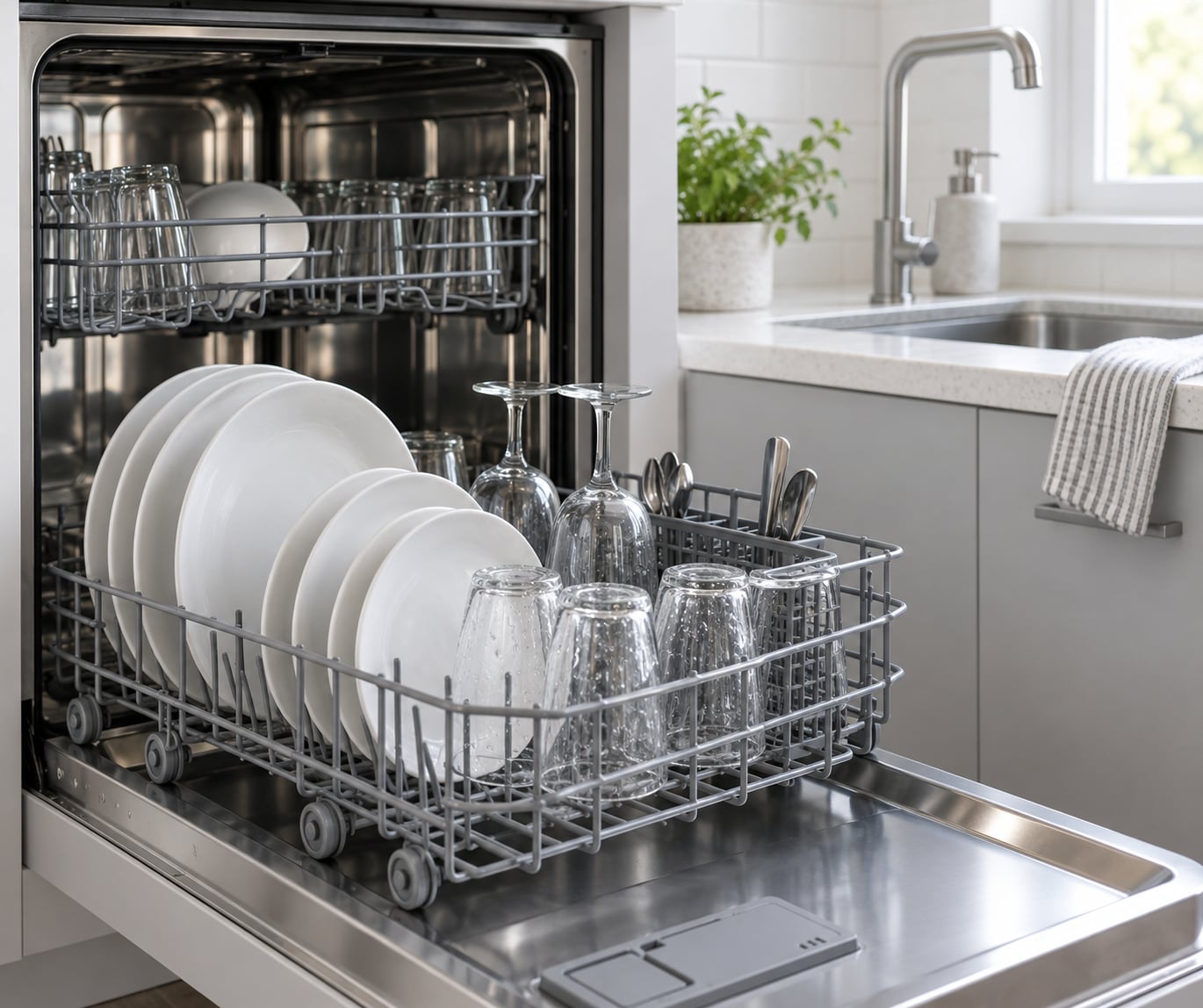
Loading matters as much as any product. Face bowls and mugs down so water drains out of them, set glasses at an angle rather than upside down, run pans along the side or the back of the lower rack so the spray arm can reach their surfaces, and leave enough space that nothing is touching.
On water treatment, test before you spend. A hardness test strip or a utility report that lists grains per gallon will tell you in a minute whether the water is the real driver. In genuinely hard areas, a water softener or a plumber assessment is the durable answer, and no amount of scrubbing changes the supply.
Frequently Asked Questions
Is it safe to run vinegar in a dishwasher?
Yes, a cup of white vinegar on the top rack of an empty, hottest cycle with no detergent is a standard cleaning method. It will not damage seals, hoses or the heating element. Never mix vinegar with bleach, ammonia or any other cleaner, and skip it on machines whose manual says not to use acidic products.
Are lemon juice or other acidic cleaners better than vinegar for hard water spots?
They work on the same principle, because all three rely on acid dissolving mineral scale, and none of them is meaningfully better than plain white vinegar. Lemon juice costs more per load and the sugars can leave their own film in a hot machine. Some manufacturers sell citric-acid dishwasher tablets, which are a reasonable choice if you prefer a product made for the job.
Why does my dishwasher leave streaks on the stainless steel door?
Those streaks are usually on the stainless exterior, not on your dishes, and they are a separate problem from mineral spots on glass. Wipe the panel with a soft cloth and a drop of mild dish soap, then dry it in the direction of the grain. Never use abrasive pads or chlorine cleaners, which scratch the finish and make the streaking worse.
Why do my glasses get spots but my plates come out clean?
Glass shows what happens to any surface that dries slowly, so it reveals problems plates hide. Thicker plates keep heat and dry faster, while thin glasses cool quickly and are prone to etching, which is a permanent cloudiness rather than a deposit. If the marks wipe off, it is residue or scale and a hot vinegar cycle should clear it. If they do not, you are looking at etching.
When should I call a technician instead of cleaning the dishwasher myself?
Call for service when the problems point past the parts you can safely remove. Signs include standing water in the bottom of the tub that a clean filter does not drain, a wash pump that hums without moving water, dishes that stay dirty rather than merely spotted, a heating element that never gets hot, or error codes that clear only by unplugging the machine. Do not open the pump, element or control board yourself.
Start With the Spot Pattern
Look at the mark before you buy anything. Wipeable haze means rinse aid and detergent dose, chalky grit means hard water, and cloudy glass that no cloth touches means etching, which no cleaning will fix.
Then do the same three things in order: clean the filter and the spray arm jets, refill the rinse aid and check the dispenser cap, and run one hot detergent-free load. If the spots are still there, check your water hardness and read the manual for the rinse aid settings. If water is draining slowly or the dishes come out dirty, that is a technician job, not a cleaning job.